On 1 August 1920, Mahatma Gandhi launched the Non-Cooperation Movement, the first campaign to draw ordinary Indians across the country into organized, sustained resistance to British rule under Congress leadership. Gandhi had given the Viceroy formal notice of his intent that June, and the Indian National Congress endorsed the campaign at a special session in Calcutta that September, confirming it more fully at its regular session in Nagpur in December 1920. The movement drew its force from two distinct grievances that Gandhi deliberately joined together. The first was the Rowlatt Act of 1919, which extended wartime emergency powers of detention without trial into peacetime, and the massacre that followed protests against it: on 13 April 1919, Brigadier-General Reginald Dyer ordered troops to fire without warning on an unarmed crowd gathered at Jallianwala Bagh in Amritsar, killing, by the official British count, 379 people — a figure Indian leaders including Madan Mohan Malaviya disputed at the time as a significant undercount, and which later historians, working from incomplete records, have generally placed somewhere between 500 and over 1,000. The second grievance was the Khilafat movement, an Indian Muslim campaign protesting the British-led dismantling of the Ottoman caliphate after the First World War. Gandhi calculated, correctly in the short term, that uniting Hindu and Muslim grievances behind a single nonviolent campaign could produce the broadest possible coalition against colonial rule.
Boycott, khadi, and a mass movement
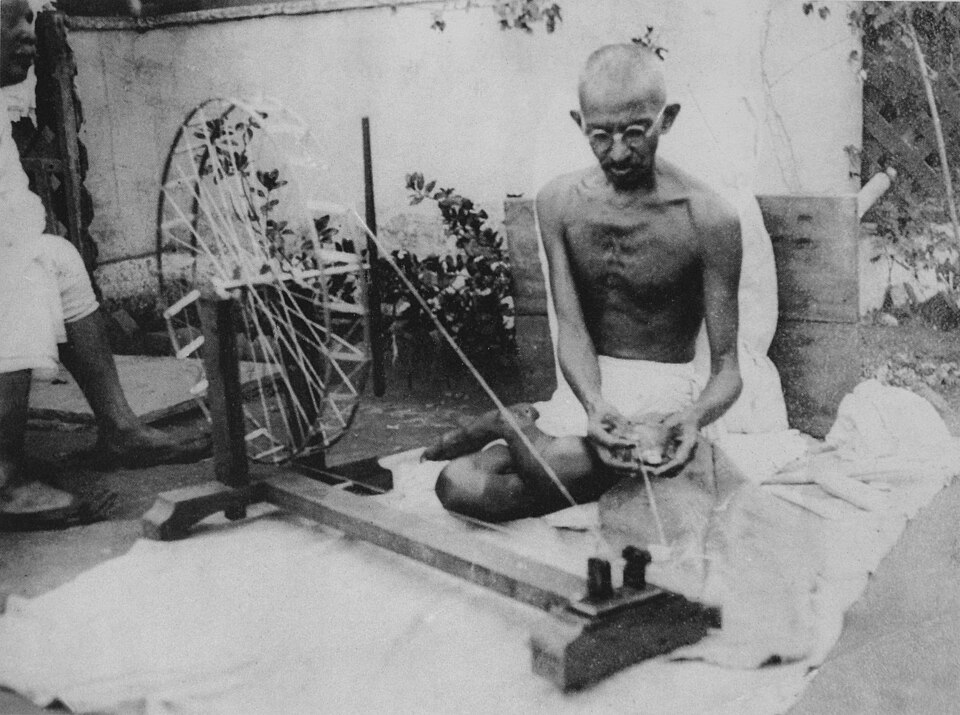
The programme itself asked Indians to withdraw cooperation from British institutions rather than to fight them directly: students were urged to leave government schools and colleges, lawyers to boycott British courts, voters to shun the new legislative councils, and titled Indians to renounce honors granted by the Crown. Alongside this boycott, Gandhi promoted the spinning wheel, or charkha, and homespun khadi cloth as a constructive alternative — a way to weaken British textile imports economically while building self-reliance and a shared national symbol that a largely rural population could join without needing English education or urban connections. This combination of boycott and constructive work, reaching villages as well as cities, is generally credited by historians with turning Indian nationalism from an elite, English-educated pursuit into a genuinely mass movement for the first time.
Chauri Chaura and a sudden end
The movement's momentum was cut short in February 1922. On 5 February, in the town of Chauri Chaura in the United Provinces, a crowd that had clashed with police set fire to a police station, killing 22 policemen inside. Gandhi, who held nonviolence to be not merely a tactic but a moral precondition for the movement's legitimacy, called off the entire national campaign within a week, on 12 February, arguing that a movement whose participants had turned to mob violence had lost its moral standing to continue. The decision was intensely controversial even among Gandhi's own colleagues: younger leaders, including Subhas Chandra Bose and Jawaharlal Nehru, felt that suspending a nationwide movement over one violent incident, however serious, sacrificed hard-won momentum and demoralized a mass base that had made real sacrifices — a criticism historians still consider a fair reading of the movement's abrupt end, even while acknowledging the consistency of Gandhi's underlying principle. The Non-Cooperation Movement did not win self-rule, and Gandhi himself was arrested and imprisoned in March 1922, but its significance outlasted its two-year run: it established the template of mass civil disobedience under organized Congress leadership, brought large numbers of ordinary Indians into active politics for the first time, and confirmed Gandhi, previously one senior leader among several, as the Congress's dominant strategist for the next quarter-century of the freedom struggle.