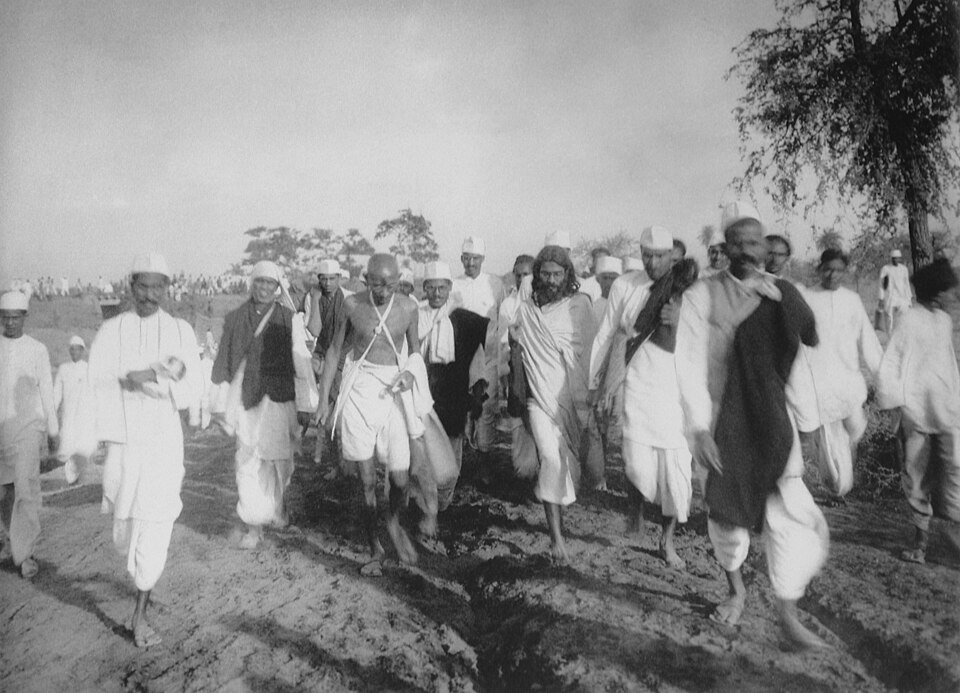
On 12 March 1930, Gandhi left Sabarmati Ashram on the Salt March, and on 6 April he picked up natural salt on the beach at Dandi, breaking the law that gave the government a monopoly on the commodity. That act is remembered as the start of the Civil Disobedience Movement, but the movement was much larger than the march. Over the next four years it became the widest campaign of open law-breaking that British India had seen, reaching coasts, forests, villages, bazaars and the Frontier, and drawing in people the earlier Non-Cooperation Movement had barely touched. How the two campaigns differ is a question of method and aim as much as of dates.
From Lahore to the salt law
The campaign had a political and a tactical origin. Politically, the Indian National Congress had given the government until the end of 1929 to accept dominion status. When the answer was unsatisfactory, the Lahore session under Jawaharlal Nehru adopted Purna Swaraj, complete independence, as its goal, and on 26 January 1930 crowds across the country pledged to observe an Independence Day. Tactically, Gandhi was asked to choose the form of struggle. In January he sent Viceroy Lord Irwin a list of eleven demands, ranging from lower land revenue and reduced military spending to the abolition of the salt tax, and said that if they were not met he would begin civil disobedience. The demands were not accepted, and he chose salt because, as the Salt March shows, it let every household take part.
A campaign that spread beyond salt
Once Gandhi had made salt at Dandi, the movement spread faster than any central plan could direct. In the south, C. Rajagopalachari led a march from Tiruchirappalli to Vedaranyam on the Tamil coast, and in Malabar K. Kelappan led volunteers to Payyanur. Elsewhere the same spirit took other forms: peasants in parts of Gujarat refused to pay land revenue, villagers in the Central Provinces and Maharashtra cut grass and wood in defiance of forest laws, and in Bihar and Bengal many refused to pay the chaukidari tax that funded the village police. Foreign cloth was boycotted and liquor shops were picketed, with Indian merchants and industrialists, who had their own reasons to dislike imported goods, giving the boycott financial backing.
Women took part on a new scale. They made salt, courted arrest, and, led by figures such as Kamaladevi Chattopadhyay and Sarojini Naidu, organised the picketing of cloth and liquor shops, work that brought many women into public politics for the first time. On the North-West Frontier, Abdul Ghaffar Khan's Khudai Khidmatgar, a disciplined non-violent force of Pashtun volunteers, joined the movement, and when a crowd gathered in Peshawar's Qissa Khwani bazaar on 23 April 1930 after his arrest, it was fired on; counts of the dead vary widely between official and nationalist accounts. Not everything fell within Gandhian limits. The raid on the Chittagong armoury on 18 April 1930 by Surya Sen's group was armed revolt, and Congress did not claim it.
Repression, a pact and the Round Table
The government answered with arrests and bans. Gandhi was arrested in early May 1930, and over the following year tens of thousands of people were jailed, with estimates of more than 60,000. Congress committees were declared illegal, newspapers were censored and crowds were lathi-charged, most famously at Dharasana, where unarmed volunteers marching on a salt works were beaten without resisting. The First Round Table Conference met in London from November 1930, but Congress, with its leaders in prison, did not attend, and little could be settled without it.
Both sides then looked for a way out. After his release in January 1931, Gandhi negotiated with Irwin, and the two signed the Gandhi–Irwin Pact on 5 March 1931. Civil disobedience was suspended, political prisoners not convicted of violence were to be released, and people living on the coast were allowed to make salt for their own use; Gandhi, in return, agreed to attend the next Round Table Conference. The pact was controversial. Radicals, including many younger Congress members, thought it gave away too much for too little, and the mood at the Karachi Congress later that month was darkened by the execution of Bhagat Singh, Rajguru and Sukhdev on 23 March. Gandhi went to London in the autumn of 1931 as Congress's sole delegate, but the Second Round Table Conference was dominated by disputes between communal and princely representatives, and he returned empty-handed.
| Phase | Period | What happened |
|---|---|---|
| First phase | Mar 1930 – Mar 1931 | Salt March, mass law-breaking, repression, Gandhi–Irwin Pact |
| Interval | Mar – Dec 1931 | Karachi Congress, Second Round Table Conference in London |
| Second phase | Jan 1932 – 1934 | Renewed campaign, Congress banned, Poona Pact, withdrawal |
Renewal, the Poona Pact and the end
Within days of Gandhi's return in late 1931, the new Viceroy, Lord Willingdon, took a harder line. Gandhi was arrested again in January 1932, Congress was banned, and the second phase of civil disobedience met heavier repression than the first. In August 1932 the government issued the Communal Award, which gave separate electorates to the 'depressed classes', the communities now called Dalits. Gandhi, in Yerwada jail, feared that this would split Hindu society permanently and began a fast to the death. The result was the Poona Pact, signed on 24 September 1932 with B. R. Ambedkar, which dropped separate electorates in favour of reserved seats within the general electorate, and with more seats than the Award had offered. The settlement is still debated: some see it as the saving of a compromise, others as a concession extracted from Ambedkar under the pressure of Gandhi's fast.
By then the campaign was losing force. Arrests had taken most of the organisation, a long depression had strained the finances of the peasants and traders who had supported it, and the government was not negotiating. Gandhi suspended mass civil disobedience in 1933 and it was withdrawn in 1934, when Congress turned back to elections and legislative work.
Did it fail?
Measured by its stated goal it did not succeed: India did not become independent, and the Government of India Act of 1935 offered provincial self-government within the Empire. Historians, however, tend to judge the movement by what it changed. It drew in groups that earlier campaigns had missed, from women and Frontier Pashtuns to the small farmers who refused to pay revenue, and it gave Congress a mass organisation that could fight elections, which it then did: in 1937 it won outright majorities in five of the eleven provinces. It also showed that British authority could be openly defied and that the government's response, mass imprisonment, was costly and increasingly hard to defend abroad. There is debate about how far the pact of 1931 and the withdrawal of 1934 showed realism and how far a loss of nerve, and about the movement's limits among Muslim and Dalit communities. Its methods and its unfinished business both returned in the last mass campaign, the Quit India Movement of 1942.