The Non-Cooperation Movement of 1920–22 and the Civil Disobedience Movement of 1930–34 are often taught as a pair, and the short version is that the first withdrew from British institutions while the second actively broke British laws. Gandhi led both, the Indian National Congress organised both, and both were meant to be non-violent. The differences are in the goal, the method, the people who joined and the way each ended, and the table below sets them side by side.
| Non-Cooperation Movement | Civil Disobedience Movement | |
|---|---|---|
| Dates | 1 Aug 1920 – 12 Feb 1922 | 1930 – 1934, in two phases |
| Trigger | Rowlatt Act, Jallianwala Bagh, the Khilafat issue | Lahore resolution, the Viceroy's failure to meet Gandhi's eleven demands |
| Goal | Swaraj, loosely defined | Purna Swaraj, complete independence |
| Core method | Withdrawal: boycott of schools, courts, councils, titles and foreign cloth, with khadi as the constructive alternative | Open law-breaking: salt-making, forest laws, tax refusal, along with boycott of cloth and liquor |
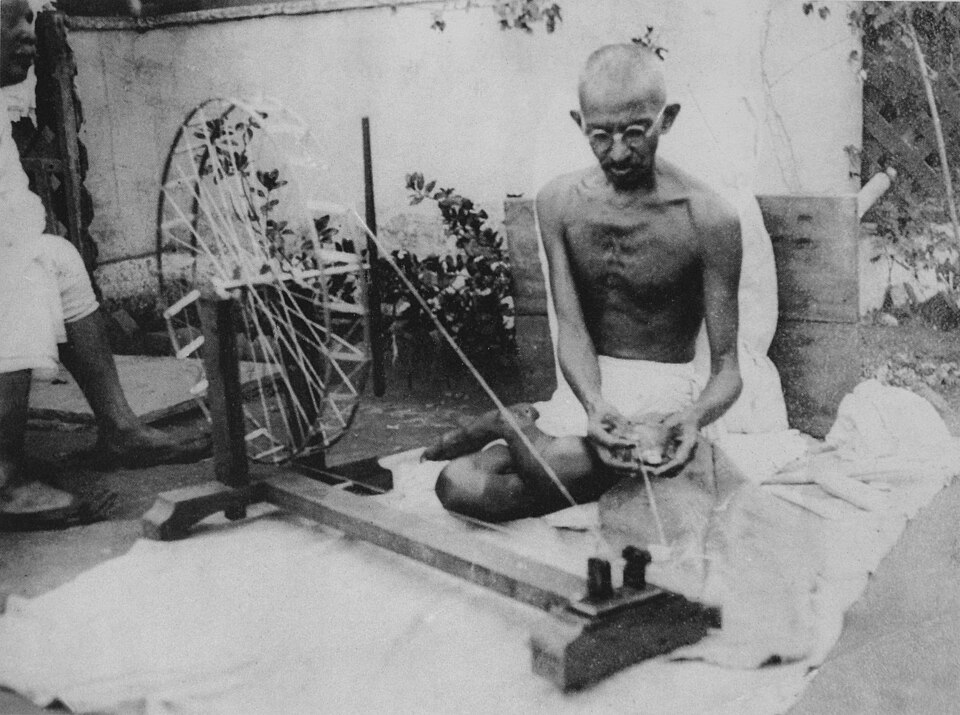
| Symbol | The charkha and khadi | Salt and the march to Dandi |
| Who joined | Students, lawyers, Khilafat Muslims, peasants in some regions | Women in large numbers, peasants, traders, the Frontier Pashtuns |
| Government response | Arrests, including of Gandhi in March 1922 | Mass arrests, bans on Congress, lathi charges and firing |
| How it ended | Called off by Gandhi after Chauri Chaura | Paused by the Gandhi–Irwin Pact, renewed in 1932, withdrawn by 1934 |
Where the textbook contrast holds
The contrast in method is real. The Non-Cooperation Movement mostly asked Indians to refuse to do things: not to attend government schools, not to practise in British courts, not to stand for the new councils, not to wear imported cloth. The movement was an attempt to make the colonial state unworkable by withholding the cooperation it depended on, and Gandhi paired it with the constructive programme of spinning and khadi.
The Civil Disobedience Movement asked for something more direct. At Dandi in April 1930, Gandhi broke a specific law in public, and thousands followed by making salt, cutting grass and wood in protected forests, and refusing to pay taxes. The act itself, not the abstention, was the protest, and the arrests it produced were meant to show the injustice of the law. The goal had also hardened: the Lahore resolution of December 1929 made complete independence the aim, where the earlier campaign had spoken of swaraj without fixing its meaning, and the Salt March was the first demonstration of the new approach.
Where it is too neat
Historians warn against treating the two as opposites. Non-cooperation was never only abstention: it had a plan for civil disobedience built into it. At its Ahmedabad session in December 1921, Congress authorised Gandhi to launch mass civil disobedience, and he chose Bardoli taluka in Surat district, where peasants would refuse to pay land revenue, as the place to begin. He announced the Bardoli programme in early February 1922, just before the violence at Chauri Chaura made him call off the whole movement. In that sense the second campaign took up what the first had been about to try.
The reverse is also true. The campaign of 1930 kept the boycott of foreign cloth and liquor, and it kept the idea that the state could not rule without cooperation. The labels 'passive' and 'active' sometimes used in exam guides are also misleading, and Gandhi himself disliked the phrase 'passive resistance' for either campaign, since in his view satyagraha was a form of active moral force. A better way to see the pair is as two stages of the same strategy, with the second moving from refusing cooperation towards open defiance.
What changed between 1922 and 1930
The eight years between the two campaigns explain why the second took the form it did. After Gandhi's imprisonment in 1922, Congress divided over whether to contest the new councils, and the Swaraj Party under C. R. Das and Motilal Nehru contested the 1923 elections to obstruct the government from within. The Khilafat issue disappeared when Turkey abolished the caliphate in 1924, and with it much of the Hindu–Muslim cooperation of 1920–22. Political energy moved to other fronts: the boycott of the all-white Simon Commission in 1927–28, the Bardoli satyagraha of 1928 led by Vallabhbhai Patel, and the Nehru Report of 1928. When the Viceroy, Lord Irwin, offered no firm timetable for dominion status in 1929, Congress at Lahore chose complete independence and gave Gandhi the lead once more.
The result was a campaign with a sharper aim and a wider reach, but also one that began without the Khilafat alliance. Historians generally note that Muslim participation in 1930 was patchy outside areas such as the North-West Frontier, a weakness that would matter in the years leading to Partition.
Which to read first
Start with the Non-Cooperation Movement for the setting of 1919–22 and the logic of boycott, then read the Civil Disobedience Movement to see that logic turned into open law-breaking, and finally the Quit India Movement for the campaign of 1942, which went furthest of all.