Aurangzeb ruled the Mughal Empire for forty-nine years, from 1658 to 1707, longer than any Mughal except Akbar. At his death it covered more of the subcontinent than it ever had, from Kabul to the far south of the Deccan. Yet within a generation of his death the empire was breaking apart, and historians have argued for more than a century about how much of that was his doing. Few figures in Indian history are judged as differently. Some see a pious, hard-working ruler who governed by Islamic law, others a bigot who turned the empire against most of its subjects, and many recent historians a capable but rigid emperor whose wars cost more than they won (John F. Richards, The Mughal Empire[1]).
How did Aurangzeb become emperor?
Mughal succession had no fixed rule: any son of an emperor could claim the throne, and the strongest usually took it. When Shah Jahan fell seriously ill in September 1657, all four of his sons prepared for war. Dara Shukoh, the eldest and his father's favourite, was at court in Delhi. Shah Shuja governed Bengal, Murad Bakhsh Gujarat, and Aurangzeb the Deccan, where he had served for years as governor and commander (Satish Chandra, Medieval India, Part II[4]).
Aurangzeb allied with Murad and marched north. In April 1658 they defeated an imperial army at Dharmat, near Ujjain, and in late May they met Dara himself at Samugarh, near Agra. Dara's army broke, and he fled. Aurangzeb took Agra, confined Shah Jahan in the fort, where he lived until his death in 1666 (he was buried beside his wife in the Taj Mahal), and then had Murad arrested. Dara was captured in 1659, paraded through Delhi, and executed after a trial for apostasy. His interest in Hindu philosophy, which had led him to translate the Upanishads into Persian, was used against him. Shuja fled to Arakan in Burma and disappeared, and Murad was executed in 1661 (Jadunath Sarkar, History of Aurangzib[3]). Aurangzeb was crowned with the title Alamgir, "seizer of the world".
What kind of ruler was he?
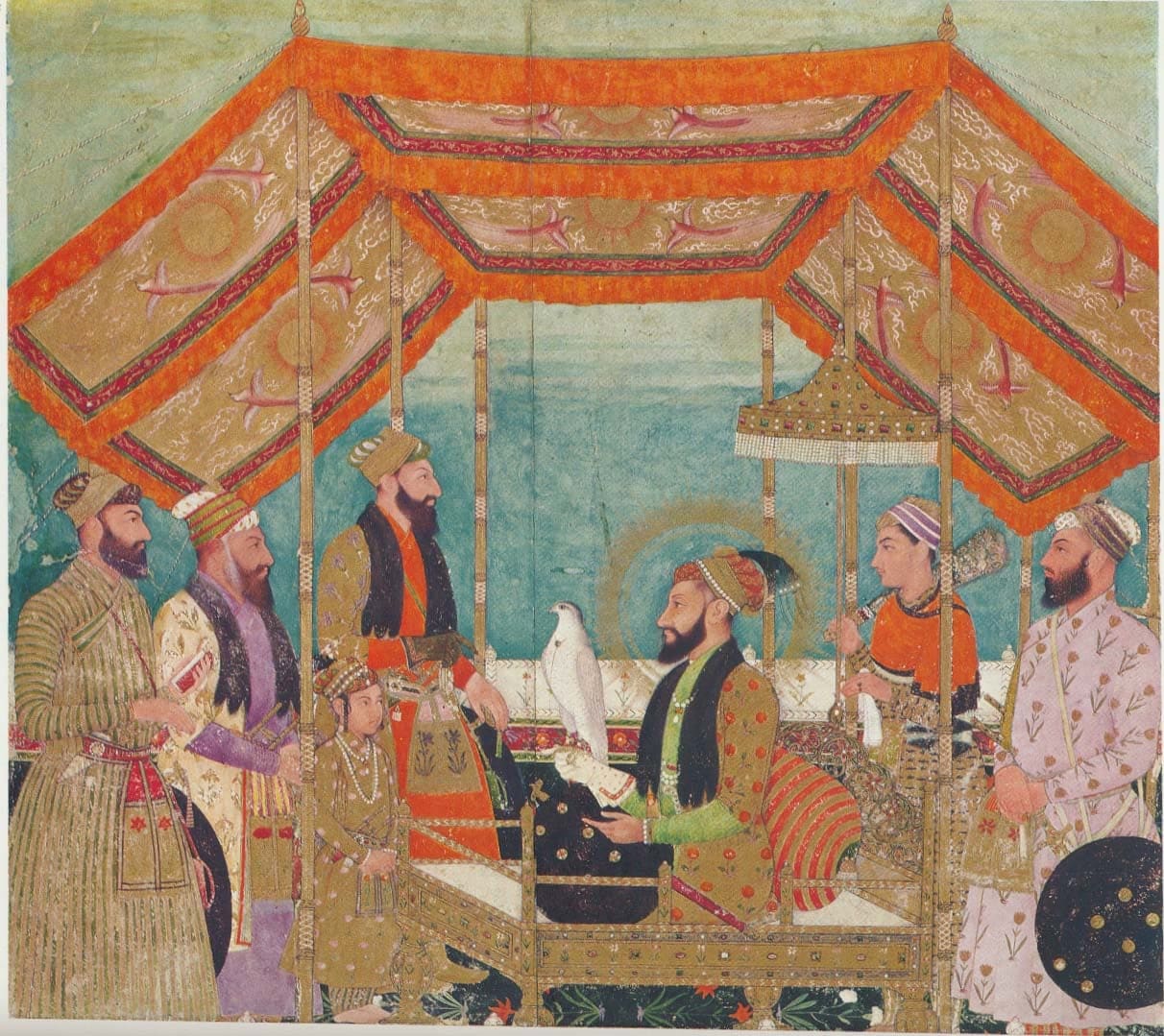
Aurangzeb was by every account devout, disciplined and tireless. He prayed punctually, knew the Quran by heart, and was said to pay for his personal expenses by copying the Quran and sewing prayer caps. He read and answered official papers himself, and his letters are full of detailed orders to commanders and governors. He also wanted the empire to be governed by Islamic law. He appointed muhtasibs, censors who enforced public morality, sponsored the compilation of a huge digest of Hanafi law, the Fatawa-i Alamgiri, and dropped court customs he considered un-Islamic, such as the emperor's daily appearance at the palace window and the weighing of the emperor against gold. He stopped the court's patronage of music, though music continued to flourish in noble households (John F. Richards, The Mughal Empire[1]).
In 1679 he reimposed the jizya, the tax on non-Muslims that Akbar had abolished in 1564 (see Akbar's House of Worship). He ordered the destruction of some prominent temples, including the Vishwanath temple at Varanasi in 1669 and the Keshava Deva temple at Mathura in 1670, and forbade the building of new temples in some places. At the same time, his government continued to issue and confirm grants of land to many temples and Brahmins. Historians such as Richard Eaton have argued that the temples he destroyed were often linked to rulers or rebels he was fighting, so that the destruction was political as well as religious. Others see a clear religious motive. The evidence supports elements of both views (Richard M. Eaton, Essays on Islam and Indian History[5]).
What rebellions did he face?
The first half of the reign saw a series of revolts in the north. Jat peasants rose near Mathura in 1669, and in 1672 the Satnamis, a devotional sect of peasants and artisans, fought an imperial army near Delhi. In 1675 the ninth Sikh Guru, Tegh Bahadur, was arrested and executed in Delhi, and the Sikh community under his son, Guru Gobind Singh, turned increasingly to arms (Jadunath Sarkar, History of Aurangzib[3]).
The most damaging conflict was with the Rajputs, who had been the empire's most loyal allies since Akbar. When Raja Jaswant Singh of Marwar died in 1678 without a surviving son, Aurangzeb tried to control the succession and occupied Marwar. Mewar joined the resistance, which was led by the Rathore noble Durgadas. In 1681 Aurangzeb's own son, Prince Akbar, sent to fight the Rajputs, rebelled with their support and declared himself emperor. The rebellion collapsed, and Prince Akbar fled south to the court of the Maratha king Sambhaji.
Why did he spend his last years in the Deccan?
In 1681 Aurangzeb followed his son south. He never returned to the north. For twenty-six years the emperor, his court and a vast army camp moved across the Deccan. He conquered the sultanate of Bijapur in 1686 and Golconda in 1687, two of the four Deccan sultanates that had defeated Vijayanagara at Talikota more than a century before, after an eight-month siege that ended when a gate was opened by bribery. In 1689 Mughal troops captured Sambhaji, the son of Shivaji, who was tortured and executed. On paper, the Mughal Empire had reached its greatest extent (John F. Richards, The Mughal Empire[1]).
But the Marathas did not give up. Under Sambhaji's brother Rajaram and then Rajaram's widow Tarabai, they fought a decentralised war, raiding Mughal supply lines and collecting their own taxes across the Deccan. The aged emperor spent years besieging hill forts, which his armies often took only for the Marathas to retake them later. The war drained the treasury and distracted the emperor from the north, where governors and landholders grew more independent (Satish Chandra, Medieval India, Part II[4]). The rise of the Marathas is told in the Maratha Empire.
How did the empire change under him?
The Mughal state paid its nobles, the mansabdars, by assigning them the revenue of lands called jagirs. M. Athar Ali's study of the nobility found that the number of mansabdars grew sharply in the Deccan years, as Aurangzeb tried to win over Deccani nobles and Maratha chiefs with high ranks. Hindus, mostly Marathas and Rajputs, made up about a third of the higher nobility in his later reign, a larger share than under Akbar. But there were not enough productive jagirs to go round. Nobles waited years for assignments, squeezed the peasants on the lands they did get, and grew less loyal (M. Athar Ali, The Mughal Nobility under Aurangzeb[2]). Historians such as Satish Chandra describe this as a "jagirdari crisis" and see it as one of the main causes of the empire's later weakness.
How is Aurangzeb remembered?
Aurangzeb died at Ahmednagar on 3 March 1707, aged eighty-eight. In letters to his sons near the end, he wrote that he had come alone and was leaving as a stranger, and that he did not know what punishment awaited him. He asked for a simple grave, and he is buried under the open sky at Khuldabad near Aurangabad, close to the shrine of a Sufi saint (Jadunath Sarkar, History of Aurangzib[3]).
His reputation has been fought over ever since. Jadunath Sarkar, whose five-volume history remains the most detailed account, judged him harshly, blaming his religious policy for alienating Hindus and destroying the empire Akbar built. Later historians, including Satish Chandra and John Richards, put more weight on structural problems: the jagir system, the strain of the Deccan wars, and the rising power of regional groups such as the Marathas, Sikhs and Jats, all of which would have tested any emperor. The debate is also a live political one in India today, and it is often argued with less care for evidence than the subject deserves. Within a few years of his death, his sons and grandsons were fighting for a throne whose power was draining away, as told in the decline of the Mughal Empire.
Aurangzeb timeline
| Date | Event |
|---|---|
| 1618 | Aurangzeb is born at Dahod, Gujarat |
| September 1657 | Shah Jahan falls ill; war of succession begins |
| May 1658 | Aurangzeb defeats Dara Shukoh at Samugarh |
| 1658–1659 | Aurangzeb is crowned as Alamgir; Dara is captured and executed |
| 1666 | Shah Jahan dies in Agra Fort; Shivaji escapes from Agra |
| 1669 | Jat rising near Mathura; Vishwanath temple at Varanasi destroyed |
| 1671–1673 | Badshahi Mosque built in Lahore |
| 1675 | Guru Tegh Bahadur executed in Delhi |
| 1679 | Jizya reimposed; war with Marwar begins |
| 1681 | Prince Akbar rebels; Aurangzeb moves to the Deccan |
| 1686–1687 | Conquest of Bijapur and Golconda |
| 1689 | Sambhaji captured and executed |
| 3 March 1707 | Aurangzeb dies at Ahmednagar |