The Mughal Empire began in 1526, when Babur, a Central Asian prince descended from both Timur and Genghis Khan, defeated the last Delhi Sultanate ruler, Ibrahim Lodi, at the First Battle of Panipat. Babur's rule was brief, and his son Humayun's reign proved even shakier: in the 1540s Humayun was driven out of India entirely by the Afghan noble Sher Shah Suri, spending years in exile in Persia before reclaiming Delhi in 1555, only to die the following year after a fall. Humayun's 13-year-old son Akbar inherited a throne that was, in practice, still contested — it was the regent Bairam Khan who secured it by defeating the forces of the Hindu general Hemu at the Second Battle of Panipat in 1556. What followed, over the roughly five decades of Akbar's reign, transformed a fragile foothold into the empire most people picture when they think of Mughal India.
Binding a diverse empire together
Akbar's central problem was governing a vast, religiously and ethnically mixed territory with a ruling elite that was itself a minority. His most consequential response was a policy of alliance rather than pure conquest toward the Rajput kingdoms of Rajasthan: Akbar married Rajput princesses, most prominently a daughter of Raja Bharmal of Amber, and brought Rajput nobles into the highest ranks of Mughal service rather than treating them purely as subjects. Raja Man Singh of Amber, for instance, rose to command Mughal armies from Afghanistan to Bengal. This policy did not mean an end to conflict — the Mughals fought and eventually defeated resistant Rajput rulers such as Maharana Pratap of Mewar — but it meant most Rajput states became durable partners in the empire rather than permanent adversaries, supplying soldiers, administrators, and, eventually, a Mughal empress.
Akbar paired this political strategy with new administrative machinery. The mansabdari system assigned every noble a numerical rank (mansab) that fixed both status and the number of cavalry he was obliged to maintain, converting a loose coalition of military chiefs into a graded imperial bureaucracy open to Muslims and Hindus alike — by some estimates, roughly a third of the mansabdars toward the end of Akbar's reign were Hindu, mostly Rajput. On the revenue side, his finance minister Raja Todar Mal introduced the dahsala system, assessing land tax as a share of a ten-year average of a plot's produce and collecting it in cash, which made revenue more predictable for the state and, in principle, fairer to cultivators than earlier ad hoc assessments.
Religious policy, and a debate that is still live
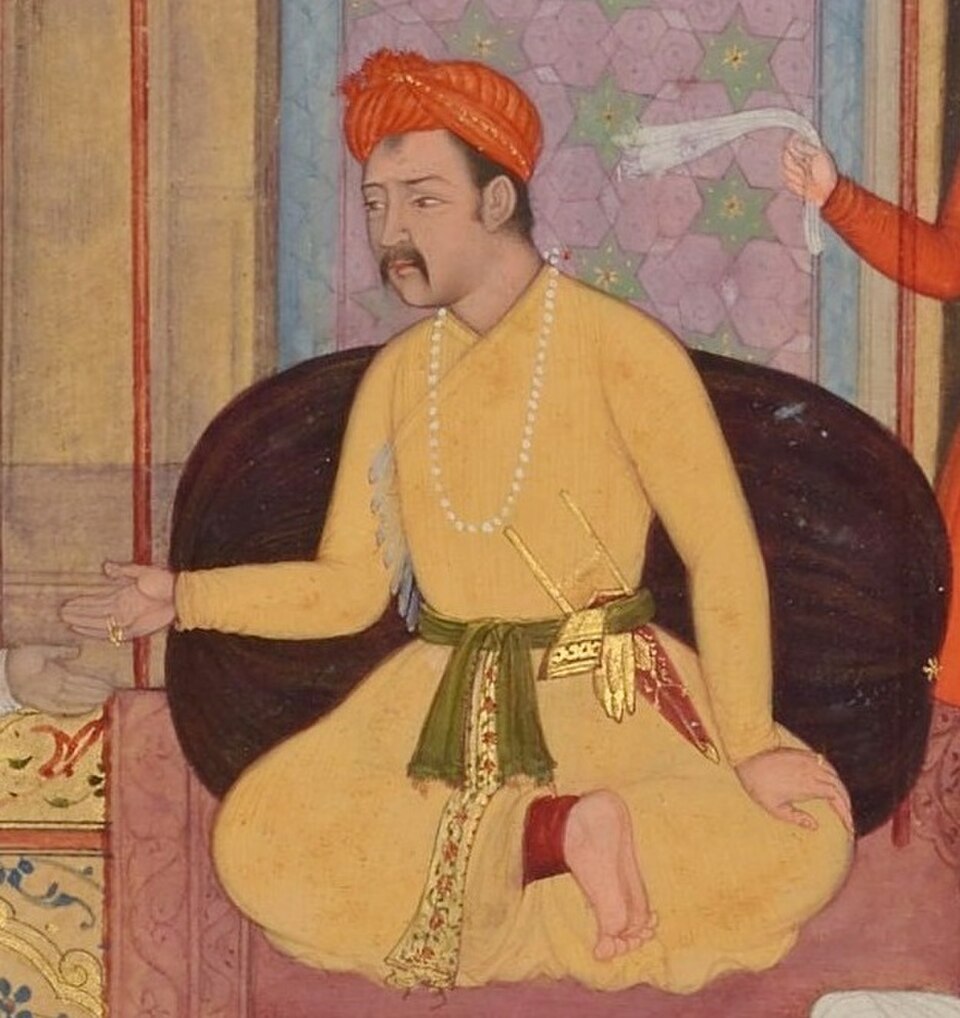
Akbar's religious policy is the part of his reign most written about, and most argued over. In 1563 and 1564 he abolished, respectively, a pilgrimage tax on Hindu sites and the jizya, the poll tax historically levied on non-Muslim subjects under earlier Islamic-ruled states, and he opened senior administrative and military positions to non-Muslims on a scale earlier sultans had not. From 1575 he convened scholars of different faiths — Muslim, Hindu, Jain, Zoroastrian, and, later, Jesuit Christian missionaries from Portuguese Goa — in a purpose-built hall at his new capital, Fatehpur Sikri, called the Ibadat Khana, to debate theology in his presence. Around 1582 he promulgated what later chroniclers called Din-i-Ilahi, a small court order or discipline drawing selectively on several religious traditions, with Akbar himself at its symbolic center.
Historians do not fully agree on how to read this. Some see a ruler engaged in genuine, curious theological inquiry, reflected in his own recorded conversations and his patronage of translations of the Sanskrit epics into Persian. Others read the same policies primarily as statecraft: a pragmatic recognition that a durable empire ruled by a Muslim minority over an overwhelmingly non-Muslim population needed a broader basis of legitimacy than religious orthodoxy alone could provide, expressed in the court principle of sulh-i-kul, or "universal peace" among faiths and communities. Both readings can be true to different degrees, and mainstream historians generally treat Din-i-Ilahi itself as a small, largely court-confined phenomenon rather than a mass religious movement — it did not survive Akbar and left few adherents after his death. What is well documented is that his policies provoked real opposition from sections of the Muslim clergy who saw them as a departure from orthodox practice, and that his great-grandson Aurangzeb later reversed course sharply, reinstating the jizya in 1679.
Fatehpur Sikri and a lasting settlement
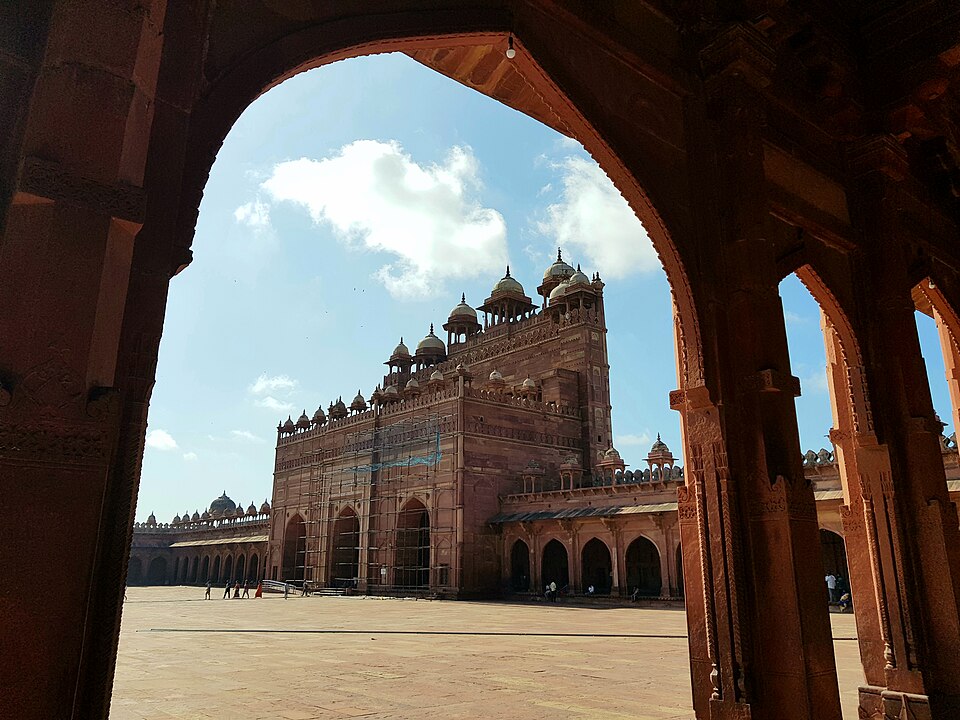
Akbar built an entirely new capital at Fatehpur Sikri, near Agra, from 1571, incorporating the Buland Darwaza gateway to commemorate his 1573 conquest of Gujarat; the city was largely abandoned within about fifteen years, probably owing to water shortages, but its red sandstone buildings survive largely intact. When Akbar died in 1605, he passed on an empire far larger, richer, and more administratively coherent than the one he inherited, and a Mughal-Rajput political settlement durable enough that his son Jahangir, and later emperors, continued to govern through it for another century. The dynasty Babur founded in 1526 would rule, in some form, until the British formally deposed the last Mughal emperor in 1857 — but it was Akbar's reign that turned a conqueror's foothold into an empire built to last.