The Rajputs, the warrior clans of Rajasthan and the hills and plains around it, have two reputations in Indian history. In one, they are the defenders who held out for centuries against the sultans of Delhi and the Mughal emperors, fighting from great hill forts and choosing death over surrender. In the other, they are the indispensable partners of the Mughal Empire, its generals, governors and in-laws. Both are true, often of the same families within a single generation, as they moved between resistance and alliance (Satish Chandra, Medieval India, Part II[1]).
Who were the Rajputs?
The word comes from rajaputra, "son of a king". The Rajput clans emerged as ruling lineages between about the seventh and tenth centuries. Some, such as the Pratiharas, Chauhans, Paramaras and Chandelas, had ruled kingdoms across northern India. Their bards traced them to the sun, the moon, or a sacred fire on Mount Abu. Historians see the Rajputs as having formed from many groups, including local chiefs, older ruling families and probably newcomers, who came to share a warrior identity and an ethic of honour, loyalty to clan and lineage, and martial courage.
Rajput states were organised around clans. A ruler, such as the Rana of Mewar or the Rao of Marwar, was the head of his clan, and his kinsmen held lands and forts in return for service. This gave Rajput armies their fierce loyalty, but it also made them prone to splitting, and Rajput kingdoms fought each other as often as they fought outsiders.
How did the Rajputs face the Delhi Sultanate?
The first great defeat came at Tarain, north of Delhi. In 1191 the Chauhan king Prithviraj III defeated Muhammad of Ghor there. The next year, in 1192, Muhammad returned and won, and the way to the Delhi Sultanate lay open. For the next three centuries the sultans raided and besieged the Rajput forts. Alauddin Khalji took Ranthambhore in 1301 and Chittor, the fortress-capital of Mewar, in 1303 (Satish Chandra, Medieval India, Part II[1]).
At the fall of a besieged fort, Rajput tradition records the practice of jauhar, in which the women of the fort burned themselves to death rather than be captured, while the men rode out to fight to the last. It is described both in Rajput sources and in the chronicles of their enemies, and it was a real and terrible practice of siege warfare in this period. The best-known story of Chittor, of Rani Padmini, whose beauty is said to have drawn Alauddin to the siege, is another matter. It first appears in the poem Padmavat, written by the Sufi poet Malik Muhammad Jayasi in 1540, more than two centuries later, and most historians treat it as literature rather than history.
The Sisodias of Mewar recovered Chittor in the fourteenth century, and Mewar became the leading Rajput power. Rana Kumbha, who ruled from 1433 to 1468, built the vast fort of Kumbhalgarh and the Vijay Stambha, the Tower of Victory, at Chittor (G. N. Sharma, Mewar and the Mughal Emperors[2]).
What happened at Khanwa?
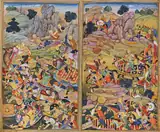
In 1526 Babur defeated Ibrahim Lodi at the first battle of Panipat. The strongest power left in the north was a confederacy of Rajput rulers led by Rana Sangram Singh of Mewar, known as Rana Sanga, who had fought the sultans of Delhi, Malwa and Gujarat and was said to have lost an eye, an arm and the use of a leg in battle. On 17 March 1527 his army met Babur's at Khanwa, west of Agra. Babur used the same tactics as at Panipat: carts chained together to protect his matchlock men and field guns, with mounted archers sweeping round the flanks. The Rajput army was broken, and Sanga died the next year (John F. Richards, The Mughal Empire[3]).
How did Akbar win the Rajputs over?
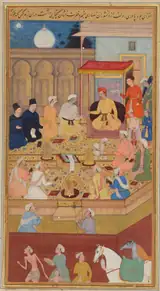
Akbar changed the relationship. In 1562 Raja Bharmal of Amber, a Kachhwaha ruler near modern Jaipur, gave his daughter to Akbar in marriage, and Bharmal's son Bhagwant Das and grandson Man Singh rose to the highest ranks of the empire. Other Rajput houses, including Bikaner, Jaisalmer and eventually Marwar, followed. Rajput rulers kept their kingdoms as hereditary lands, watan jagirs, served as Mughal commanders with high ranks, and their daughters married into the imperial family. They were not required to convert, and Rajput princesses kept their own religious practices at the Mughal court. The alliance gave Akbar loyal soldiers who were not part of the Central Asian nobility, and it was one of the roots of his policy of sulh-i kul (John F. Richards, The Mughal Empire[3]).
For those who would not submit, Akbar was ruthless. In 1567–68 he besieged Chittor. Its defenders, led by Jaimal and Patta after Rana Udai Singh had withdrawn to the hills, held out for months. When the fort fell in February 1568, there was a jauhar, and Akbar ordered the killing of many of the non-combatants who had helped the defence; Mughal sources put the dead in the tens of thousands. Udai Singh never returned. He made Udaipur, the city he had founded around 1559, his new capital (G. N. Sharma, Mewar and the Mughal Emperors[2]).
Why does Haldighati matter?
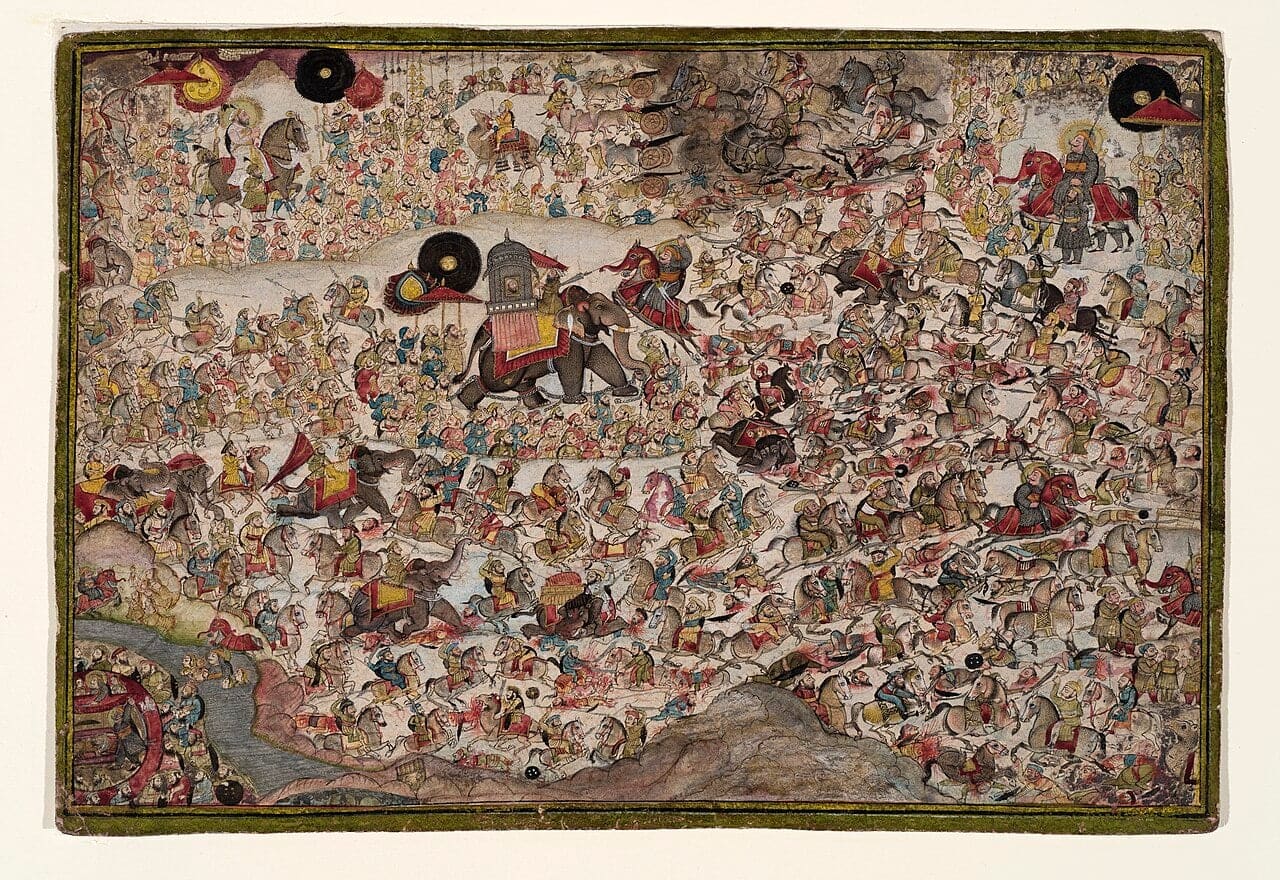
Udai Singh's son, Rana Pratap, who came to the throne in 1572, refused to go to Akbar's court. In June 1576 a Mughal army commanded by Man Singh of Amber met Pratap's forces at Haldighati, a narrow pass in the Aravalli hills. Pratap's army included an Afghan contingent under Hakim Khan Sur, and Man Singh's included many Rajputs, so this was not a simple war of faiths. The Mughals won the field, and Pratap escaped, according to legend on his wounded horse Chetak. He spent the rest of his life fighting from the hills and had recovered much of Mewar, though not Chittor, by his death in 1597 (G. N. Sharma, Mewar and the Mughal Emperors[2]).
His son Amar Singh kept up the fight until 1615, when, worn down by Mughal campaigns, he made terms with Jahangir. Mewar accepted Mughal overlordship, but on honourable terms: the Rana was excused from attending the imperial court in person and from giving a daughter in marriage.
How did the alliance end?
For most of the seventeenth century the Rajput rulers were pillars of the empire. The alliance broke down under Aurangzeb. When Raja Jaswant Singh of Marwar died in 1678, Aurangzeb tried to control the succession to the Marwar throne. Marwar and Mewar went to war with the empire, the Rathore noble Durgadas led the resistance, and Aurangzeb's own son Akbar rebelled with Rajput support in 1681. The war with Mewar ended in 1681, but Marwar fought on for decades, and the Rajput rulers drifted away from the Mughal centre in the eighteenth century (Satish Chandra, Medieval India, Part II[1]).
How has the Rajput past been remembered?
Much of the popular image of the Rajputs comes from James Tod, a British political agent in Rajasthan, whose Annals and Antiquities of Rajasthan (1829–32) retold the bardic chronicles as a romance of chivalry, comparing the Rajputs to the knights of medieval Europe. Tod's work was immensely influential, and it shaped how both British and Indian writers saw the Rajputs. Nationalists in the late nineteenth and twentieth centuries took up Pratap as a symbol of resistance to foreign rule (James Tod, Annals and Antiquities of Rajasthan[4]). Historians since have tried to separate the romance from the record, without losing sight of either the real courage of the sieges or the political calculations that led most Rajput houses into partnership with the Mughals.
Rajput kingdoms timeline
| Date | Event |
|---|---|
| 1191–1192 | Prithviraj Chauhan wins, then loses, at Tarain |
| 1301 | Alauddin Khalji takes Ranthambhore |
| 1303 | Alauddin Khalji takes Chittor |
| 1433–1468 | Reign of Rana Kumbha of Mewar |
| 1527 | Babur defeats Rana Sanga at Khanwa |
| 1535 | Bahadur Shah of Gujarat sacks Chittor |
| 1540 | Jayasi writes the Padmavat |
| 1562 | Marriage alliance between Akbar and Amber |
| 1567–1568 | Akbar besieges and takes Chittor |
| 1576 | Battle of Haldighati |
| 1597 | Rana Pratap dies |
| 1615 | Mewar makes terms with Jahangir |
| 1679–1681 | War between Aurangzeb and Mewar; Marwar fights on for decades |
| 1829–1832 | James Tod publishes the Annals and Antiquities of Rajasthan |