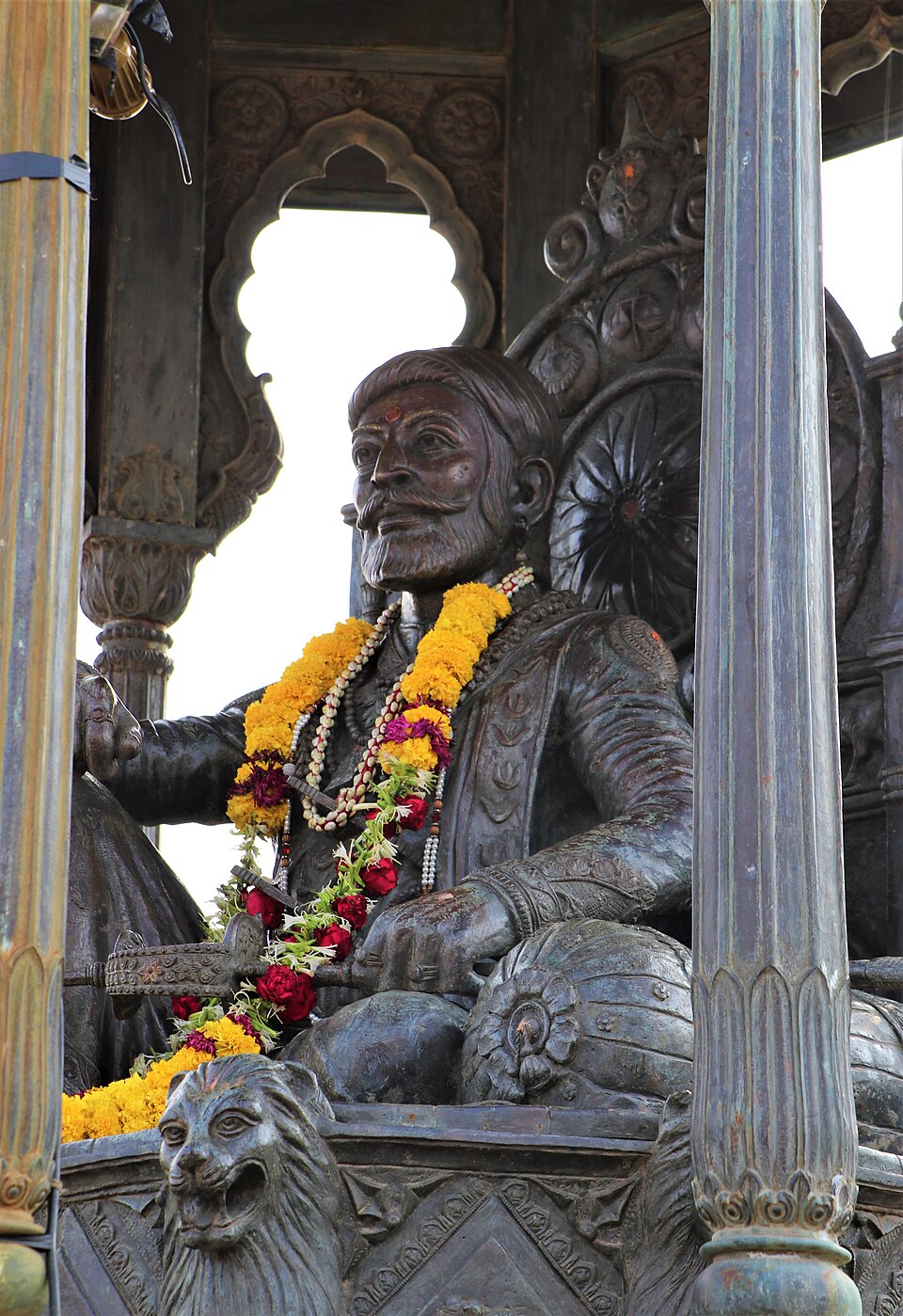
Shivaji Bhonsle was born in 1630 at Shivneri Fort near Pune, into a Maratha family already serving the Deccan sultanates: his father Shahaji held a position under the Sultanate of Bijapur, while Shivaji himself grew up largely under his mother Jijabai's care. By his mid-teens he had begun seizing hill forts around Pune — Torna in 1646 was his first — and by the late 1650s he controlled a compact but well-defended territory carved out mostly at Bijapur's expense. A decisive early test came in 1659, when Bijapur sent its general Afzal Khan to negotiate with, and likely capture, the young chieftain; the two met alone at the foot of Pratapgad fort, and Shivaji, anticipating treachery, killed Afzal Khan at close quarters and signaled a prepared ambush that routed the accompanying Bijapuri army. Episodes like this built Shivaji's reputation for tactical daring well before he held any formal royal title.
Guerrilla warfare and an escape from Agra
Shivaji's conflict with the far larger Mughal Empire escalated after he raided the wealthy Mughal port of Surat in 1664. The Mughal commander Jai Singh defeated him at Purandar in 1665, forcing a humiliating treaty in which Shivaji surrendered 23 forts and traveled to the Mughal court at Agra the following year to submit to Emperor Aurangzeb. There he was seated among lower-ranking nobles, a deliberate insult, and placed under house arrest; he escaped in August 1666 by reportedly having himself smuggled out of the city concealed among baskets of sweets, though the precise details of the escape are known mainly through later, sometimes differing, accounts. Rebuilding his position from his forts, Shivaji fought less through open pitched battles — where Mughal cavalry and artillery held clear advantages — than through what came to be called ganimi kava, hit-and-run raiding that exploited his intimate knowledge of Deccan terrain and dense fort network, by some estimates eventually numbering between 240 and 280 forts. Aurangzeb reportedly dismissed him contemptuously as a "mountain rat," a nickname that in hindsight undersold how effective the strategy proved.
Coronation and administration
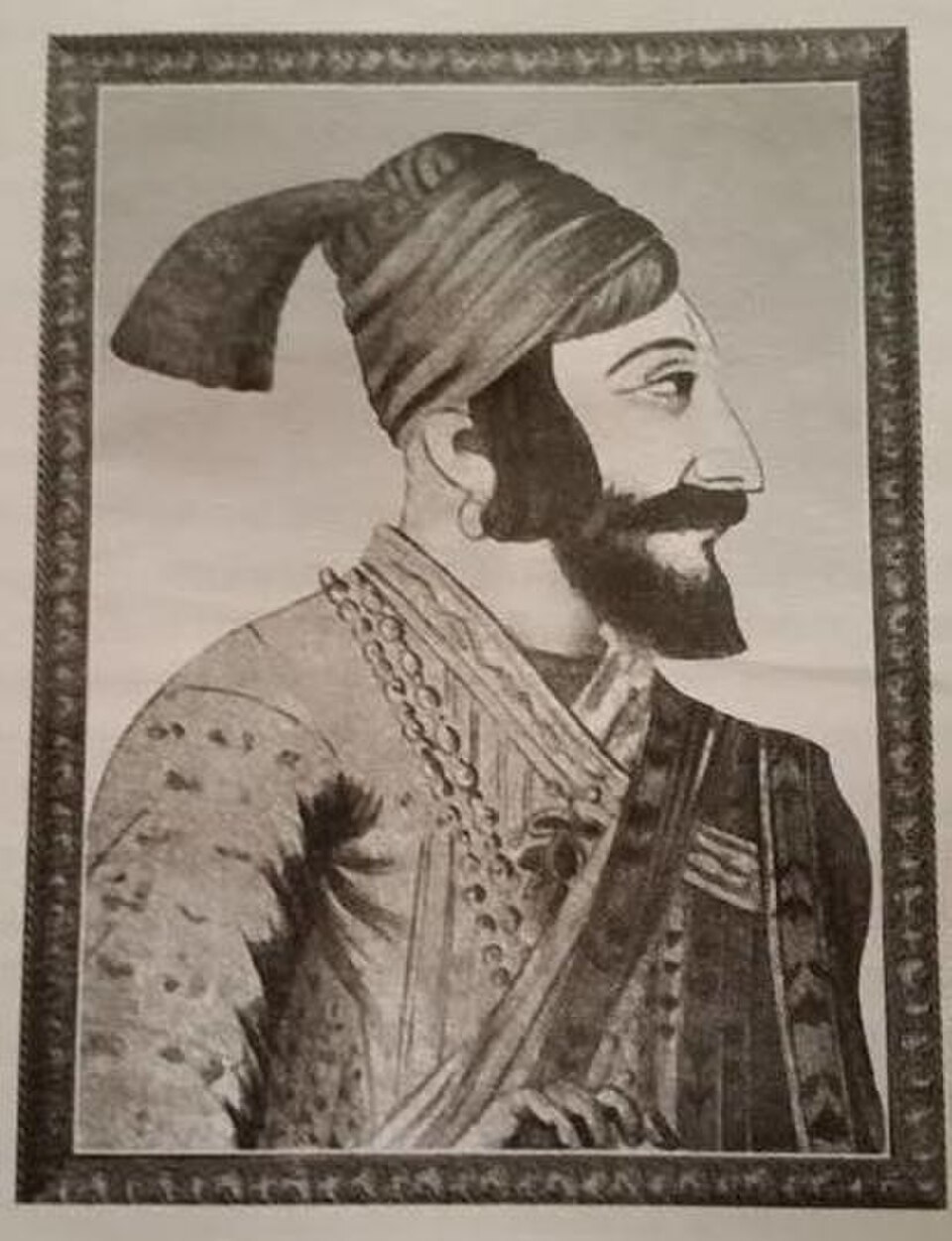
In 1674, Shivaji had himself formally crowned Chhatrapati (sovereign) at Raigad Fort, taking the additional title Haindava Dharmoddharak, protector of the Hindu faith. The coronation was not straightforward: local Brahmin priests initially objected that Shivaji's family, of farming background, could not properly claim the Kshatriya (warrior) status traditionally required of kings, and the issue was resolved only when the pandit Gaga Bhatt produced a genealogy connecting Shivaji to the Sisodia Rajput lineage — a claim modern historians generally regard as tenuous, constructed to legitimize the coronation rather than a documented fact. Once crowned, Shivaji organized his government around the Ashtapradhan, a council of eight ministers with distinct portfolios including finance, military command, foreign affairs, and religious matters, and replaced Persian, the customary language of administration under the Sultanates and Mughals, with Marathi and Sanskrit in his court records. He also built one of the first significant Indian naval forces of the era, based along the Konkan coast, to protect trade and coastal forts from both European and rival Indian fleets.
Religious policy: more complicated than the later legend
Shivaji's later reputation, especially from the nineteenth century onward, often cast him primarily as a Hindu champion resisting Muslim rule, and his title "protector of the Hindu faith" supports that reading in part. But the documented record of his actual governance is more mixed: he employed Muslim officers and soldiers, including his naval commander Darya Sarang, formed his first dedicated Pathan cavalry unit as early as 1656, and is recorded as protecting mosques, Muslim clergy, and Christian missionaries from harm even during otherwise punishing raids, such as the 1664 sack of Surat. Historians today generally treat Shivaji's religious framing and his actual administrative practice as two related but distinct things worth examining separately, and note that his image has been reinterpreted repeatedly since his death — as a champion of lower castes in some nineteenth-century readings, as an anti-colonial nationalist symbol under British rule, and, in some modern political movements, as a specifically Hindu nationalist icon — making him one of the more contested figures in how medieval Indian history gets retold in the present.
From one kingdom to a confederacy
Shivaji died in 1680, and disputed succession briefly split his fledgling state before his son Sambhaji secured the throne. The kingdom survived sustained Mughal pressure under Aurangzeb through the following decades, and over the eighteenth century its character changed substantially: real power shifted from the Chhatrapati's court to the Peshwa, originally the chief minister of the Ashtapradhan, who became the confederacy's de facto head under leaders like Baji Rao I. Under the Peshwas, Maratha power expanded dramatically beyond the Deccan into Malwa, Gujarat, and parts of North India, organized loosely around several powerful allied houses — the Peshwa at Pune, the Scindias of Gwalior, the Holkars of Indore, the Gaekwads of Baroda, and the Bhonsles of Nagpur — rather than a single centralized empire. This expansion reached its limit at the Third Battle of Panipat in 1761, where Maratha forces suffered a catastrophic defeat against an Afghan-led coalition under Ahmad Shah Abdali, with heavy losses that historians still cite as one of the bloodiest single-day battles in eighteenth-century India. The confederacy partially recovered under the able young Peshwa Madhavrao I within the following decade, but persistent rivalries among its constituent houses left it vulnerable, and over the following decades it was the expanding British East India Company, not any single Indian rival, that would ultimately absorb Maratha territories through a series of Anglo-Maratha wars ending in 1818.