When Aurangzeb died in March 1707, the Mughal emperor was, on paper, the ruler of almost the entire subcontinent, and the court at Delhi was one of the richest in the world. Fifty years later the emperor's writ barely ran beyond the walls of Delhi. Governors in Hyderabad, Awadh and Bengal ruled their provinces as their own, the Marathas collected taxes across much of the north and west, a Persian king had sacked the capital, and the East India Company was about to become the master of Bengal. Yet the dynasty lasted another century, and almost every new power in India still sought the emperor's seal to make its rule legitimate. Explaining how both of those things were true is the puzzle of the Mughal decline (John F. Richards, The Mughal Empire[3]).
What went wrong after 1707?
The first problem was succession. Aurangzeb's sons fought for the throne as he had, and the eldest surviving son, Muazzam, won and ruled as Bahadur Shah I. He was already in his sixties, and he died in 1712. In the next seven years Delhi saw five emperors. Jahandar Shah was killed within a year. His nephew Farrukhsiyar was put on the throne by two powerful nobles, the Sayyid brothers Abdullah Khan and Husain Ali Khan, and when he tried to get rid of them, they deposed, blinded and killed him in 1719. Two short-lived puppet emperors followed before Muhammad Shah took the throne later that year. The "kingmakers", as the Sayyids were called, were overthrown in 1720, but by then everyone knew that the emperor could be made and unmade by his own nobles (Satish Chandra, Medieval India, Part II[4]).
The second problem was money. The nobles were paid from the revenue of land assignments, called jagirs, and in Aurangzeb's last decades there were too many nobles for the land available. Nobles fought over the best jagirs, held them for short periods, and pushed peasants hard to get what they could. Historians of the Aligarh school, such as Irfan Habib and Satish Chandra, saw this agrarian and jagir crisis as the root of the decline. It also helped push zamindars, Jats, Sikhs and Marathas into rebellion.
How did the provinces break away?
Muhammad Shah reigned from 1719 to 1748, but power drained away from him to the provinces. The most powerful noble at court, Nizam-ul-Mulk, despaired of reforming the government and went south. In 1724 he defeated the Mughal governor of the Deccan at Shakar Kheda and made himself master of what became the state of Hyderabad. Saadat Khan, appointed governor of Awadh in 1722, made that province a hereditary state with its capital later at Lucknow. In Bengal, Murshid Quli Khan, who had managed its revenue since 1700, became governor in 1717, and his successors ruled Bengal with little reference to Delhi (Muzaffar Alam, The Crisis of Empire in Mughal North India[1]).
These governors did not declare independence. They kept Mughal titles, issued coins in the emperor's name, and sent tribute, if irregularly. Muzaffar Alam's study of Awadh and Punjab argued that the period was not simply one of collapse. Local landholders, merchants and bankers had grown richer under Mughal rule, and the new regional states were built by people who had gained from it. On this reading, power moved from the centre to the regions rather than disappearing, and many regional economies did well in the eighteenth century (Muzaffar Alam, The Crisis of Empire in Mughal North India[1]).
At the same time the Marathas were pushing north. In 1719 the Sayyid brothers granted them the right to collect chauth and sardeshmukhi, shares of the revenue, in the Deccan. Under the Peshwa Baji Rao I they took Malwa and pressed deep into Gujarat, and in 1737 a Maratha army raided the outskirts of Delhi itself.
What did Nadir Shah do to Delhi?
In 1738 Nadir Shah, the soldier who had made himself king of Persia, invaded from Afghanistan. On 24 February 1739 he routed the Mughal army at Karnal, north of Delhi, and Muhammad Shah submitted. Nadir Shah entered Delhi in March. When a rumour of his death set off attacks on his soldiers, he ordered a massacre on 22 March, in which tens of thousands of the city's people were killed in a single day (Jadunath Sarkar, Fall of the Mughal Empire[2]).
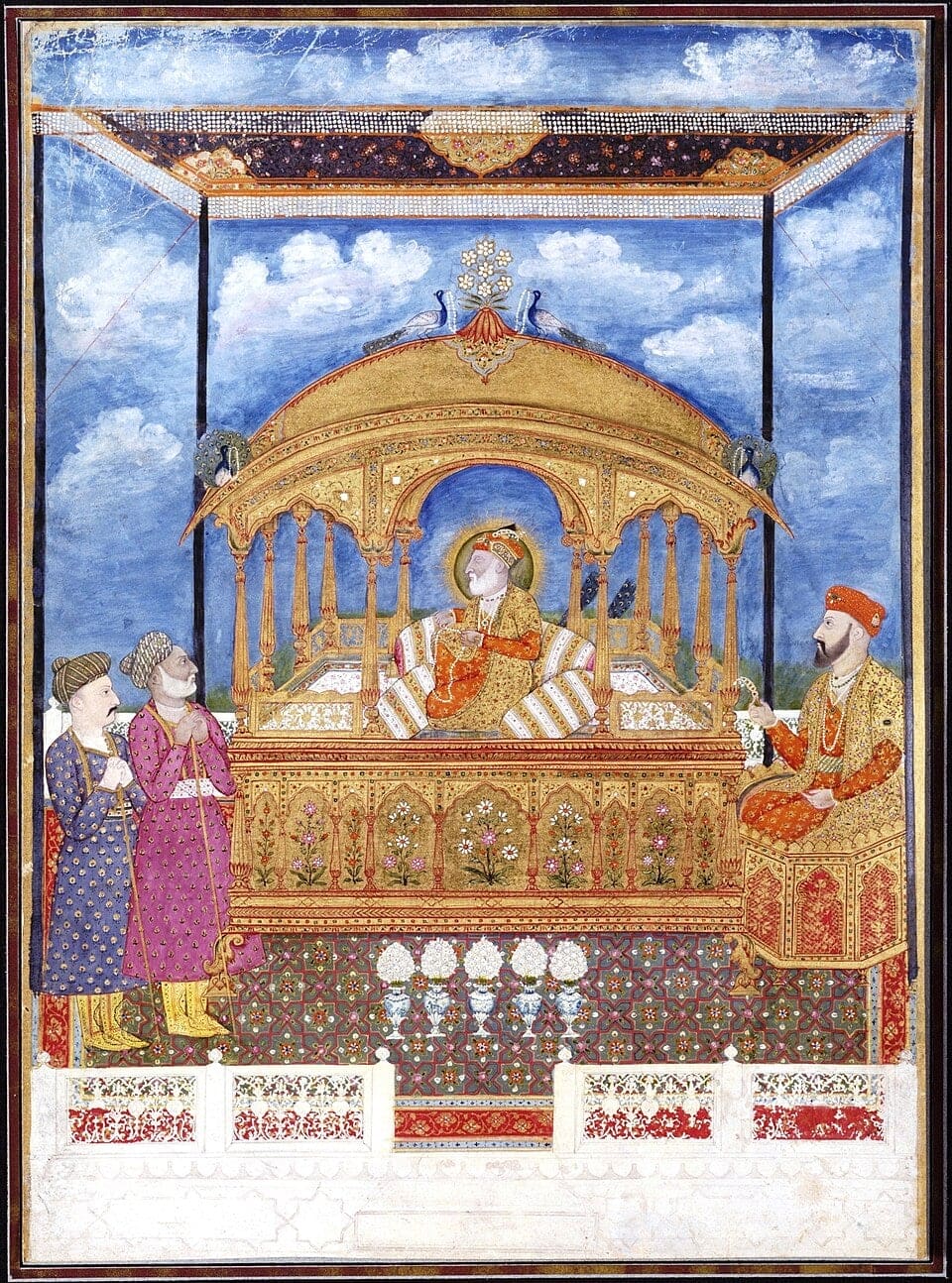
When Nadir Shah left in May, he took the Mughal treasury with him, including Shah Jahan's jewelled Peacock Throne and the Koh-i-Noor diamond. The raid ruined the empire's finances and showed the world how weak it had become. The Afghan ruler Ahmad Shah Abdali, who had served in Nadir Shah's army, invaded India repeatedly from 1748, sacked Delhi again in 1757, and in 1761 defeated the Marathas at the third of the battles of Panipat.
How did the emperors become British pensioners?
The emperors who followed Muhammad Shah had even less power. Ahmad Shah was deposed and blinded in 1754, and Alamgir II was murdered by his own chief minister in 1759. His son, Shah Alam II, spent his first years as emperor in exile in the east. He joined the Nawabs of Bengal and Awadh against the East India Company and was defeated with them at Buxar in 1764. In 1765, under the Treaty of Allahabad, he granted the Company the diwani, the right to collect the revenues of Bengal, Bihar and Orissa, in return for an annual payment, a story told in Plassey and Buxar (John F. Richards, The Mughal Empire[3]).
Shah Alam returned to Delhi in 1772 under Maratha protection. In 1788 the Rohilla chief Ghulam Qadir seized the palace, searched it for hidden treasure and blinded the emperor. The Maratha general Mahadji Scindia restored him. In 1803 British forces under General Lake defeated the Marathas outside Delhi, and from then on the emperor lived in the Red Fort as a British pensioner. His successors Akbar II and Bahadur Shah II kept their titles, their court and their ceremonies, but the Company stopped minting coins in the emperor's name in 1835.
How did the dynasty end?
Bahadur Shah II, known by his pen name Zafar, became emperor in 1837 at the age of sixty-one. He was a poet and patron of poets, and his court was home to Ghalib and Zauq, among the greatest Urdu poets. In May 1857 the soldiers who rose against the Company at Meerut marched to Delhi and proclaimed him their leader. The emperor's name gave the revolt of 1857 a legitimacy no one else could provide (Satish Chandra, Medieval India, Part II[4]).
When the British retook Delhi in September 1857, Zafar surrendered. His sons were shot, and he was tried, convicted and exiled to Rangoon in Burma, where he died in 1862. The Mughal dynasty, founded by Babur at Panipat in 1526, ended with him.
Was it a decline or a transformation?
For Jadunath Sarkar, writing in the early twentieth century, the eighteenth century was a story of decay: weak emperors, corrupt nobles, and an empire undone by Aurangzeb's religious policy and its own vices. Later historians have given more structural explanations, from the jagir crisis to the costs of the Deccan wars, and some, like Muzaffar Alam and C. A. Bayly, have questioned the word "decline" itself. The eighteenth century was also the age of the Jantar Mantar, the observatory Sawai Jai Singh built in Delhi in 1724, of the Urdu poetry of Mir and Sauda, and of thriving regional courts at Hyderabad, Lucknow and Murshidabad. What declined, on this view, was the power of the centre, not Indian society or its economy. The Mughal decline left a political vacuum, and over the next century the East India Company filled more and more of it (Muzaffar Alam, The Crisis of Empire in Mughal North India[1]).
Mughal decline timeline
| Date | Event |
|---|---|
| 1707 | Aurangzeb dies; Bahadur Shah I wins the war of succession |
| 1713 | Farrukhsiyar becomes emperor with the support of the Sayyid brothers |
| 1717 | Farrukhsiyar's farman grants the East India Company duty-free trade in Bengal |
| 1719 | Farrukhsiyar is killed; Muhammad Shah becomes emperor |
| 1720 | The Sayyid brothers are overthrown |
| 1722 | Saadat Khan becomes governor of Awadh |
| 1724 | Nizam-ul-Mulk wins at Shakar Kheda and founds Hyderabad state |
| 1737 | Maratha raid on Delhi under Baji Rao I |
| February–May 1739 | Nadir Shah wins at Karnal and sacks Delhi |
| 1757 | Ahmad Shah Abdali sacks Delhi |
| 1761 | Third Battle of Panipat |
| 1765 | Shah Alam II grants the diwani to the East India Company |
| 1788 | Shah Alam II is blinded by Ghulam Qadir |
| 1803 | The British take Delhi |
| 1857–1858 | Bahadur Shah Zafar leads the revolt, is tried and exiled to Rangoon |