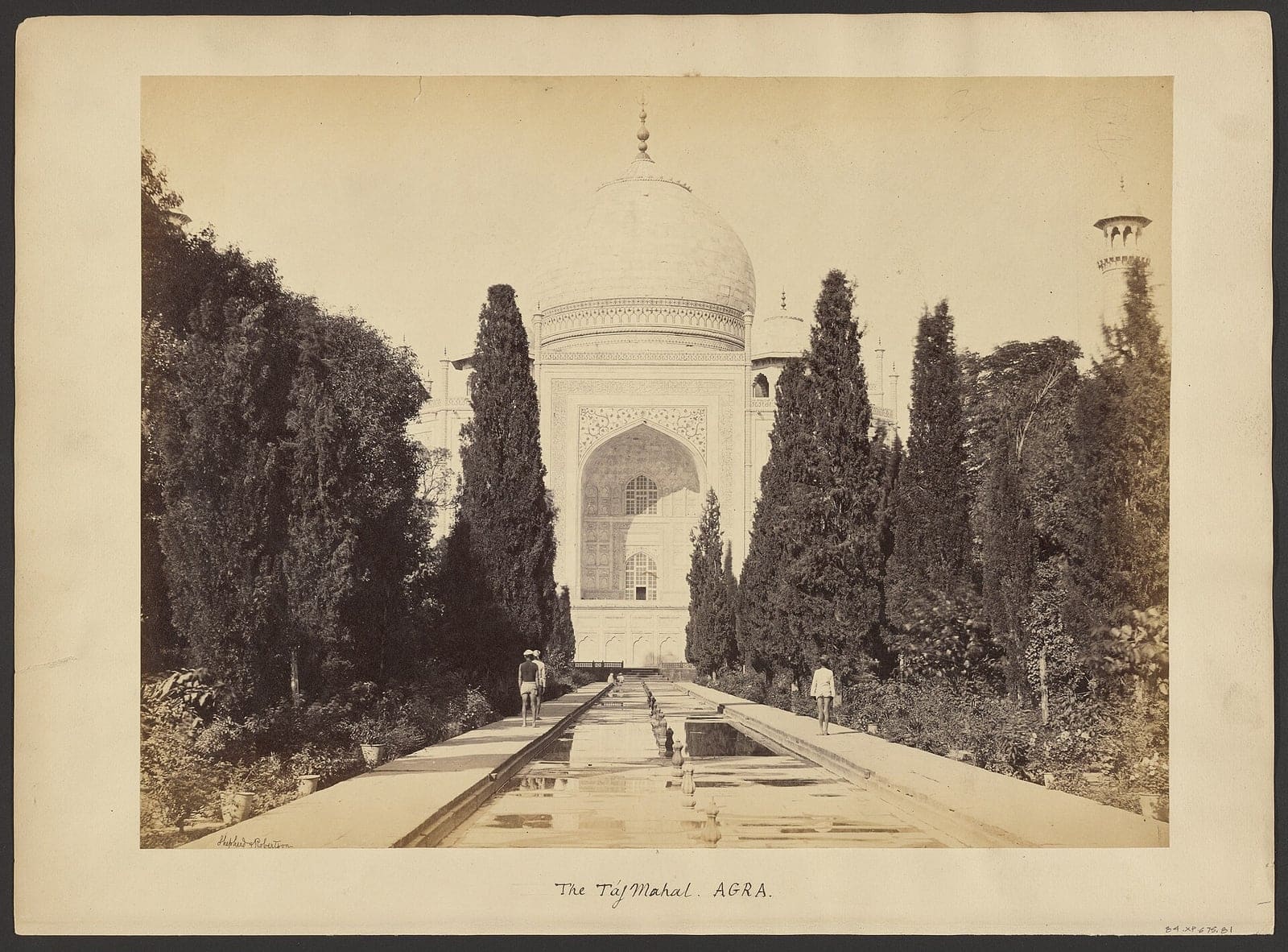
In June 1631, Mumtaz Mahal, the wife of the Mughal emperor Shah Jahan, died at Burhanpur in the Deccan after giving birth to their fourteenth child. She had been married to him for nineteen years and had travelled with him on campaign. The court histories describe the emperor's grief: he went into mourning, gave up music and fine clothes for a time, and his beard is said to have turned white. Within months he had chosen a site for her tomb on the bank of the Yamuna at Agra, his capital. The building that rose there over the next fifteen years, which Mughal writers called the rauza-i munawwara, the "illumined tomb", is the Taj Mahal (W. E. Begley and Z. A. Desai, Taj Mahal: The Illumined Tomb[1]).
Who built the Taj Mahal, and when?
The Mughal emperor Shah Jahan built the Taj Mahal at Agra as a tomb for his wife Mumtaz Mahal. Work began in 1632, the tomb was largely finished by about 1643, and the whole complex by about 1648.
Mumtaz Mahal's body was first buried in a garden at Burhanpur and sent to Agra in December 1631, arriving early in the new year. Work on the tomb began in 1632. Shah Jahan acquired the land from Raja Jai Singh of Amber, one of the Rajput princes in Mughal service, giving him four mansions in Agra in exchange. The orders recording the exchange survive, along with orders to Jai Singh to send marble from his territory (W. E. Begley and Z. A. Desai, Taj Mahal: The Illumined Tomb[1]).
Who was the architect of the Taj Mahal?
The official histories do not name a single architect. Most historians credit Ustad Ahmad Lahauri, whom a later text written by his son describes as the builder of the Taj and of the Red Fort at Delhi. The works were supervised by two officials, Mir Abdul Karim and Makramat Khan, and the emperor took a close interest in the design. The calligrapher Amanat Khan, who designed the Quranic inscriptions framing the arches, signed his name on the building, the only person to do so. The attribution to Ustad Ahmad rests on that later family text rather than on the court records, so it is likely but not certain (Ebba Koch, Mughal Architecture[2]).
How long did it take to build the Taj Mahal?
The court historians say the tomb took about twelve years and cost five million rupees. The mausoleum itself was largely finished by about 1643, and the gateway, mosque and other buildings were completed by about 1648. The French jeweller Jean-Baptiste Tavernier, who visited Agra, wrote that twenty thousand men worked on it. The workforce included masons, stone-cutters, inlayers and calligraphers from across the empire and beyond (Inayat Khan, The Shah Jahan Nama[3]).
How was it made?
The tomb is built of brick faced with white marble from Makrana in Rajasthan, carried more than three hundred kilometres to Agra. The surrounding buildings are of red sandstone from quarries near Fatehpur Sikri. Into the marble, craftsmen set flowers and vines of cut semi-precious stones, among them jasper, carnelian, lapis lazuli and agate, a technique the Mughals called parchin kari and Europeans pietra dura. Carved marble panels of flowering plants run around the base of the walls (Ebba Koch, Mughal Architecture[2]).
Most Mughal tombs, like Humayun's in Delhi, stand in the centre of a square garden. The Taj stands at the far end of its garden, on a terrace above the river, where the gardens of Agra's nobles also lined the Yamuna. The garden in front is divided into four by water channels. A red sandstone mosque stands to the west of the tomb, and an identical building on the east, called the jawab or "answer", balances it. The four minarets at the corners of the plinth lean very slightly outwards, so that in an earthquake they would fall away from the tomb (Ebba Koch, Mughal Architecture[2]).
In the main chamber, under the great dome, a carved marble screen surrounds the cenotaph of Mumtaz Mahal at the exact centre. Beside it is a second, larger cenotaph, of Shah Jahan. The real graves lie in a crypt below.
What happened to Shah Jahan?
In 1657 Shah Jahan fell ill, and his sons fought for the throne. The winner, Aurangzeb, deposed his father in 1658 and kept him confined in the fort at Agra, a short way upriver from the tomb, until his death in 1666. His Peacock Throne, which later carried the Koh-i-Noor, stayed in Delhi until Nadir Shah took it in 1739. Shah Jahan was buried beside Mumtaz Mahal, and his cenotaph, placed to one side of hers, is the one asymmetrical element in the building (W. E. Begley and Z. A. Desai, Taj Mahal: The Illumined Tomb[1]).
Was the Taj Mahal a temple? Which stories are true?
Tavernier wrote that Shah Jahan had begun a tomb for himself on the opposite bank, which grew into the legend of a "Black Taj" in black marble. Excavations at Mehtab Bagh, across the river, in the 1990s found a Mughal garden laid out to view the Taj, with no foundations of a second tomb. The story that Shah Jahan cut off the hands of the workers so they could never build anything as beautiful again has no basis in any record. The claim, popularised by P. N. Oak in the 1960s, that the Taj was a Hindu temple is contradicted by the land records, the court histories and the building itself, and courts have repeatedly rejected petitions based on it (W. E. Begley and Z. A. Desai, Taj Mahal: The Illumined Tomb[1]).
Under British rule the gardens were neglected and replanted in an English style. Lord Curzon, Viceroy from 1899 to 1905, paid for a major restoration and gave the tomb the lamp that hangs in the main chamber. In the twentieth century the threat was air pollution. Smoke from the foundries and factories of Agra and the Mathura refinery was yellowing the marble, and in 1996 the Supreme Court ordered polluting industries in a protected zone around the Taj to close or move.
UNESCO declared the Taj Mahal a World Heritage Site in 1983, describing it as the jewel of Muslim art in India. It draws millions of visitors a year, more than any other monument in India. In Mughal architecture it carried to its furthest point the garden tomb that began with Humayun's tomb in Delhi in the 1560s (UNESCO World Heritage Centre, "Taj Mahal"[4]).
Taj Mahal timeline
| Date | Event |
|---|---|
| 1612 | Prince Khurram, later Shah Jahan, marries Arjumand Banu Begum (Mumtaz Mahal) |
| 1628 | Shah Jahan becomes emperor |
| June 1631 | Mumtaz Mahal dies at Burhanpur |
| 1632 | Work begins on the tomb at Agra |
| c. 1643 | The mausoleum is largely complete |
| c. 1648 | The whole complex is finished |
| 1658 | Aurangzeb deposes Shah Jahan and confines him in Agra Fort |
| 1666 | Shah Jahan dies and is buried beside Mumtaz Mahal |
| 1899–1908 | Restoration under Lord Curzon |
| 1983 | UNESCO World Heritage Site |
| 1996 | Supreme Court orders polluting industries out of the Taj zone |