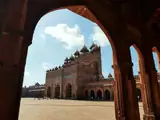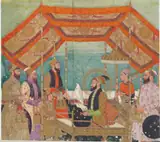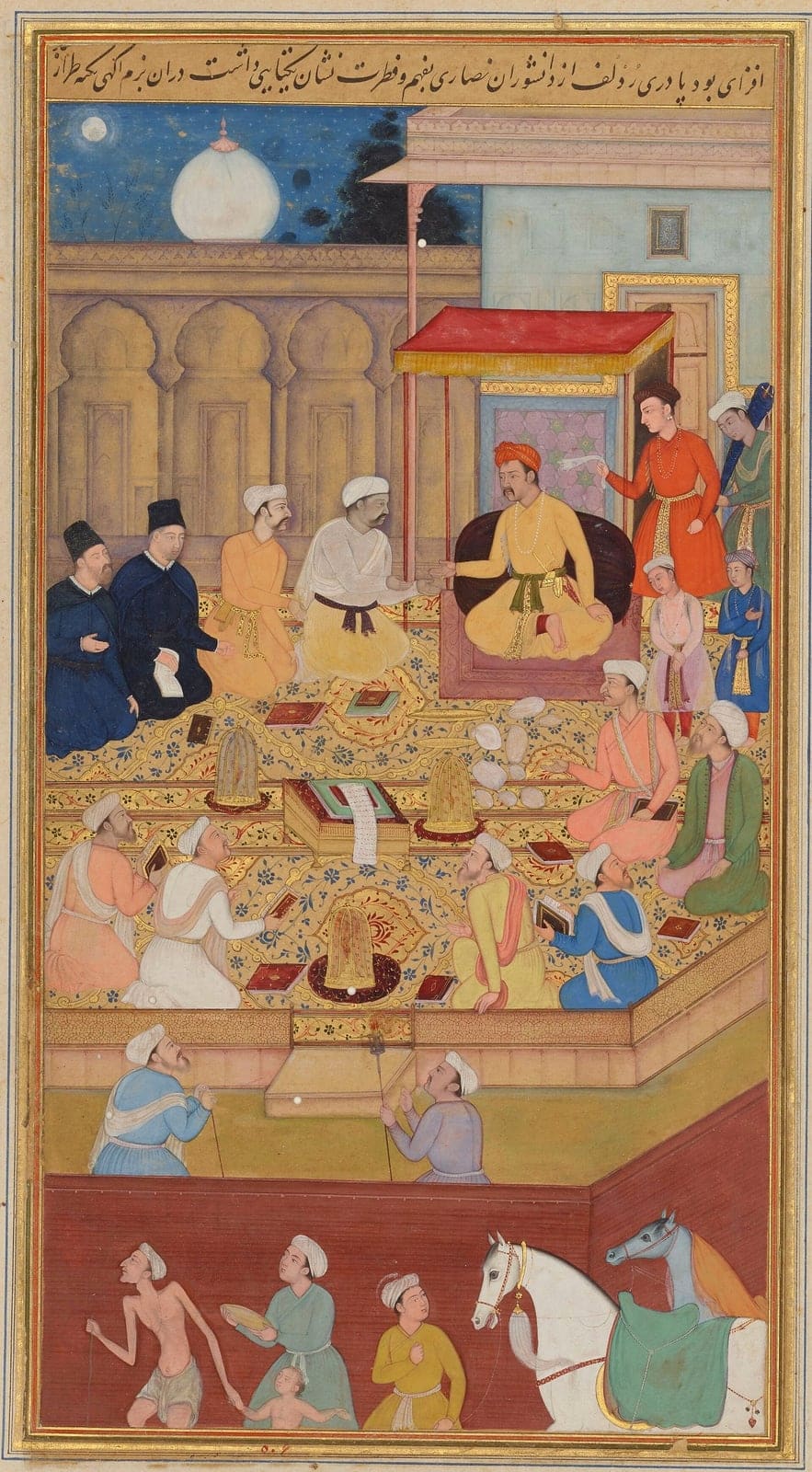
In 1575, at his new capital of Fatehpur Sikri near Agra, the Mughal emperor Akbar ordered a hall built for religious discussion. He called it the Ibadat Khana, the House of Worship. At first it was meant for Muslim scholars to debate questions of faith and law on Thursday nights in the emperor's presence. Within a few years it was hosting Brahmins, Jain monks, Zoroastrian priests and Jesuits from Goa. The debates lasted only until the early 1580s, but they changed how Akbar governed an empire in which Muslims were a minority, and the principle he took from them, sulh-i kul or "peace with all", shaped Mughal rule for most of the following century (John F. Richards, The Mughal Empire[1]).
Why did Akbar build the Ibadat Khana?
By 1575 Akbar was in his early thirties and had ruled for almost twenty years. He had conquered Gujarat and was campaigning in Bengal, and the Mughal Empire he had inherited as a fragile foothold was now the largest state in India. He had already made unusual choices. In 1562 he married a princess of the Kachhwaha Rajputs of Amber and took her family into high office. He stopped the enslavement of prisoners of war, abolished the tax on Hindu pilgrims in 1563, and in 1564 abolished the jizya, the tax on non-Muslims (Satish Chandra, Medieval India, Part II[4]).
He was also, by every account, deeply curious about religion. He could not read, perhaps because of dyslexia, but had books read to him and spent nights in conversation with Sufis and scholars. Fatehpur Sikri itself was built next to the hermitage of the Chishti Sufi Shaikh Salim, whose blessing Akbar believed had given him his heir. The Ibadat Khana was built near the great mosque there, as a place where the scholars of Islam could help him find out what was true (Abu'l Fazl, The Akbarnama, Vol. 3[2]).
What happened in the debates?
The first debates went badly. The leading ulama (religious scholars) at court quarrelled over precedence and seating, then over doctrine, and then with each other personally. The two most senior, Makhdum ul-Mulk and Shaikh Abdun Nabi, accused each other of ignorance and corruption, and their arguments became so heated that Akbar was disgusted. Abdul Qadir Badauni, a scholar at court who later wrote a bitter private history of the reign, describes the scholars shouting and the emperor losing faith in their authority (Satish Chandra, Medieval India, Part II[4]).
From 1578 Akbar opened the hall to other faiths. Brahmins explained Hindu doctrine to him, and he is said to have had a scholar called Purushottam give him names of things in Sanskrit. Dastur Meherji Rana, a Zoroastrian priest from Navsari in Gujarat, taught him about the Parsi faith, and the Jain teacher Hiravijaya Suri came from Gujarat in the early 1580s and persuaded him to forbid the killing of animals on certain days. Akbar also asked the Portuguese at Goa to send learned priests. Three Jesuits arrived at Fatehpur Sikri in February 1580: Rodolfo Acquaviva, Antonio Monserrate, and Francisco Henriques, a convert from Islam who acted as interpreter (Abu'l Fazl, The Akbarnama, Vol. 3[2]).
Monserrate's Commentary gives an outsider's view of the debates. The Jesuits were given lodgings in the palace, allowed to set up a chapel, and invited to argue with the Muslim scholars in front of the emperor. Akbar treated them warmly, kissed the Bible and an image of the Virgin Mary, and even placed one of his sons in their care to learn Portuguese. The Jesuits came hoping to convert him and left disappointed. Akbar was willing to honour Christ but would not accept that any one faith was the whole truth (Antonio Monserrate, The Commentary of Father Monserrate[3]).
What was the decree of 1579?
In September 1579 the leading scholars at court signed a document, the mahzar, which declared Akbar a just ruler and gave him the right, where Muslim jurists disagreed, to choose which opinion to follow, provided it agreed with the Quran and served the public good. Vincent Smith, writing in 1917, called it the "infallibility decree", but that overstates it. It gave Akbar the last word on disputed points of law, rather than the power to make new doctrine. It also took authority away from the ulama who had embarrassed themselves in the Ibadat Khana. Earlier that year Akbar had himself read the Friday sermon in the mosque at Fatehpur Sikri, in verses written by the court poet Faizi (John F. Richards, The Mughal Empire[1]).
Many orthodox Muslims were alarmed. In 1580 and 1581 rebellions broke out among Mughal officers in Bihar and Bengal, and some of the rebels' scholars declared that it was a religious duty to rise against Akbar. Akbar's half-brother Mirza Hakim, who ruled Kabul, was invited to take the throne and marched into Punjab. Akbar put down the rebels and marched to Kabul in 1581, and the crisis passed.
Did Akbar found a new religion?
Around 1582 the debates in the Ibadat Khana stopped. In the same years Akbar began admitting a small number of courtiers as personal disciples, in a ceremony modelled on a Sufi master's initiation of a follower. Disciples promised to be loyal to the emperor with their property, life, honour and religion. This discipleship was later called the Din-i Ilahi, the "religion of God", and Badauni presented it as a new faith that replaced Islam. Most historians now see it as something much smaller, an order of devoted followers that never numbered more than a few dozen. It had no scripture or priests, and no one was pressed to join. The Rajput nobleman Man Singh is said to have declined to become a disciple, and he lost nothing by it (John F. Richards, The Mughal Empire[1]).
What lasted was a policy. Abul Fazl, Akbar's closest adviser and the author of the Akbarnama, described the emperor as standing above the quarrels of the sects, owing the same protection to all of them. This was sulh-i kul. In practice it meant that Hindus, Shias, Sunnis and others could serve and rise in the imperial service; that temples as well as mosques received grants; and that the court built a shared culture. Akbar's translation bureau put the Mahabharata into Persian as the Razmnama (Book of War), as well as the Ramayana. He kept the Zoroastrian festival of Nauruz, showed himself each morning to his subjects at a balcony window, and honoured the sun and fire as signs of God (Abu'l Fazl, The Akbarnama, Vol. 3[2]).
How was Akbar's experiment remembered?
The two main chroniclers of the reign disagreed completely. Abul Fazl saw Akbar as a philosopher-king guided by divine light. Badauni, whose Muntakhab ut-Tawarikh was kept secret until after Akbar's death, saw an emperor led astray from Islam by flatterers and heretics. Later critics, such as the Naqshbandi Sufi Shaikh Ahmad Sirhindi, wrote against what they saw as the dilution of Islam under Akbar (Encyclopaedia Britannica, "Akbar"[5]).
His successors Jahangir and Shah Jahan kept the core of sulh-i kul, if with less enthusiasm for debate. His great-grandson Dara Shukoh carried his intellectual interest further, translating the Upanishads into Persian. It was Dara's brother and rival who took a different course after 1658, as described in Aurangzeb's reign and legacy. Akbar's experiment came from a long Indian tradition of religious conversation, which also produced the saints and poets of the Bhakti and Sufi movements. What was new was that an emperor made that conversation a principle of government.
Akbar's religious policy timeline
| Date | Event |
|---|---|
| 1556 | Akbar becomes emperor at thirteen |
| 1562 | Marriage alliance with the Kachhwaha Rajputs of Amber; enslavement of prisoners of war forbidden |
| 1563 | Pilgrim tax on Hindus abolished |
| 1564 | Jizya abolished |
| 1571 | Construction of Fatehpur Sikri begins |
| 1575 | The Ibadat Khana is built |
| 1578 | The debates are opened to other faiths |
| 1579 | Akbar reads the Friday sermon; the mahzar is signed |
| February 1580 | The first Jesuit mission arrives from Goa |
| 1580–1581 | Revolts in Bihar and Bengal; Akbar marches to Kabul |
| c. 1582 | The debates end; the discipleship later called Din-i Ilahi begins |
| 1605 | Akbar dies at Agra |