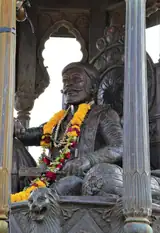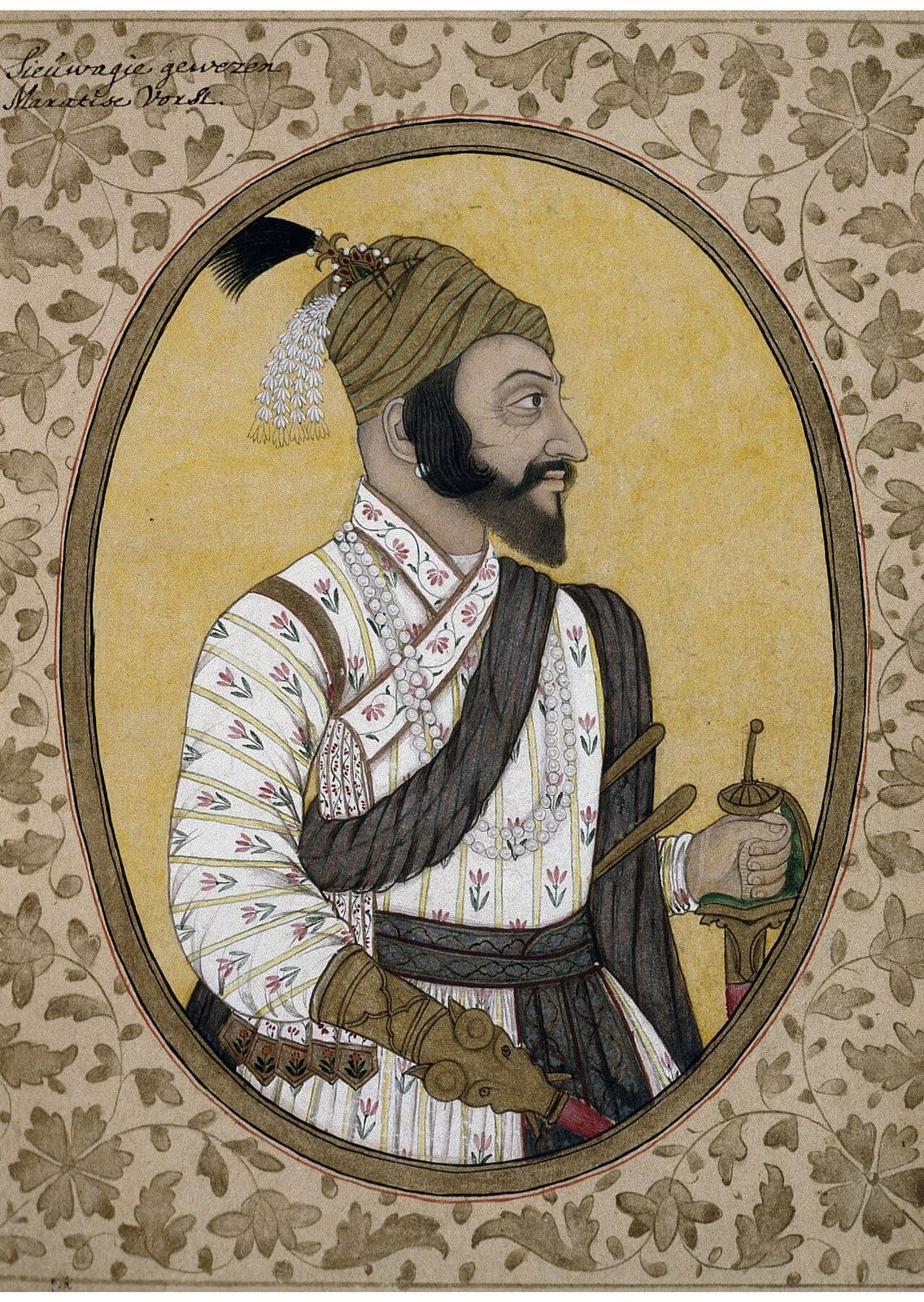
Shivaji Bhonsle was born in the hill fort of Shivneri, near Junnar in the western Deccan, around 1630. The government of Maharashtra observes his birthday on 19 February 1630, though some traditions give 1627. When he died at Raigad fifty years later, he was a crowned king, the Chhatrapati, ruling a kingdom of more than two hundred forts, with an army, a navy and a council of ministers. He had built it in the face of two of the strongest states in India, the sultanate of Bijapur and the Mughal Empire of Aurangzeb. The Maratha Empire that his successors built across much of India in the eighteenth century grew from the state he founded (Jadunath Sarkar, Shivaji and His Times[1]).
Where did Shivaji come from?
His father, Shahaji Bhonsle, was a Maratha general who served the sultanates of the Deccan, first Ahmadnagar and then Bijapur, and held lands around Pune as a jagir. Shahaji spent most of his career in the south, in what is now Karnataka, and Shivaji grew up in Pune with his mother, Jijabai, under the care of an administrator, Dadoji Konddev. The Deccan of his youth was a frontier. The Mughals were advancing from the north and swallowed Ahmadnagar in the 1630s, while Bijapur and Golconda, two of the sultanates that had broken Vijayanagara at Talikota in 1565, held the south. In the hills and valleys of the Sahyadri range, the Maval country west of Pune, local Maratha families held land and forts under whichever sultan was strongest (Stewart Gordon, The Marathas[2]).
As a teenager Shivaji began taking control of the forts in his father's lands and beyond. Around 1646 he seized Torna, and he built a new fort, Rajgad, on a nearby hill. Over the next decade he took more forts, by negotiation, bribery or surprise, and gathered a following among the Maval peasants, who became his infantry. Bijapur, distracted by its own troubles, at first did little to stop him.
How did Shivaji fight Bijapur and the Mughals?
In 1659 Bijapur sent a senior general, Afzal Khan, with a large army to crush him. Shivaji withdrew to Pratapgad, deep in the forested hills, and agreed to meet Afzal Khan below the fort. At the meeting, on 10 November 1659, the two men struggled and Shivaji killed the general, by tradition with steel "tiger claws" hidden in his hand. Each side later claimed the other had planned treachery. Shivaji's troops, waiting in the forest, then routed the leaderless army (Jadunath Sarkar, Shivaji and His Times[1]).
The next year a Bijapur army besieged him in Panhala. Shivaji slipped out at night in July 1660, and Baji Prabhu Deshpande held the pass of Ghod Khind behind him with a few hundred men, dying there, until Shivaji reached safety. Then the Mughals came. Aurangzeb sent his uncle Shaista Khan, who occupied Pune and settled into Shivaji's own house. In April 1663 Shivaji and a small band got into the house at night, killed several of Shaista Khan's household and wounded the governor, who lost fingers escaping through a window. In January 1664 Shivaji sacked Surat, the richest port of the Mughal Empire, for several days.
Aurangzeb then sent Mirza Raja Jai Singh of Amber, one of his ablest generals. Jai Singh besieged Purandar and pressed Shivaji so hard that, in June 1665, he agreed to the Treaty of Purandar, handing over 23 of his forts and agreeing to serve the Mughals. In 1666 Jai Singh persuaded him to visit the emperor at Agra (Stewart Gordon, The Marathas[2]).
What happened at Agra?
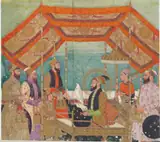
At Aurangzeb's court Shivaji was placed among nobles of lower rank than he expected. He protested openly and walked out, and was put under guard. For three months he was a prisoner. In August 1666 he escaped. The story told ever since is that he and his son Sambhaji were carried out hidden in large baskets of sweets that he had been sending out as gifts. He made his way back to the Deccan in disguise. Within a few years he had retaken most of the forts he had surrendered, among them Kondhana, captured in a famous night assault in 1670 in which his commander Tanaji Malusare was killed, and which was later called Sinhagad, the "lion's fort". He sacked Surat again the same year (Jadunath Sarkar, Shivaji and His Times[1]).
Why was Shivaji crowned?
By the 1670s Shivaji ruled a sizeable state, but in the eyes of the world he was still a rebel and a jagirdar's son. On 6 June 1674, at his hill capital of Raigad, he was crowned in a Vedic ceremony performed by Gaga Bhatt, a Brahmin scholar from Banaras, who also provided a genealogy linking the Bhonsles to the Sisodia Rajputs of Mewar. Shivaji took the title Chhatrapati, "lord of the umbrella", a sovereign king who owed allegiance to no sultan or emperor. The coronation gave his state legitimacy, let him make treaties as an equal and raised his standing among the Maratha families who had been his peers (James W. Laine, Shivaji[3]).
How did Shivaji govern?
Shivaji's power rested on his forts. Each was held by a team of officers from different castes, who checked one another, and the garrisons were paid in cash rather than given land, so that commanders could not become independent lords. He ruled with a council of eight ministers, the Ashtapradhan, each responsible for an area such as finance, foreign affairs or the army. Beyond his own territory he collected chauth, a quarter of the revenue, from regions that paid him to be left alone. He built sea forts, among them Sindhudurg off the Konkan coast, and a navy to challenge the Siddis of Janjira and the European traders on the coast (Stewart Gordon, The Marathas[2]).
In 1677–78 he led a long campaign into the south, allied with the sultan of Golconda, and took Jinji and Vellore in the Tamil country. He died at Raigad on 3 April 1680, aged about fifty. His son Sambhaji succeeded him, and within a year Aurangzeb himself came south to destroy the Maratha state. It took a war of twenty-seven years, and the Mughal Empire was exhausted before the Marathas were.
How is Shivaji remembered?
Even the Mughal historian Khafi Khan, who called him a rebel, recorded that he ordered his men not to harm mosques, the Quran or women. In the nineteenth and twentieth centuries he became a hero of Indian nationalism. Bal Gangadhar Tilak began public Shivaji festivals in the 1890s, and the anti-caste reformer Jyotirao Phule wrote a ballad about him as a king of the peasants. Today he is the central figure of Maharashtra's history and politics, honoured in the names of Mumbai's airport and its main railway terminus.
In 2003 the American historian James Laine published a book examining the stories told about Shivaji. It led to protests, an attack on the Bhandarkar Oriental Research Institute in Pune that had helped him, and a ban by the state government. The Bombay High Court struck the ban down in 2007, and the Supreme Court upheld that ruling in 2010. Historians continue to debate how much of Shivaji's career was driven by religion, by regional loyalty or by the politics of a Deccan nobleman (James W. Laine, Shivaji[3]).
Shivaji timeline
| Date | Event |
|---|---|
| c. 1630 | Shivaji born at Shivneri (19 February 1630 is the official date) |
| c. 1646 | Takes the fort of Torna |
| 10 November 1659 | Kills Afzal Khan at Pratapgad |
| July 1660 | Escapes from Panhala; Baji Prabhu Deshpande's stand at Ghod Khind |
| April 1663 | Night raid on Shaista Khan in Pune |
| January 1664 | First sack of Surat |
| June 1665 | Treaty of Purandar with Jai Singh |
| 1666 | Visit to Agra, imprisonment and escape |
| February 1670 | Kondhana (Sinhagad) retaken; Tanaji Malusare killed |
| 6 June 1674 | Crowned Chhatrapati at Raigad |
| 1677–1678 | Southern campaign to Jinji and Vellore |
| 3 April 1680 | Dies at Raigad |