Panipat is an ordinary town on the plain north of Delhi, and armies kept fighting there because of where it sits. Anyone marching on Delhi from the northwest, through the Khyber Pass and across Punjab, had to cross the narrow band of open, flat country between the Yamuna river to the east and drier land to the west, and Panipat sits on that road about 90 kilometres short of the capital. A defender who wanted to stop an invader before he reached the city, or an invader who wanted to bring a defender to battle, tended to end up in the same place. Three times in 235 years, the battle fought there decided who would rule North India.
1526: Babur and the end of the Sultanate
By the early sixteenth century, the Delhi Sultanate under Ibrahim Lodi was a shrunken and quarrelsome state, and several of its own nobles, among them Daulat Khan Lodi, the governor of Punjab, invited outside help against the sultan. The help that came was Babur, a Central Asian prince descended from both Timur and Genghis Khan, who had lost his homeland in Ferghana and ruled from Kabul. He had raided into India several times before; in late 1525 he came to stay.
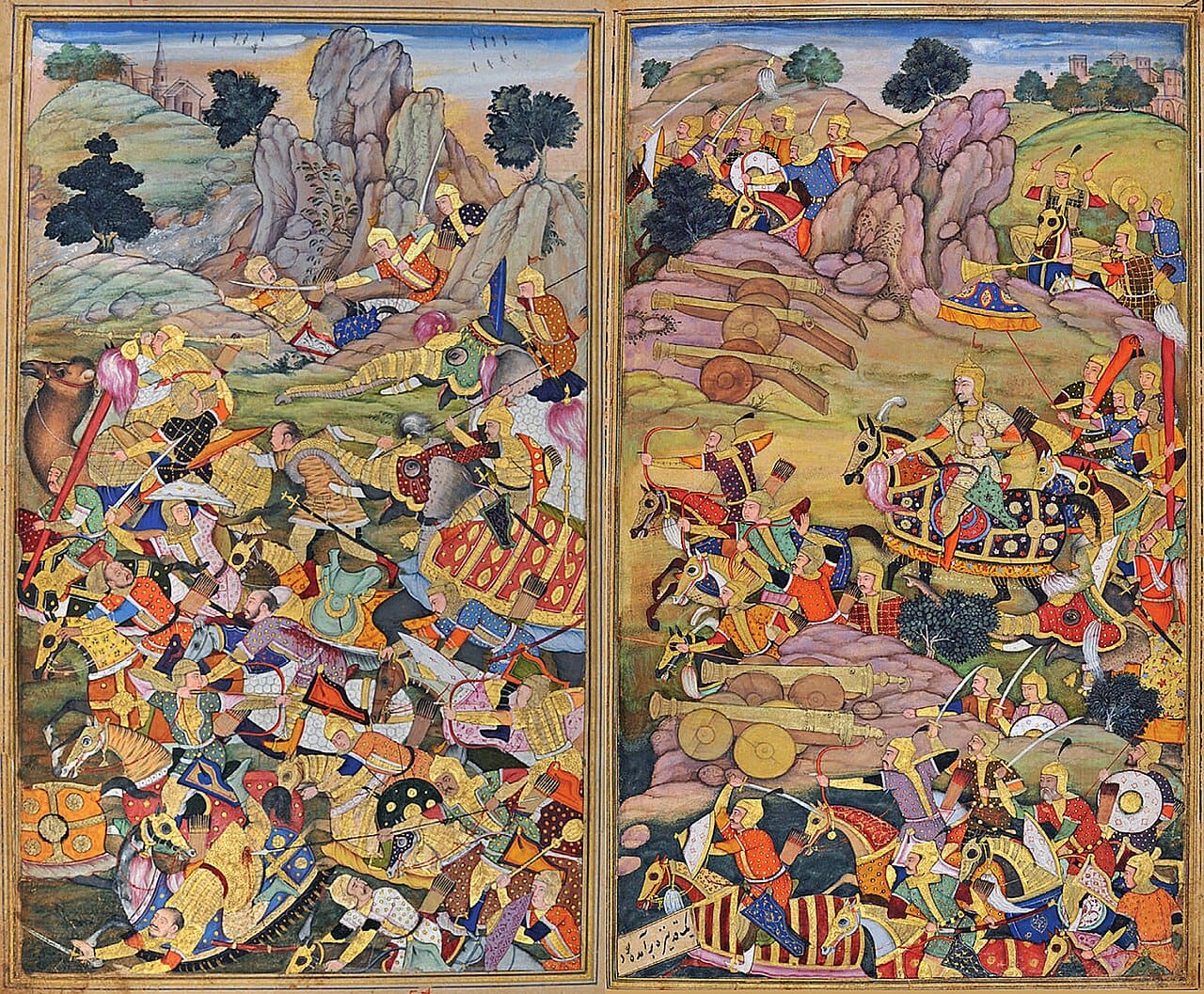
The two armies met at Panipat on 21 April 1526. Babur himself, in his memoir the Baburnama, put his force at around 12,000 and Ibrahim's at 100,000 with 1,000 elephants. Historians treat both numbers with caution, but agree he was heavily outnumbered, and that he prepared the ground carefully. He chained about 700 carts together across his front, leaving gaps for cavalry to charge through, and put his matchlockmen and guns behind them under his Ottoman-trained gunner Ustad Ali Quli. His flanks were anchored by the town of Panipat on one side and by ditches and felled trees on the other. When Ibrahim's army attacked into this narrow front, Babur's cavalry swept around both its sides in the Central Asian flanking manoeuvre known as tulughma and attacked from behind, while the guns and muskets fired into the crowded centre. The battle was over by midday. Ibrahim Lodi was killed in the fighting, the only Sultan of Delhi to die on the battlefield. Babur occupied Delhi and Agra within days, and the Mughal Empire is dated from that victory.
Historians argue about how much the guns mattered. Babur's artillery was slow to reload and probably did more to frighten Ibrahim's elephants than to kill soldiers, and many military historians give the cavalry manoeuvre at least as much credit. Either way, the battle ended three centuries of sultanate rule from Delhi.
1556: Hemu and the young Akbar
Thirty years later the Mughals had to win North India again. Babur's son Humayun had lost it to the Afghan ruler Sher Shah Suri in 1540 and regained Delhi only in 1555, a few months before he died in a fall down a library staircase. His heir, Akbar, was thirteen. The real power in the Mughal camp was his guardian and regent, Bairam Khan.
The challenge came from Hemu, a Hindu from a merchant background who had risen to command the armies of the Sur dynasty and had won a long run of battles for it. In October 1556 he took Delhi and is said to have crowned himself with the title Vikramaditya, the name of a legendary Indian king. Bairam Khan marched the Mughal army south to meet him.
The armies met at Panipat on 5 November 1556. The Mughals began with an advantage: their vanguard had already captured Hemu's artillery train, which had been moving with a light guard. Even so, Hemu's elephants and cavalry broke into both Mughal wings, and the battle seemed to be going his way until an arrow struck him in the eye. He collapsed in his howdah; his troops, unable to see their commander, lost heart and fled. Hemu was captured and brought before Akbar and Bairam Khan and killed. Accounts differ on who struck the blow; several Mughal chroniclers say Bairam Khan urged the young Akbar to do it, which some later writers dispute. With Hemu dead and Delhi retaken, Akbar's throne was secure, and under him the empire his grandfather had founded became a lasting state.
1761: the Marathas and Ahmad Shah Abdali
By the mid-eighteenth century the Mughal emperor was a figurehead, and the strongest power in India was the Maratha confederacy, whose armies had pushed north into Punjab. That brought them into conflict with Ahmad Shah Abdali, also known as Durrani, the founder of an Afghan kingdom that claimed Punjab and had invaded India several times already. In 1759 he invaded again.
The Peshwa in Pune sent a large army north under his cousin Sadashivrao Bhau, accompanied by the Peshwa's teenage son and heir, Vishwasrao. The army took Delhi in August 1760, but Abdali won over two important North Indian allies: Najib-ud-Daula, the Rohilla chief, and Shuja-ud-Daula, the Nawab of Awadh. The Marathas, by contrast, found few allies, partly because their raids and taxes had alienated many of the northern rulers whose support they now needed. In late 1760 Bhau entrenched his army at Panipat. Abdali camped opposite and cut the Maratha supply lines. For two months the two sides skirmished while food ran out in the Maratha camp, which held not only soldiers but tens of thousands of non-combatants, including pilgrims who had travelled north with the army.
On 14 January 1761, starving, the Marathas attacked. Their best weapon was a corps of infantry and artillery trained in the European style and commanded by Ibrahim Khan Gardi, which tore into the Afghan right early in the day. For several hours the battle was close. In the early afternoon Vishwasrao was killed, Bhau plunged into the fight and disappeared, and the Maratha line gave way. The pursuit and the killings that followed were horrific: tens of thousands of soldiers and camp followers died on the field or in the massacre of prisoners afterwards. Contemporary accounts and later historians give very different totals, but almost all put the dead well into the tens of thousands, making it one of the bloodiest battles of the eighteenth century anywhere.
After 1761
Abdali did not stay to rule. His soldiers, unpaid and far from home, wanted to go back to Afghanistan, and he left within months, placing no lasting government in Delhi. The Peshwa, Balaji Bajirao, died that June, his health reportedly broken by the news. The Marathas recovered faster than anyone expected: under the young Peshwa Madhavrao I they were back in the north within a decade and escorted the Mughal emperor Shah Alam II back to Delhi in 1772. But Panipat had cost them a generation of commanders, and the rivalries among the confederacy's great houses grew after it.
Historians have long debated what the third battle really changed. The older view, influenced by Jadunath Sarkar, saw it as the moment that ended any chance of an Indian power filling the space left by the Mughals and so cleared the way for the British, who had won at Plassey four years earlier. Others point out that the Maratha recovery was real and that the British victory owed more to the confederacy's internal divisions and the East India Company's growing finances than to a single defeat. Panipat today is a busy textile town. A memorial stands at Kala Amb, where much of the 1761 fighting is believed to have taken place, and the town's Panipat Museum covers all three battles.