The East India Company won Bengal in two battles fought seven years apart, and they were very different fights. At Plassey in June 1757, Robert Clive beat the Nawab of Bengal mostly because the nawab's own commander had agreed in advance not to fight. At Buxar in October 1764, Major Hector Munro beat the combined armies of Bengal, Awadh and the Mughal emperor in a long, hard battle. Plassey made the Company the power behind the throne in Bengal. Buxar, and the treaty that followed it in 1765, made the Company Bengal's government (NCERT, Our Pasts III, ch. 2, pp. 12–14[1]).
| Plassey | Buxar | |
|---|---|---|
| Date | 23 June 1757 | 22–23 October 1764 |
| Where | Palashi, on the Bhagirathi, about 150 km north of Calcutta | Buxar, on the Ganga in western Bihar |
| Company commander | Robert Clive | Major Hector Munro |
| Opponents | Siraj-ud-Daulah, Nawab of Bengal, with a few French gunners | Mir Qasim (deposed Nawab of Bengal), Shuja-ud-Daula (Nawab of Awadh) and the Mughal emperor Shah Alam II |
| Armies (estimates) | About 3,000 Company troops against about 50,000 | About 7,000 Company troops against about 40,000 |
| What decided it | Mir Jafar's troops stood aside; rain soaked the nawab's powder | Hours of infantry fighting; the allied armies broke and fled |
| Immediate result | Mir Jafar made nawab; Siraj-ud-Daulah killed | Mir Qasim a fugitive; Awadh and the emperor forced to terms |
| What the Company gained | Huge payments and land around Calcutta | The diwani of Bengal, Bihar and Orissa, granted in August 1765 |
Plassey, 1757: a battle settled before it began
The quarrel started with a new nawab. Siraj-ud-Daulah succeeded his grandfather Alivardi Khan in April 1756 and soon clashed with the Company, which was strengthening the fortifications of Calcutta without his permission and abusing its trade privileges. In June 1756 he took Calcutta. Some of the British captured there died overnight in a small cell in Fort William, the "Black Hole". One survivor, John Zephaniah Holwell, put the dead at 123, and historians now think his numbers were greatly exaggerated, but the story was used to justify what followed. A Company force under Clive and Admiral Charles Watson came up from Madras and retook Calcutta in January 1757 (Encyclopaedia Britannica, "Battle of Plassey"[3]).
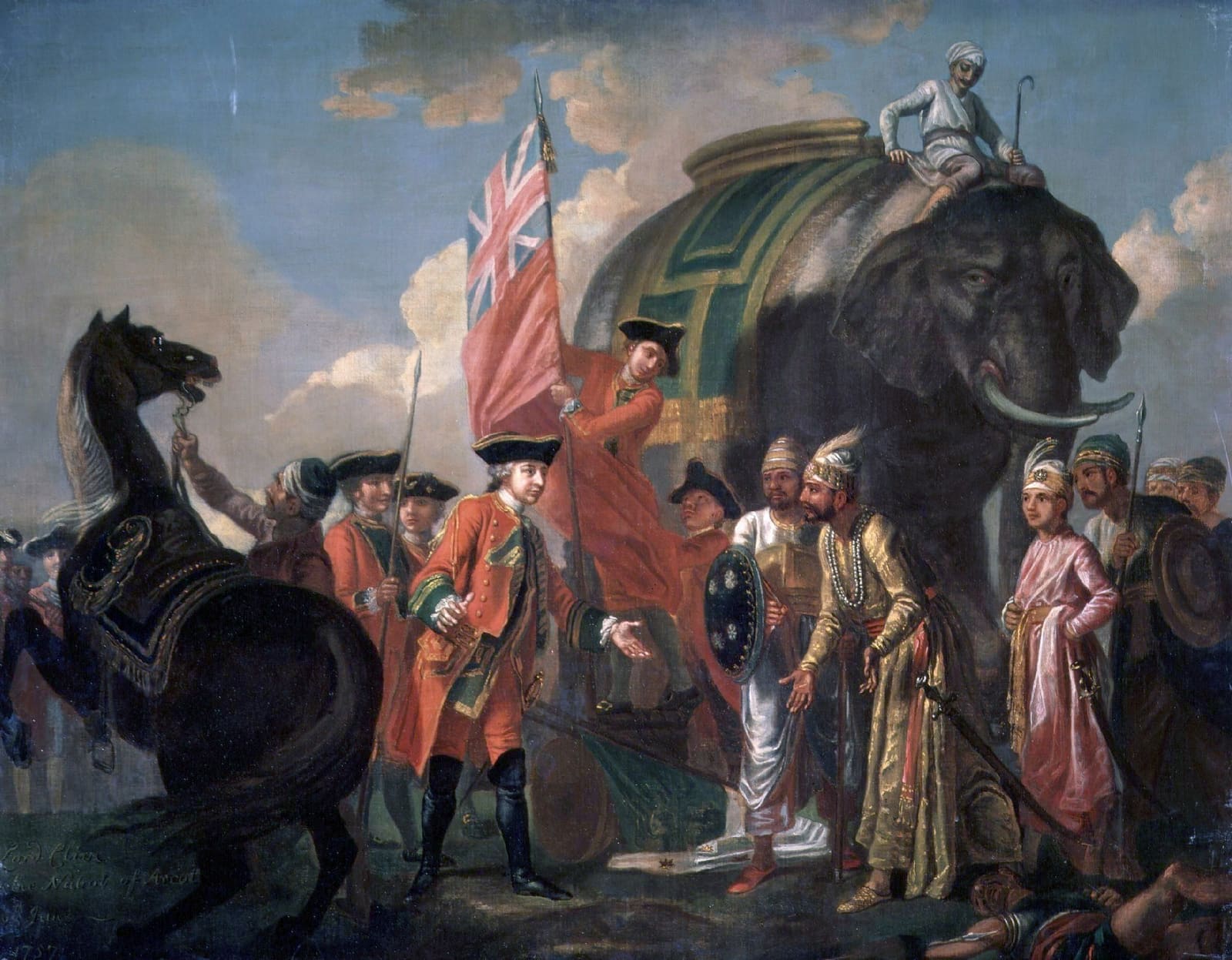
Clive then looked for a way to replace the nawab altogether. He found allies inside the nawab's court: Mir Jafar, the commander of the army; Rai Durlabh, another senior general; and the Jagat Seths, the great banking house of Bengal, who had their own reasons to want Siraj gone. Clive agreed that Mir Jafar would become nawab if he kept his troops out of the coming battle (NCERT, Our Pasts III, ch. 2, pp. 12–13[1]).
The armies met on 23 June 1757 near the village of Palashi, anglicised as Plassey, beside a mango grove on the Bhagirathi. Clive had about 3,000 men, roughly a third of them European, and the nawab perhaps 50,000. For most of the morning the two sides fired at each other with little effect. Around midday a heavy rainstorm soaked the nawab's gunpowder, while the British kept theirs under tarpaulins. When the nawab's loyal commander Mir Madan led a charge, assuming the British guns were also wet, he was cut down by grapeshot. Large parts of the nawab's army, under Mir Jafar and Rai Durlabh, never moved. By late afternoon Siraj-ud-Daulah had fled. Clive's losses were about 22 killed and 50 wounded (Encyclopaedia Britannica, "Battle of Plassey"[3]). Within two weeks Siraj had been caught and murdered on the orders of Mir Jafar's son, Miran.
Mir Jafar became nawab, and the Company collected its price: millions of rupees in payments to the Company and its officers, and the zamindari of the land south of Calcutta. In return Bengal got a ruler who depended on Company troops to stay in power (P. J. Marshall, Bengal: The British Bridgehead, p. 78[2]).
Between the battles: the nawab who fought back
The arrangement soon soured. Mir Jafar could not meet the Company's demands for money, and in 1760 the Company replaced him with his son-in-law, Mir Qasim, who paid for the post by granting it the revenues of Burdwan, Midnapore and Chittagong. Mir Qasim turned out to be a capable ruler with ideas of his own. He moved his capital from Murshidabad to Munger in Bihar, away from Calcutta, reorganised his revenue collection and built a new army.
What finally broke the arrangement was trade. The Company's dastak, a pass that let its goods move without paying duties, was being used by its officials for their own private trade inside Bengal, which undercut Indian merchants and cost the nawab revenue. In 1763 Mir Qasim abolished internal duties for all traders, removing the advantage. The Company treated this as hostile, and war followed (NCERT, Our Pasts III, ch. 2, p. 14[1]). Mir Qasim lost a series of battles in 1763, had dozens of British prisoners killed at Patna, and fled west to Awadh. The Company put the elderly Mir Jafar back on the throne.
Buxar, 1764: three armies in open battle
In Awadh, Mir Qasim found two allies. Shuja-ud-Daula, the Nawab of Awadh, ruled the richest province of north India and had fought on the winning side at the third battle of Panipat three years earlier. Shah Alam II, the Mughal emperor, was then living under Shuja's protection, unable to return to Delhi. Together they marched east to win back Bengal for Mir Qasim.
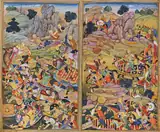
Munro met them at Buxar, on the south bank of the Ganga in western Bihar, on 22 October 1764. Shortly before, he had put down a mutiny among his own sepoys by having its leaders blown from cannon. His army of about 7,000 faced perhaps 40,000. This time nobody had made a deal in advance, and the infantry, artillery and cavalry fought for hours before the allied armies broke (Encyclopaedia Britannica, "Battle of Buxar"[4]). The Company's losses ran to more than 800 killed and wounded, far more than at Plassey. Shah Alam had taken little part in the fighting and opened talks with the British soon after. Shuja-ud-Daula fought on for some months before surrendering. Mir Qasim, unwelcome even to his allies, spent his last years as a fugitive and died poor near Delhi in 1777.
The settlement of 1765
Clive returned to Bengal as governor in 1765 and settled the war at Allahabad in August. Shah Alam granted the Company the diwani of Bengal, Bihar and Orissa, the right to collect their land revenue, in return for an annual payment of 26 lakh rupees and the districts of Kora and Allahabad. Shuja-ud-Daula got Awadh back, paid a war indemnity of 50 lakh rupees, and accepted Company troops for his defence at his own expense (P. J. Marshall, Bengal: The British Bridgehead, pp. 89–90[2]). In Bengal a nawab still sat on the throne, but he now looked after law and order while the Company took the money, a split that came to be called the dual system.
Which battle mattered more?
Plassey is the better-known date, the one usually given as the start of British rule in India. As a battle it was small, and a political bargain decided it, but it showed that a nawab of Bengal could be made and unmade from Calcutta (Marshall, Bengal: The British Bridgehead, p. 78[2]).
Many historians see Buxar as the more decisive of the two. It was won in a straight fight against the strongest powers of eastern and northern India, it turned Awadh into a dependent buffer state, and it brought the Mughal emperor himself into a deal that gave the Company's rule a legal basis. After Buxar no Indian ruler in the east could seriously challenge the Company (Marshall, Bengal: The British Bridgehead, p. 90[2]). Bengal's peasants paid for the diwani: within five years the famine of 1770 struck the province, and the Company went on collecting revenue through it. From here the story belongs to the East India Company as it turned from a trading company into a government.