For thirty-two years the most dangerous enemy the East India Company faced in southern India was the kingdom of Mysore. Its rulers, Haidar Ali and then his son Tipu Sultan, fought the Company four times between 1767 and 1799. Mysore fought it to a standstill in the first two wars, lost half its territory in the third, and in the fourth lost everything: on 4 May 1799 British troops stormed the island capital of Srirangapatna and Tipu was killed defending it (Encyclopaedia Britannica, "Mysore Wars"[4]). Each war began with grievances left over from the last, which is why the four are usually studied together.
Haidar Ali's Mysore
In the mid-eighteenth century Mysore was ruled, in name, by the Wodeyar dynasty. Real power passed to Haidar Ali, a cavalry officer of modest background who rose through the Mysore army and by 1761 had pushed the king's ministers aside, keeping the Wodeyar ruler on the throne as a figurehead. Haidar had watched French-trained troops fight in the Carnatic wars and he copied them, hiring French officers and building infantry and artillery drilled in the European style alongside the fast light cavalry that had always been the strength of Deccan armies. He governed from Srirangapatna, a fortress on an island in the Kaveri river a few miles from the town of Mysore, and expanded quickly, taking Bednur and the Malabar coast.
His timing was good: the Maratha confederacy, the strongest power on Mysore's northern border, was still recovering from its heavy defeat at Panipat in 1761. Still, a growing Mysore alarmed all its neighbours: the Marathas, the Nizam of Hyderabad, and the Company at Madras, together with its client the Nawab of Arcot. In all four wars the outcome turned partly on which of them sided with whom.
The first war (1767–1769)
The first war began when the Company and the Nizam agreed to attack Mysore together in 1767. Haidar briefly persuaded the Nizam to change sides, the combined Mysore and Hyderabad armies were beaten in the Carnatic, and the Nizam changed sides again. The war then dragged on until early 1769, when Haidar slipped past the Company's armies with a body of cavalry and appeared within a few miles of Madras itself. The alarmed Madras council agreed to the Treaty of Madras in April 1769: each side returned what it had captured, and each promised to help the other if it were attacked (Encyclopaedia Britannica, "Mysore Wars"[4]).
The second war (1780–1784)
That promise was tested in 1771, when the Marathas invaded Mysore and the Company did nothing, and Haidar held it against the Company afterwards. In 1779, with Britain and France at war again, the Company seized Mahé, a French port on the Malabar coast that Haidar regarded as under his protection. The Company was also fighting the Marathas at the time, and Haidar joined them and the Nizam in an alliance against it. In July 1780 he came down through the passes into the Carnatic with a large army and burned the countryside almost to the walls of Madras.
In September 1780, at Pollilur near Kanchipuram, Tipu cut off a Company column of nearly 4,000 men under Colonel William Baillie that was marching to join the main army. Haidar arrived with his main force, an ammunition cart exploded inside Baillie's square, and the column was destroyed. Baillie and the other survivors were marched to prison at Srirangapatna. It was the worst defeat the Company had yet suffered in India, and Tipu later had it painted across a wall of his summer palace (Mohibbul Hasan, History of Tipu Sultan[2]).
The Company recovered. The Governor-General, Warren Hastings, sent troops and money from Bengal under Sir Eyre Coote, who beat Haidar at Porto Novo in July 1781, and Hastings detached the Marathas from the alliance through the Treaty of Salbai in 1782. In December 1782 Haidar died in camp, and Tipu, then about 32, took over the war. He besieged and took Mangalore, and in March 1784 both sides signed the Treaty of Mangalore, which again returned all conquests and freed the prisoners.
Tipu's kingdom
Tipu used the years of peace to reorganise his state. He introduced a new calendar, new coins and new weights and measures, and tried to make trade serve the state: he stopped the export of sandalwood, pepper and cardamom through his ports and forbade local merchants to trade with the Company (NCERT, Our Pasts III, "From Trade to Territory"[1]). He brought in silk farming and kept modernising the army, whose best-known weapon was the rocket. Mysorean rockets had iron casings, which let them hold more powder and fly much further than earlier rockets, and they were fired in volleys at enemy infantry and cavalry. Tipu also looked abroad for allies against the Company, sending embassies to the Ottoman sultan at Constantinople and to France, where his envoys were received by Louis XVI at Versailles in 1788. They came home with gifts and no troops.
Closer to home, he fought the Marathas and the Nizam between 1785 and 1787. That war ended with Tipu making concessions, and it left both neighbours ready to join the Company the next time.
The third war (1790–1792)
That time came at the end of 1789, when Tipu attacked the defensive lines of Travancore, a small kingdom in the far south that was an ally of the Company. The Governor-General, Lord Cornwallis, formed a Triple Alliance with the Marathas and the Nizam and in 1791 took personal command. He captured Bangalore in March and reached Srirangapatna in May, but his supply train collapsed and he had to retreat. He came back in February 1792 with the allied armies, broke through the defences outside the fortress and laid siege to it.
Tipu made peace. Under the Treaty of Seringapatam, signed in March 1792, he gave up about half his kingdom, divided among the three allies, with the Company taking Malabar, Dindigul and the Baramahal district. He also agreed to pay a war indemnity of over three crore rupees, and handed over two of his young sons as hostages until it was paid (Encyclopaedia Britannica, "Mysore Wars"[4]). The boys were returned in 1794.
The fourth war (1799)
In 1798 Richard Wellesley arrived as Governor-General, determined to make the Company the paramount power in India. The news that Napoleon had invaded Egypt in 1798 gave him his reason. Tipu had been in contact with the French on the island of Mauritius, whose governor had publicly called for volunteers to serve him, and Wellesley presented this as proof that Tipu was preparing a French alliance against the Company. He first brought the Nizam into a subsidiary alliance, which placed Company troops in Hyderabad, then sent two armies into Mysore early in 1799, from Madras under General George Harris and from Bombay. Wellesley's younger brother Arthur, the future Duke of Wellington, commanded the Nizam's contingent.
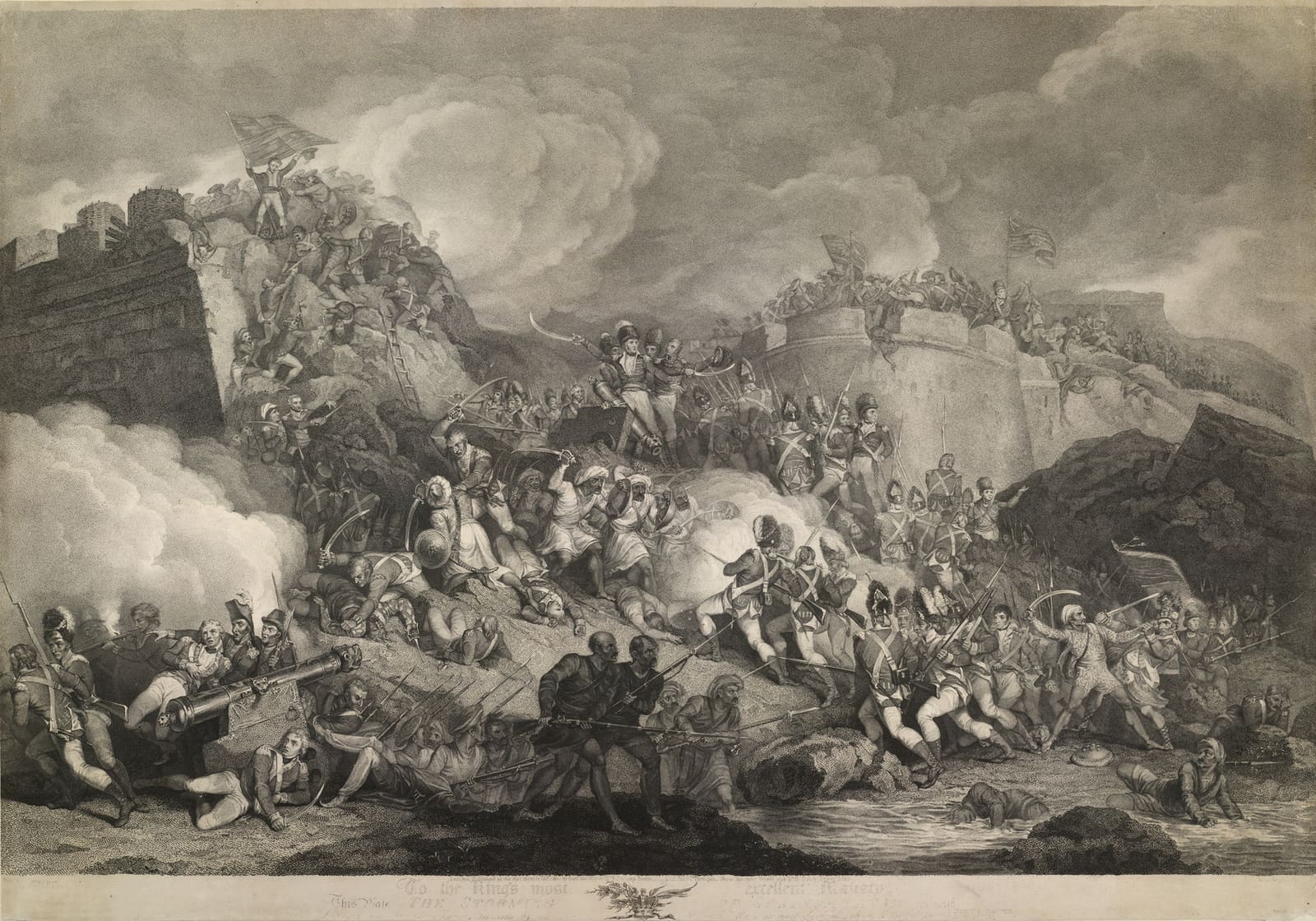
Tipu, outnumbered and with no allies left, fell back into Srirangapatna. The besiegers opened a breach in the north-western wall, and in the early afternoon of 4 May 1799 a storming party under Major-General David Baird waded across the Kaveri and climbed into the fort. It fell within hours. Tipu fought in the defence, and his body was found that evening under a heap of dead near one of the gateways. He was buried the next day beside his father in the mausoleum his family had built at Srirangapatna.
After 1799
The Company and the Nizam divided much of Mysore between them, and the Company took the coast and Coimbatore. What remained was handed back to the Wodeyar dynasty under Krishnaraja Wodeyar III, then five years old, bound to the Company by a subsidiary alliance and protected by a Company garrison. The palace was looted, and much of it went to Britain, including Tipu's Tiger, a near-life-size wooden automaton of a tiger attacking a European soldier, which growls and wails when a handle is turned. It is now in the Victoria and Albert Museum in London (V&A, "Tipu's Tiger"[5]). Captured rockets were also sent to Britain, and William Congreve's rockets, which the British army used from the early 1800s, drew on the Mysorean design.
With Mysore gone, the Marathas were the last Indian power able to stand against the East India Company on equal terms, and the Company broke them in a further series of wars that ended in 1818. Mysore itself survived as a princely state under the Wodeyars until it joined independent India in 1947.
How Tipu is remembered
Few figures from this period divide opinion in India as much as Tipu. For many, he is an early anti-colonial hero, the ruler who saw the Company as a threat to every Indian state and died fighting it rather than accept its terms. For others, especially in Kodagu (Coorg), coastal Karnataka and northern Kerala, he is remembered for campaigns in which thousands of Kodavas and Mangalorean Catholics were deported to Srirangapatna and many people in Malabar and Coorg were forcibly converted to Islam, episodes recorded in Tipu's own letters as well as in British and local accounts. Historians add two cautions. British writers after 1799 had good reason to portray him as a tyrant, since that justified the war. And, as Kate Brittlebank has argued, his actions make more sense in the terms of an eighteenth-century king trying to establish his legitimacy than in modern religious categories: the same ruler who punished communities he saw as rebels also gave grants to Hindu temples and paid for repairs to the Sringeri monastery after Maratha raiders plundered it in 1791 (Kate Brittlebank, Tipu Sultan's Search for Legitimacy[3]). The argument is still political: Karnataka's state celebration of his birthday, Tipu Jayanti, begun in 2015, drew protests every year and was dropped in 2019.