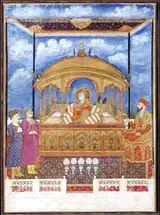
In the first half of the nineteenth century, as the East India Company absorbed one Indian state after another, a single kingdom in the northwest held its own. From his capital at Lahore, Maharaja Ranjit Singh ruled the Punjab, Multan, Kashmir and the frontier up to the Khyber Pass, with one of the strongest armies in Asia. He was a Sikh, but his ministers and generals included Hindus, Muslims and Europeans, and his kingdom was as much a Punjabi state as a Sikh one. He kept peace with the British for thirty years. Ten years after his death, the kingdom he built had been conquered and annexed (Khushwant Singh, A History of the Sikhs[1]).
Where did the Sikh Empire come from?
Sikhism began with Guru Nanak in the early sixteenth century and grew in Punjab under nine succeeding Gurus. In the seventeenth century, as relations with the Mughal state worsened, the community armed itself. The ninth Guru, Tegh Bahadur, was executed in Delhi in 1675 on Aurangzeb's orders, and his son, Guru Gobind Singh, founded the Khalsa, the order of initiated Sikhs, in 1699.
In the eighteenth century, as the Mughal Empire declined, Punjab was fought over by Mughal governors, Afghan invaders under Ahmad Shah Abdali and Sikh bands. The Sikhs organised themselves into a dozen or so misls, confederacies each led by a chief, which cooperated against the Afghans but competed with each other for land. By the 1780s the misls controlled most of central Punjab (J. S. Grewal, The Sikhs of the Punjab[2]).
How did Ranjit Singh build a kingdom?
Ranjit Singh was born in 1780 into the family that led the Sukerchakia misl, based at Gujranwala. Smallpox in childhood left him without the sight of one eye. He succeeded his father as chief when he was about twelve. On 7 July 1799, aged eighteen, he took Lahore, the old Mughal capital of Punjab, and on 12 April 1801, the festival of Baisakhi, he was proclaimed Maharaja of the Punjab. He issued coins in the name of the Sikh Gurus rather than his own, and called his government the Sarkar-i Khalsa, the state of the Khalsa (Khushwant Singh, A History of the Sikhs[1]).
Over the next three decades he absorbed or defeated the other misls and expanded in every direction. He took Amritsar in 1802, Multan in 1818 and Kashmir in 1819. In the northwest his armies fought the Afghans for the frontier, defeating them at Nowshera in 1823 and taking Peshawar under direct rule in 1834. In 1813 the exiled Afghan ruler Shah Shuja, who had taken refuge with him, gave up the Koh-i-Noor diamond, which Ranjit Singh wore on his arm (Encyclopaedia Britannica, "Ranjit Singh"[3]).
To the south and east lay the territories of the East India Company. In 1809, by the Treaty of Amritsar, Ranjit Singh agreed with the Company's envoy, Charles Metcalfe, that the Sutlej River would mark the limit of his expansion. He kept the agreement for the rest of his life, judging that he could not win a war with the British. In return, he was left free to build his empire to the north and west.
How did he rule?
Ranjit Singh's most famous creation was his army. From 1822 he employed European officers who had served under Napoleon, among them the Italian Jean-Baptiste Ventura and the Frenchman Jean-François Allard, to train an infantry and cavalry brigade in the European style, the Fauj-i-Khas. Later the Neapolitan Paolo Avitabile governed Peshawar, and the Frenchman Claude Auguste Court helped build up the artillery. Indian commanders such as Hari Singh Nalwa, who led many of the frontier campaigns and was killed at Jamrud near the Khyber Pass in 1837, became legends in Punjab (J. S. Grewal, The Sikhs of the Punjab[2]).
His court was mixed. His closest adviser and foreign minister was a Muslim, Fakir Azizuddin. The Dogra brothers from Jammu, Gulab Singh and Dhian Singh, rose to great power, Dhian Singh as chief minister. Hindu Brahmins and Khatris ran the revenue administration. Ranjit Singh did not force conversion, and he made grants to Hindu temples and Muslim shrines as well as gurdwaras. He paid for the upper storeys of the Harmandir Sahib at Amritsar to be covered with gilded copper, which gave it the name by which it is known around the world, the Golden Temple (Khushwant Singh, A History of the Sikhs[1]).
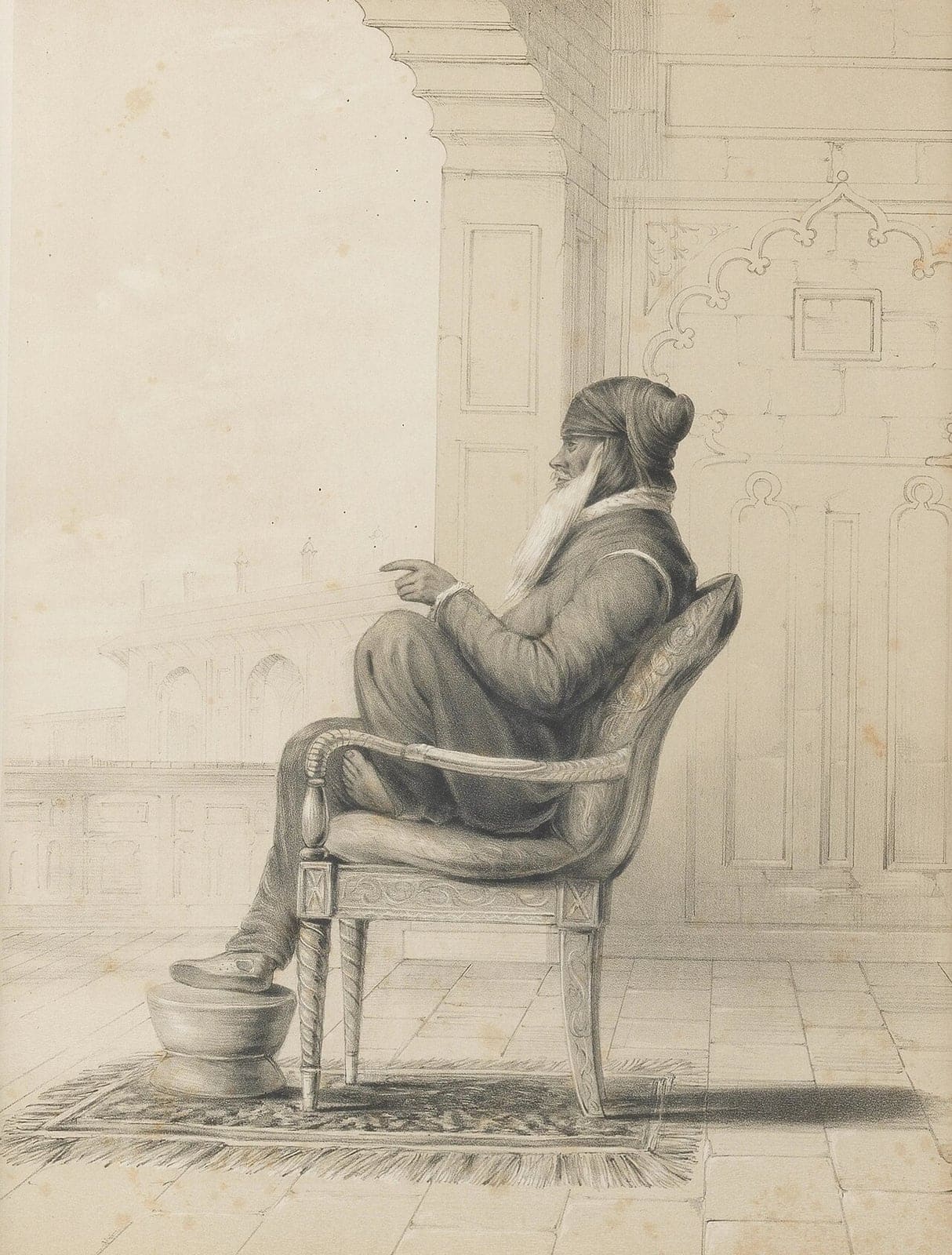
His rule was personal. He kept no formal council and made the important decisions himself. Visitors, including the British Governor-General Lord Auckland and his sister Emily Eden, who sketched him in 1838, found a small, plainly dressed man, curious about everything, who questioned them about European armies, politics and medicine.
Why did the Sikh Empire fall?
Ranjit Singh died on 27 June 1839. The kingdom depended on him, and without him it fell into chaos. His son Kharak Singh died in 1840, and his grandson Nau Nihal Singh was killed the same year when an archway collapsed on him after his father's funeral. Another son, Sher Singh, was assassinated in 1843. The throne passed to Ranjit Singh's youngest son, Duleep Singh, a child of five, with his mother Jind Kaur as regent. Factions at court, the Dogra ministers and an army that had become a political force in its own right fought for control (J. S. Grewal, The Sikhs of the Punjab[2]).
In December 1845 the Sikh army crossed the Sutlej, and the First Anglo-Sikh War began. After hard-fought battles at Mudki and Ferozeshah, the British won at Sobraon in February 1846. Some historians believe that leaders at the Lahore court, fearing their own army, did not try hard to win. Under the treaties that followed, Lahore lost territory and came under British supervision, and Kashmir was transferred to Gulab Singh, who founded the Dogra state of Jammu and Kashmir. A rising at Multan in 1848 led to the Second Anglo-Sikh War, with a bloody battle at Chillianwala and a final British victory at Gujrat in February 1849. On 29 March 1849 Lord Dalhousie annexed Punjab (Encyclopaedia Britannica, "Ranjit Singh"[3]).
What did the Sikh Empire leave behind?
The Koh-i-Noor was surrendered and sent to Queen Victoria. Duleep Singh was taken to England, where he became a Christian and a friend of the Queen, before returning to the Sikh faith late in his life. Punjab became a British province, and within a decade many of its soldiers were serving the British. In the revolt of 1857, Punjabi regiments helped the British retake Delhi, and Punjab became the main recruiting ground of the Indian Army.
The kingdom of Lahore lasted only half a century, but it is still remembered across Punjab, on both sides of today's border. It was the last major Indian state to fight the East India Company on equal terms. Like Mysore under Tipu Sultan, described in the Anglo-Mysore wars, it had a modern army built by one strong ruler, and it did not survive him for long (Khushwant Singh, A History of the Sikhs[1]).
Sikh Empire timeline
| Date | Event |
|---|---|
| 1699 | Guru Gobind Singh founds the Khalsa |
| c. 1765–1799 | The misls control most of central Punjab |
| 1780 | Ranjit Singh is born at Gujranwala |
| 7 July 1799 | Ranjit Singh takes Lahore |
| 12 April 1801 | He is proclaimed Maharaja of the Punjab |
| 1809 | Treaty of Amritsar fixes the Sutlej as the boundary with the British |
| 1813 | The Koh-i-Noor passes to Ranjit Singh |
| 1818–1819 | Conquest of Multan and Kashmir |
| 1822 | The Fauj-i-Khas is raised |
| 1834 | Peshawar comes under direct Sikh rule |
| 1837 | Hari Singh Nalwa is killed at Jamrud |
| 27 June 1839 | Ranjit Singh dies |
| 1845–1846 | First Anglo-Sikh War |
| 1848–1849 | Second Anglo-Sikh War |
| 29 March 1849 | The British annex Punjab |