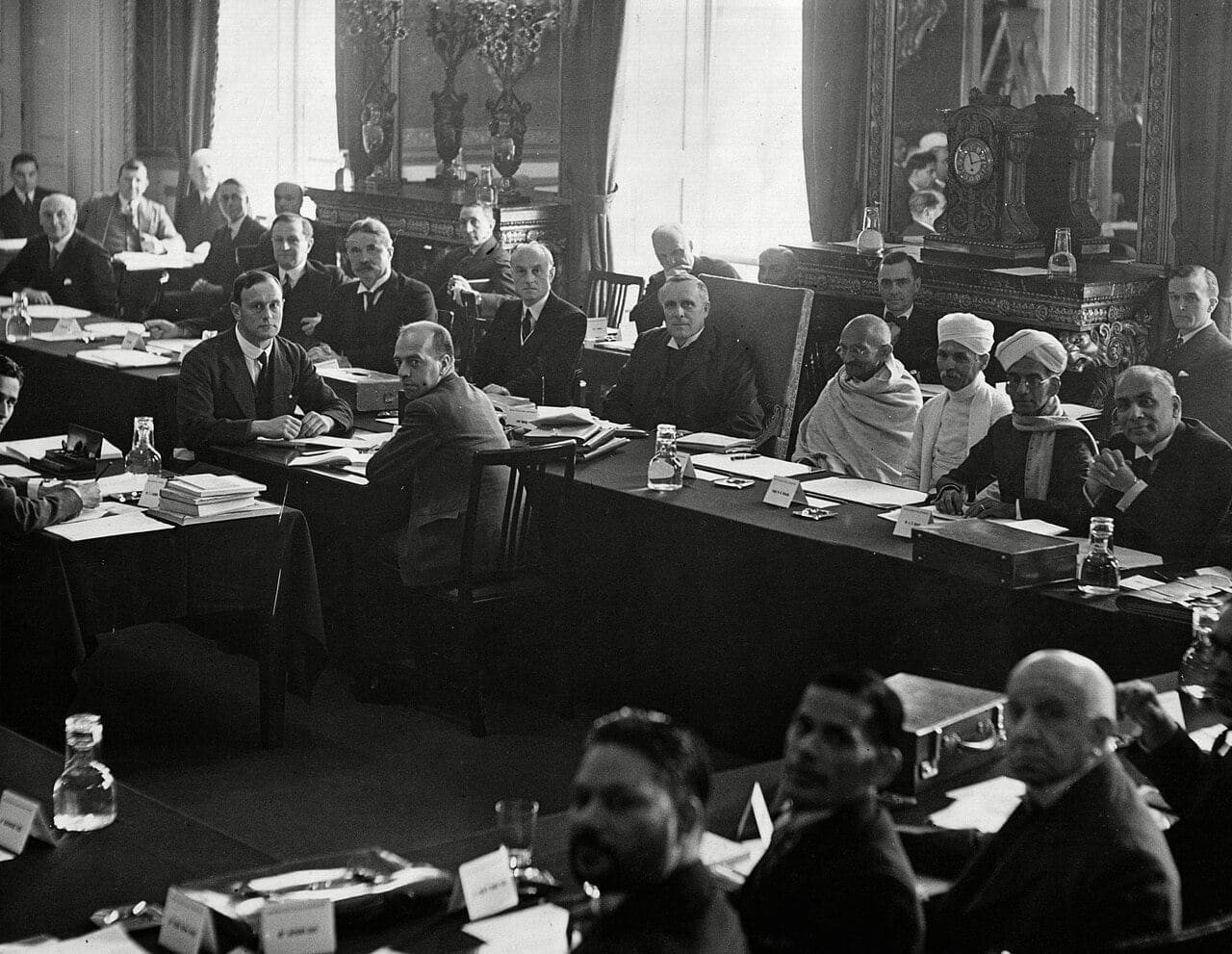
On 12 November 1930, King George V opened a conference in the Royal Gallery of the House of Lords to decide how India should be governed next. Nearly ninety delegates sat around a set of tables arranged to show that no one was at the head: British party leaders, Indian princes, Liberals, and representatives of Muslims, Sikhs, the Depressed Classes, Christians, Anglo-Indians, Europeans, landlords and business. The one organisation that could speak for most of nationalist India was missing. The Congress was leading the Civil Disobedience Movement, and tens of thousands of its members, including Gandhi, were in prison. Over the next two years, three Round Table Conferences tried to agree on a constitution. They never did, and the dispute they left behind ended in a Poona jail (Bipan Chandra et al., India's Struggle for Independence[4]).
What did the first conference achieve?
The Simon Commission's report of June 1930 had offered India very little, and the British Labour government of Ramsay MacDonald wanted a settlement that Indians would accept. At the first conference, the princes, led by the Maharaja of Bikaner, surprised the British by saying they would join an all-India federation with the provinces of British India. A federation in which the princes, who were loyal to Britain, would sit beside elected Indian politicians also appealed to the British as a way to limit the power of the Congress. When the conference closed in January 1931, MacDonald promised responsible government in the provinces and a federal government at the centre, with safeguards reserved to Britain (Judith M. Brown, Gandhi and Civil Disobedience[1]).
Mohamed Ali Jauhar, the leader of the Khilafat movement, did not live to see the conference close. Already gravely ill, he told the delegates that he would not return to a slave country and would rather die in a free foreign one. He died in London on 4 January 1931 and was buried in Jerusalem.
How did Gandhi come to London?
Without the Congress, nothing settled in London could work in India. The government released Gandhi and the Congress leaders in January 1931, and on 5 March Gandhi and the Viceroy, Lord Irwin, signed the Gandhi–Irwin Pact. Civil disobedience was suspended, and the Congress agreed to attend the next conference. It sent Gandhi as its only representative. He sailed in August 1931 and reached London in September (Judith M. Brown, Gandhi and Civil Disobedience[1]).
Gandhi spent three months in Britain, staying at Kingsley Hall, a settlement house in the poor East End of London, and walking the streets in his dhoti and shawl. In the cotton towns of Lancashire, where the Indian boycott of foreign cloth had cost many workers their jobs, the mill hands welcomed him warmly. At Buckingham Palace he took tea with King George V. Asked afterwards whether he had worn enough for the occasion, he is said to have replied that the King had enough on for both of them. Crowds followed him, and newspapers reported his every move.
At the conference itself he had little success. Gandhi claimed that the Congress represented all of India, including the minorities and the untouchables. The other delegates did not accept this. In the Minorities Committee, Muslim leaders demanded separate electorates and seat shares at least as good as the Lucknow Pact had given them, and the Sikhs, Christians, Anglo-Indians and Europeans pressed their own claims. B. R. Ambedkar asked for separate electorates for the Depressed Classes, the castes treated as untouchable. Gandhi accepted that Muslims and Sikhs had historical claims, but he refused to accept that untouchables were a separate community from Hindus, and told the committee on 13 November 1931 that he would resist separate electorates for them with his life. The Muslim, Depressed Classes, Indian Christian, Anglo-Indian and European delegates then signed a joint "Minorities Pact" without him; the Sikhs stayed out of it (Indian Round Table Conference, Second Session: Proceedings[2]).
The political ground in Britain had shifted too. In August 1931 MacDonald's Labour government had collapsed, and the National Government that replaced it, elected in October, depended on Conservatives who were cold to Indian demands. The conference closed on 1 December with MacDonald saying that if Indians could not agree on the representation of minorities, his government would decide for them. Gandhi returned to India at the end of December. The new Viceroy, Lord Willingdon, refused to meet him, civil disobedience resumed, and on 4 January 1932 Gandhi was arrested.
What were the Communal Award and the Poona Pact?
On 16 August 1932, MacDonald announced the Communal Award. Muslims, Sikhs, Indian Christians, Anglo-Indians and Europeans would each elect their own representatives in separate electorates. The Depressed Classes would have separate electorates for 71 seats and would also vote in the general constituencies, a double vote, for twenty years.
From Yerwada jail in Poona, Gandhi announced that he would fast unto death unless separate electorates for the Depressed Classes were withdrawn. He began on 20 September. As his health failed, pressure on Ambedkar was enormous, since he would be blamed if Gandhi died. After days of negotiation, Ambedkar and the caste Hindu leaders, among them Madan Mohan Malaviya, signed the Poona Pact on 24 September. Separate electorates for the Depressed Classes were dropped. Instead 148 seats in the provincial legislatures, about twice as many as under the Award, and 18 per cent of the general seats in the central legislature were reserved for them, to be filled through joint electorates after a primary election among Depressed Class voters. Britain accepted the change, and Gandhi ended his fast on 26 September (Bipan Chandra et al., India's Struggle for Independence[4]).
The pact is remembered in very different ways. For Gandhi and the Congress, it kept the Depressed Classes within Hindu society and set off a campaign against untouchability: Gandhi founded an anti-untouchability league in 1932, soon renamed the Harijan Sevak Sangh, and a weekly called Harijan in 1933. For Ambedkar, the fast was coercion. He signed to save Gandhi's life and argued that the joint electorates meant that the reserved seats would be filled by candidates acceptable to caste Hindu voters. In 1945 he wrote that "there was nothing noble in the fast" (B. R. Ambedkar, What Congress and Gandhi Have Done to the Untouchables[3]). Reserved seats in joint electorates, the principle agreed at Poona, were later written into the Constitution of India, which Ambedkar did more than anyone to draft.
What came out of the conferences?
The third conference, from November to December 1932, was a small affair of 46 delegates, without the Congress or the British Labour Party. The government then published its own proposals in a White Paper in 1933, and Parliament passed the Government of India Act in August 1935. It gave the provinces elected governments with real power and planned a federation with the princely states. The provincial part came into force, and the Congress won the elections of 1937 in most provinces. The federation never came into being, because too few princes agreed to join before the Second World War began (Judith M. Brown, Gandhi and Civil Disobedience[1]).
Round Table Conferences timeline
| Date | Event |
|---|---|
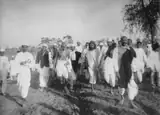
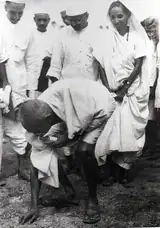
| March–April 1930 | Gandhi's Salt March begins civil disobedience |
| 12 November 1930 | First Round Table Conference opens in London |
| 4 January 1931 | Mohamed Ali Jauhar dies in London |
| 19 January 1931 | First conference closes |
| 5 March 1931 | Gandhi–Irwin Pact |
| 7 September 1931 | Second conference opens; Gandhi attends |
| 1 December 1931 | Second conference closes without agreement on minorities |
| 4 January 1932 | Gandhi arrested; civil disobedience resumes |
| 16 August 1932 | Communal Award announced |
| 20 September 1932 | Gandhi begins his fast in Yerwada jail |
| 24 September 1932 | Poona Pact signed |
| 17 November–24 December 1932 | Third conference |
| August 1935 | Government of India Act passed |