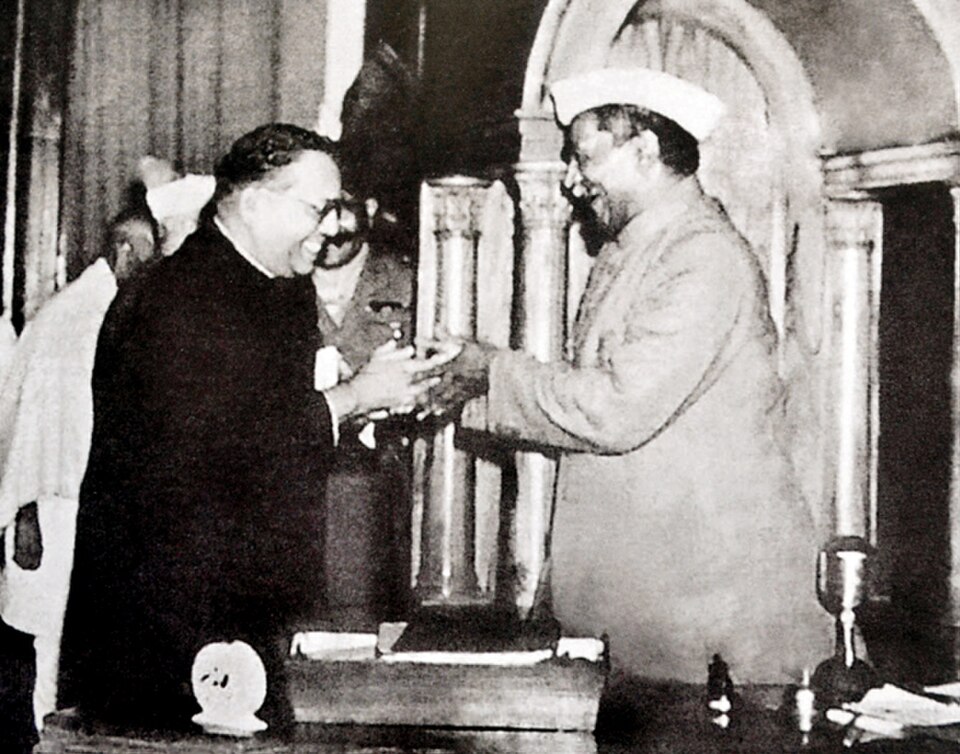
On 26 November 1949, after nearly three years of deliberation, the Constituent Assembly of India adopted the constitution that would govern the new republic. The Assembly had first met on 9 December 1946 in Delhi, formed under a scheme set out by the British Cabinet Mission earlier that year, and elected Rajendra Prasad as its President. It began with 389 members — 292 elected indirectly by the provincial legislatures of British India, 93 nominated by the princely states, and 4 from the chief commissioners' provinces — a number that fell to 299 after Partition removed the members representing territory that became Pakistan. Until India's first general election in 1951-52, this same body doubled as the country's provisional Parliament, meaning the men and women writing the constitution were simultaneously governing the country under it in draft form.
Building a draft from many sources
The Assembly's constitutional advisor, B. N. Rau, spent months studying the constitutions of dozens of other countries and prepared an initial working draft during 1947. On 29 August 1947, the Assembly appointed a seven-member Drafting Committee, chaired by Dr. B. R. Ambedkar, to turn Rau's draft and the Assembly's prior decisions into a finished text. The Committee published its draft in February 1948 and opened it to public comment for roughly eight months before Ambedkar formally introduced it to the Assembly on 4 November 1948; the ensuing clause-by-clause debate, among the most extensive in the Assembly's life, continued until 17 October 1949. The finished document drew on a wide range of models: its federal structure, provisions for emergency powers, and framework of all-India administrative services owed much to the Government of India Act, 1935; its Fundamental Rights echoed the American Bill of Rights; its Directive Principles of State Policy were adapted from Ireland's constitution; and its parliamentary system of government followed the British model. The result, originally 395 Articles across 22 Parts and 8 Schedules, was and remains the longest written constitution of any sovereign country in the world.

Ambedkar's role, and a more complicated legacy than it first appears
Ambedkar, who had spent decades campaigning against caste discrimination before independence, served simultaneously as India's law minister and as chairman of the Drafting Committee, and it fell to him to steer the document through the Assembly's debates and defend the many compromises it embodied. On 25 November 1949, the day before the constitution's adoption, he gave a closing address that is still widely quoted: "On the 26th of January 1950, we are going to enter into a life of contradictions. In politics we will have equality and in social and economic life we will have inequalities," he warned, urging the country to make its political democracy a social democracy as well or risk the whole structure being "blown up" by those left behind by it.
Yet Ambedkar's own relationship with the finished constitution was more complicated than a single celebratory account suggests. He had pressed, not always successfully, for stronger central authority to force social reform, and the final text reflected negotiation among hundreds of members representing competing regional, religious, and princely-state interests rather than any one person's design. In a Rajya Sabha debate in September 1953, responding to being called the constitution's maker, Ambedkar said plainly: "My answer is I was a hack. What I was asked to do, I did much against my will." Historians treat that remark as a reminder that the constitution's drafting was a genuinely collective and often contentious process — Ambedkar's stewardship of it remains central to how the document is remembered, but he did not regard it as a perfect embodiment of his own views.
Adoption, signing, and the choice of 26 January
Once adopted on 26 November 1949 — a date India now marks annually as Constitution Day, or Samvidhan Divas — the constitution was set down in a hand-written, calligraphed form, and 284 members present signed it on 24 January 1950. It came into force two days later, on 26 January 1950, and that date was not arbitrary: it was the anniversary of the Purna Swaraj, or complete independence, resolution that the Indian National Congress had adopted on 26 January 1930, a date the nationalist movement had then marked annually as an unofficial Independence Day for the better part of two decades. Fixing the republic's birth to that same date tied the finished constitution to two decades of prior political struggle, rather than treating it as a wholly fresh start.