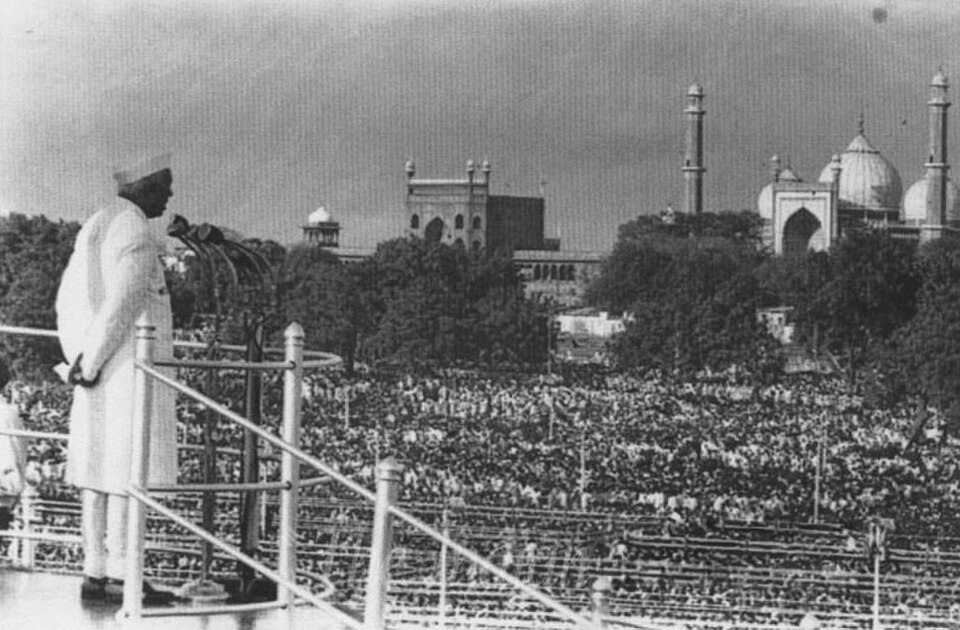
At midnight between 14 and 15 August 1947, British rule over the Indian subcontinent came to an end. Jawaharlal Nehru, addressing the Constituent Assembly sitting as India's first Parliament, marked the moment with a speech recalling that at the stroke of the midnight hour, while the world slept, India would awake to life and freedom — a line from his "tryst with destiny" address that is still widely quoted. Independence did not arrive as a single, unified transfer of power: it arrived as two, since the same set of negotiations also created the new state of Pakistan, formally inaugurated a day earlier, on 14 August, with Muhammad Ali Jinnah sworn in as its first Governor-General in Karachi.
The path to that midnight ran through more than a year of failed negotiation. A British Cabinet Mission had proposed in 1946 a loose federal structure meant to hold a single, undivided India together; when the Indian National Congress and the Muslim League could not agree on its terms, the Muslim League called for "Direct Action Day" on 16 August 1946 to press its demand for a separate Muslim-majority state, and the day set off large-scale communal killing in Calcutta that spread to other regions over the following months. By early 1947, with communal violence rising and the British government under Prime Minister Clement Attlee eager to end an increasingly costly and difficult occupation, Lord Mountbatten arrived as the last Viceroy with instructions to arrange a rapid transfer of power. His plan, announced on 3 June 1947, accepted partition as the price of a fast withdrawal and moved the transfer date forward by nearly a year, to mid-August 1947.
A border drawn in five weeks
The task of actually drawing the new border fell to a Boundary Commission chaired by Sir Cyril Radcliffe, a British lawyer who had never previously visited India and was given only about five weeks to divide the provinces of Punjab and Bengal — the two regions with the most religiously mixed populations — between the new dominions. The line he produced, now known as the Radcliffe Line, was not published until 17 August 1947, two days after both India and Pakistan had already become independent, so the new governments took charge of territory before either the officials administering it or the millions of people living along it knew for certain which country they now belonged to.
Migration, violence, and a death toll still argued over
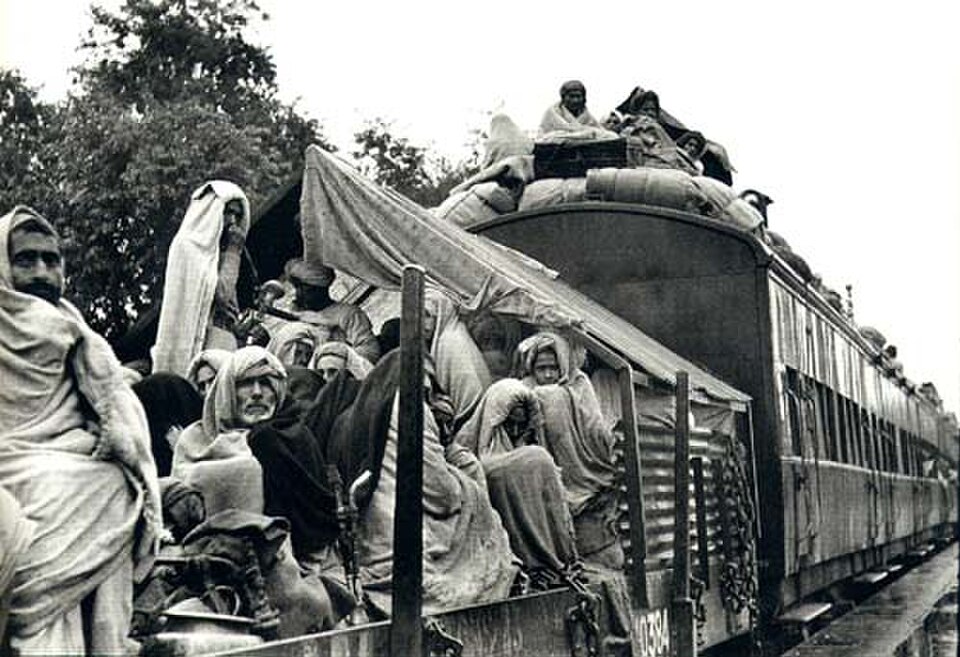
What followed was one of the largest forced migrations in recorded history. Estimates of how many people crossed the new border in both directions, mostly across Punjab and Bengal, generally range from 12 to 20 million. Trains, bullock carts, and long columns of people on foot carried Hindus and Sikhs toward India and Muslims toward Pakistan, and convoys on both sides came under attack from armed mobs; entire trainloads of refugees sometimes arrived at their destination full of dead. Women were abducted and assaulted in large numbers on both sides of the new border, and organized recovery operations by both governments continued for years afterward.
The number of people killed in this violence is one of the genuinely unresolved questions in modern Indian history. Contemporary British and Indian officials, working with incomplete records amid mass chaos, produced estimates as low as roughly 200,000; many standard accounts have long cited a figure in the range of 500,000 to 1 million. More recent demographic reconstructions by economic historians, working backward from census and migration data, have argued for substantially higher totals — in the range of two to three million deaths from violence, disease, and the exposure of displacement combined. Historians have not converged on a single number, largely because so much of the killing happened outside any official record-keeping, and because studies differ on how to separate deaths from direct violence from deaths caused by the disease and starvation that swept through overcrowded refugee camps. What is not disputed is that the scale of death and displacement was enormous, and that responsibility for it is itself debated: historians continue to weigh how much blame belongs to the haste of the British withdrawal and the boundary-drawing process, how much to the political failure of the Congress and the Muslim League to agree on a shared framework, and how much to the communal mobilization that had been building for years before 1947.
Independence as a beginning, not a resolution
For the new Indian state, independence on 15 August 1947 opened rather than closed a set of enormous tasks: resettling millions of refugees, integrating the roughly 565 princely states that had not been directly ruled by Britain, and writing a constitution for a country that had just been carved in two under violent and hurried circumstances. Those tasks — taken up almost immediately by the same generation of leaders who had negotiated independence — would define India's first years as a sovereign nation.