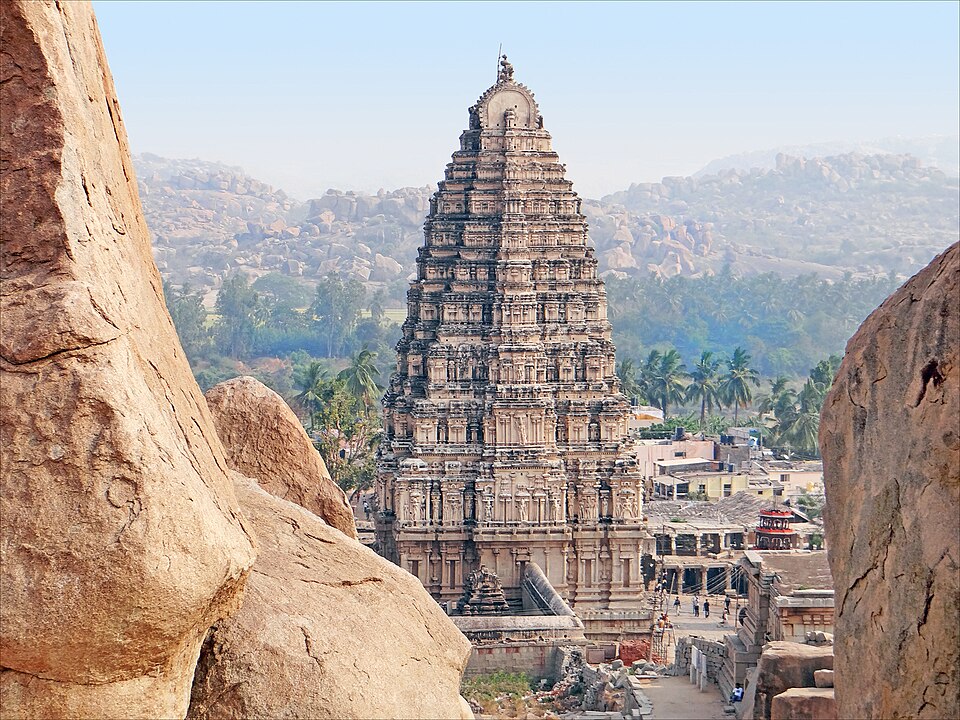
In 1336, two brothers, Harihara and Bukka, founded a new kingdom on the southern bank of the Tungabhadra river in what is now Karnataka, naming its capital Vijayanagara ("city of victory"). Their exact origins are debated: one account describes them as Kannadiga commanders who had served the Hoysala kingdom, while another holds that they were Telugu officials of the Kakatiya kingdom taken into Delhi Sultanate service after Muhammad bin Tughlaq's conquest of Warangal, and later established themselves independently in the south. Tradition credits the sage Vidyaranya with encouraging the brothers to found a Hindu kingdom capable of resisting the Sultanate's expansion into the peninsula, though historians note that the evidence for Vidyaranya's precise role comes from later tradition rather than contemporary record. What is not in dispute is the scale of what followed: over the next two centuries, four successive dynasties — Sangama, Saluva, Tuluva, and Aravidu — ruled an empire that, at its height, controlled most of peninsular India south of the Krishna river.
A capital that impressed foreign visitors
Vijayanagara's capital, whose ruins surround the present-day village of Hampi, grew into one of the largest cities in the world during the fifteenth and sixteenth centuries, with population estimates from visiting travelers and modern historians ranging roughly from 300,000 to half a million people. Portuguese travelers who visited the city, including Domingo Paes around 1520, left detailed written accounts: Paes compared the city favorably to Rome and described its king, at the time Krishnadevaraya, as one of the most powerful rulers he had encountered in India. These foreign accounts, alongside Persian and other Indian sources, are valuable precisely because Vijayanagara's own inscriptions tend toward formal royal titles and religious donations rather than descriptive detail, so historians read the traveler accounts and the inscriptional record together, aware that each has its own biases and gaps.
Krishnadevaraya and imperial administration
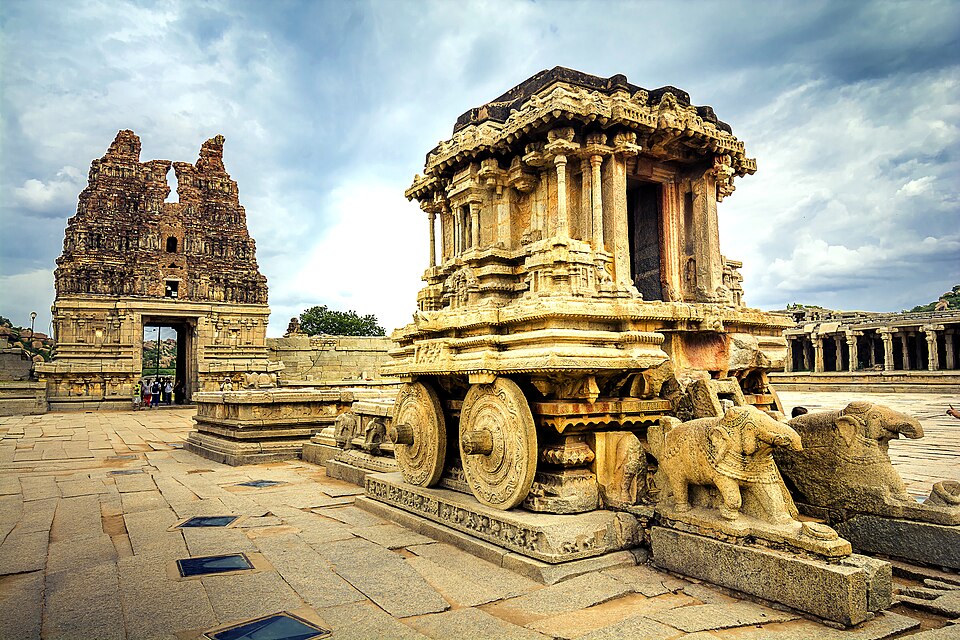
The empire reached its peak under Krishnadevaraya (reigned 1509-1529) of the Tuluva dynasty, who extended Vijayanagara's territory at the expense of the Deccan sultanates to the north, capturing the fortress of Raichur in 1520, and who is remembered as both a capable military commander and a patron of Telugu and Sanskrit literature. Day-to-day administration across the empire's provinces rested heavily on the nayaka system, under which military governors called nayakas held authority over defined territories in exchange for maintaining troops and remitting revenue to the center — a structure that gave the empire flexibility and military reach but also meant central control depended significantly on the loyalty of powerful regional commanders, a dependency that would matter at the empire's end. Vijayanagara's economy rested on extensive trade: cotton and silk textiles moved outward, spices from the Malabar coast and diamonds from Golconda moved through its markets, and horses — essential for its cavalry — were imported from Arabia and Persia via the west coast ports.
A Hindu kingdom in conversation with Islamicate culture
Vijayanagara's rulers styled themselves protectors of Hindu institutions, temples, and Brahmins, and popular history has often cast the empire simply as a Hindu bulwark against the neighboring Deccan sultanates. The reality, as more recent scholarship has emphasized, was more layered. Vijayanagara kings adopted the Sanskrit-Persian hybrid title "Hindu-raya suratrana," whose meaning is itself debated — some historians, notably Phillip Wagoner, read it as "sultan among Hindu kings," evidence of rulers consciously adopting Persianate and Islamicate court dress, titles, and architectural forms (including the distinctive Lotus Mahal, which borrows Indo-Islamic arches) as marks of imperial authority recognizable across the wider Deccan political world; others read the phrase more narrowly, as "protector of the gods of the Hindu kings," with less deliberate cultural borrowing implied. Krishnadevaraya himself is recorded as employing both Hindu and Muslim soldiers in his armies. None of this contradicts the empire's genuine and extensive patronage of Hindu temple building, including major additions to the Virupaksha and Vitthala temple complexes at its capital — but it complicates any simple narrative that casts sixteenth-century Deccan politics as a straightforward religious binary.
The Battle of Talikota and after
By the mid-sixteenth century, Vijayanagara's effective ruler was Rama Raya, a powerful regent of the Aravidu line who dominated the weaker Tuluva successors and pursued an aggressive, opportunistic policy of shifting alliances among the neighboring Deccan sultanates of Bijapur, Ahmadnagar, Golconda, and Bidar. In January 1565, those sultanates set aside their rivalries and combined against him at the Battle of Talikota (also called Rakkasagi-Tangadagi). Rama Raya was captured and beheaded during the battle, and the sudden loss of its commander threw the large Vijayanagara army into disarray; some accounts also describe key mercenary contingents switching sides at a decisive moment, though the precise sequence of the battle is reconstructed mainly from later and sometimes conflicting narrative sources. The victorious sultanate armies occupied and thoroughly plundered the capital over the following months, leaving it in the ruined state still visible at Hampi today. The Vijayanagara state itself survived for another century under the Aravidu dynasty, ruling from successively smaller capitals further south, but it never recovered its former scale, and by the mid-seventeenth century its remaining territories had fragmented among former nayaka governors and rising regional powers.