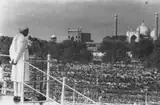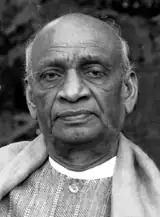
On 20 February 1947, the British Prime Minister, Clement Attlee, told the House of Commons that Britain would hand over power in India to "responsible Indian hands" by a date not later than June 1948. If the Indian parties had not agreed on a constitution by then, Britain would decide for itself to whom power should be given. The same day Attlee announced that the Viceroy, Lord Wavell, would be replaced by Lord Louis Mountbatten. Within six months Mountbatten had moved the date forward by ten months, and on 14 and 15 August 1947 power passed to two new states, Pakistan and India. The Partition that came with independence was agreed by a handful of leaders and officials, then worked out in provincial votes, an Act of Parliament and the division of everything from the army to the office furniture (V. P. Menon, The Transfer of Power in India[1]).
Why did Britain set a deadline?
By early 1947 Britain could no longer govern India against the will of Indians. The war had left it deeply in debt, the Labour government elected in 1945 was committed to Indian independence, and the INA trials and the naval mutiny had shown that the Indian army and police could not be relied on to put down a mass movement. The Cabinet Mission plan of 1946 for a united India had collapsed, and Direct Action Day had begun a wave of communal killing. The Congress and the Muslim League sat together in an Interim Government but could barely work with each other.
Wavell had proposed a "breakdown plan" for a phased British withdrawal province by province, which London rejected as defeatist. A fixed date, Attlee's government believed, would force the Indian parties to agree. Mountbatten, a relative of the King and the wartime Allied commander in South-East Asia, insisted on wide powers before accepting the job. He was sworn in as Viceroy in New Delhi on 24 March 1947 (Yasmin Khan, The Great Partition[4]).
How did the plan for Partition take shape?
Mountbatten spent his first weeks in interviews with Indian leaders. Jinnah would accept nothing less than Pakistan. The Congress, which had argued for a united India, had already accepted in March 1947 that if Pakistan came, the Punjab must be divided, and Nehru and Vallabhbhai Patel were increasingly ready to accept a smaller Pakistan to get a strong central government for the rest of India.
Mountbatten's first plan, known in his staff as Plan Balkan, would have handed power to the provinces, which could then decide whether to join together, with Bengal and the Punjab given the choice to divide. In May, at Simla, Mountbatten showed it privately to Nehru, who rejected it furiously as a plan that would break India into pieces. V. P. Menon, the Reforms Commissioner and the most senior Indian in the constitutional office, then put forward a plan he had already discussed with Patel: power would go quickly to two central governments, India and Pakistan, as dominions within the Commonwealth, so that no new constitutions were needed first. Mountbatten flew to London and won the British cabinet's approval (V. P. Menon, The Transfer of Power in India[1]).
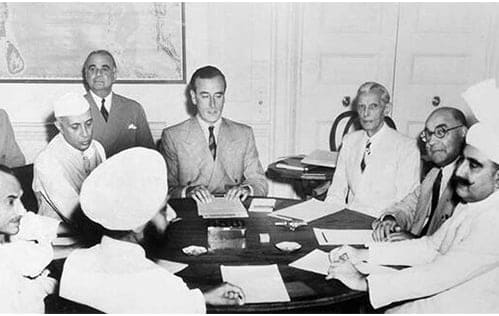
On 2 June Mountbatten put the plan to seven Indian leaders, among them Nehru, Patel, Jinnah, Liaquat Ali Khan and the Sikh leader Baldev Singh. On the evening of 3 June he announced it on All India Radio, followed by Nehru, Jinnah and Baldev Singh. The next day, at a press conference, he said that power would be transferred around 15 August, barely ten weeks away. He later explained that he chose the date because it was the second anniversary of Japan's surrender to the Allies in 1945.
What had to be decided before 15 August?
Under the plan, the members of the Bengal and Punjab legislative assemblies voted in June, sitting in sections for the Muslim-majority and Hindu-majority districts, and chose partition. The Sind assembly voted to join Pakistan. In July a referendum in the North-West Frontier Province, boycotted by the Congress and Abdul Ghaffar Khan's Khudai Khidmatgars, chose Pakistan, and a referendum in the Sylhet district of Assam chose to join East Bengal (Yasmin Khan, The Great Partition[4]).
The British Parliament passed the Indian Independence Act in a few weeks. It received royal assent on 18 July 1947. From 15 August there would be two dominions, India and Pakistan, each with its own Governor-General and its Constituent Assembly as its parliament, and British authority over the princely states would lapse (Indian Independence Act 1947[2]). Jinnah decided to become Pakistan's Governor-General himself, so Mountbatten, who had hoped to serve both countries, stayed on as Governor-General of India.
Everything the government of British India owned had to be divided. A Partition Council chaired by Mountbatten and committees of Indian and Pakistani officials shared out the armed forces, the railways, the civil servants, the treasury, the public debt and even office furniture and library books. Pakistan was allotted 17.5 per cent of the assets and took on the same share of the debt, and the army was divided roughly two to one. Officials and soldiers chose which country to serve. Meanwhile the new States Department, run by Patel and Menon, persuaded almost all of the more than five hundred princely states to sign instruments of accession to India before 15 August, the beginning of the integration of the princely states (V. P. Menon, The Transfer of Power in India[1]).
The new borders were drawn by two Boundary Commissions, for Bengal and the Punjab, each with two judges nominated by the Congress and two by the League, chaired by Sir Cyril Radcliffe, a London lawyer who had never been to India. He arrived on 8 July. The judges divided along party lines, so Radcliffe decided almost everything himself, with old maps and census figures, in about five weeks. His awards were ready by 12 August, but Mountbatten held them back until after the independence celebrations, and they were published on 17 August.
Was the haste a mistake?
The violence of Partition, in which hundreds of thousands were killed and some twelve to fifteen million people were driven from their homes, has made the speed of 1947 one of the most argued-over decisions of the end of empire. Stanley Wolpert, in a book titled Shameful Flight, argued that Mountbatten's rush and Britain's eagerness to leave left no time to plan for the protection of people caught on the wrong side of the new borders, and that holding back the boundary awards left millions uncertain where they lived (Stanley Wolpert, Shameful Flight[3]).
Mountbatten and his defenders, including Menon, replied that the administration was already breaking down, that killing had begun in the Punjab in March 1947, and that a longer wait would have meant more violence, not less. Historians such as Yasmin Khan have stressed that the speed of the British exit mattered less than the fact that neither the British nor the new governments planned for the mass migration and violence that came. Whatever the verdict on the timing, the transfer of power was negotiated among a small group of leaders at the top, and the people who would live with its consequences were barely consulted.
Transfer of power timeline
| Date | Event |
|---|---|
| 20 February 1947 | Attlee announces withdrawal by June 1948 and Mountbatten's appointment |
| March 1947 | Congress accepts the partition of the Punjab; killings in Rawalpindi |
| 24 March 1947 | Mountbatten sworn in as Viceroy |
| May 1947 | Nehru rejects Plan Balkan at Simla; Menon's two-dominion plan adopted |
| 3 June 1947 | The partition plan is announced on All India Radio |
| 20–26 June 1947 | Bengal, Punjab and Sind assemblies vote |
| July 1947 | Referendums in the North-West Frontier Province and Sylhet |
| 8 July 1947 | Radcliffe arrives in India |
| 18 July 1947 | Indian Independence Act receives royal assent |
| 14–15 August 1947 | Pakistan and India become independent |
| 17 August 1947 | Radcliffe's boundary awards published |