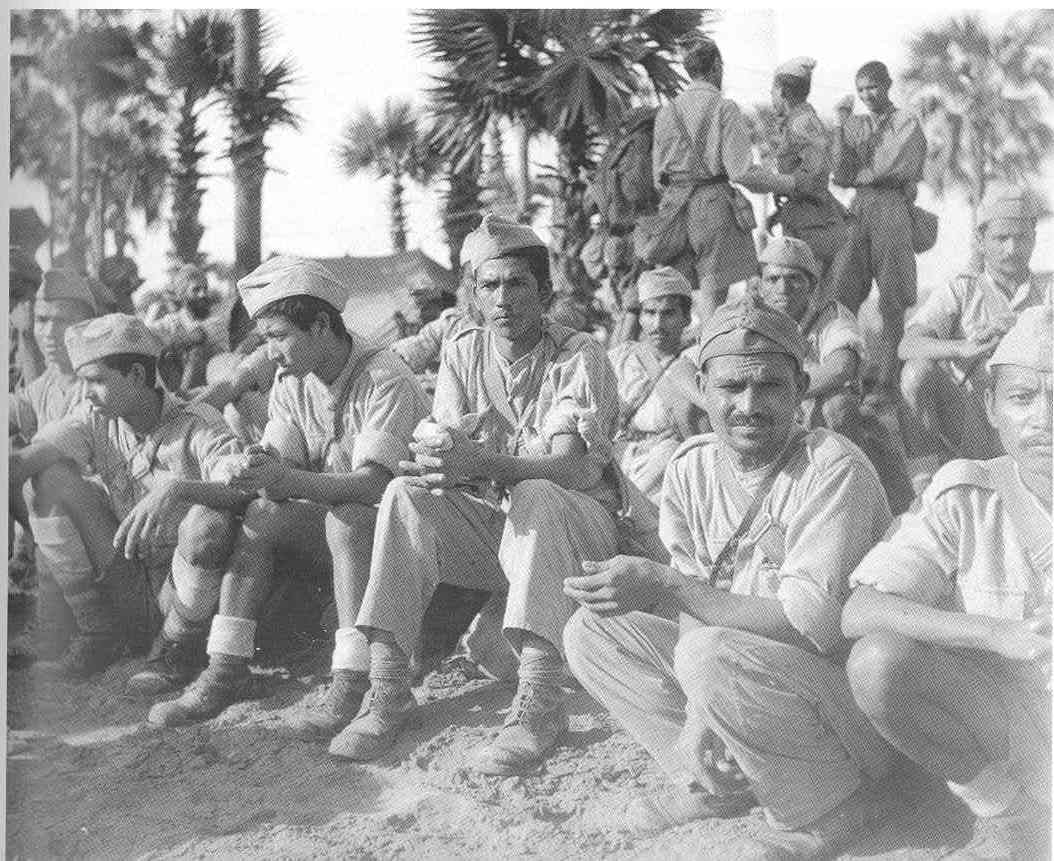
On 5 November 1945, three officers of the Indian National Army went on trial before a British court martial inside the Red Fort in Delhi, the old palace of the Mughal emperors. They were charged with waging war against the King-Emperor. Captain Shah Nawaz Khan was a Muslim, Captain Prem Kumar Sahgal a Hindu and Lieutenant Gurbaksh Singh Dhillon a Sikh. The government had meant the trial to show what happened to soldiers who betrayed their oath. Instead the three became heroes, and the country rallied behind them. "Lal Qile se aayi awaz: Sahgal, Dhillon, Shahnawaz", went the slogan, "From the Red Fort comes the cry". Three months later, ratings of the Royal Indian Navy mutinied in Bombay. Together these events convinced the British that they could no longer rely on Indian troops to hold India (Bipan Chandra et al., India's Struggle for Independence[4]).
Why were INA officers put on trial?
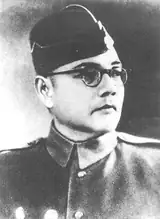
The Indian National Army had been raised in 1942 from Indian soldiers taken prisoner by the Japanese in Malaya and Singapore. From 1943 it was led by Subhas Chandra Bose, who formed a Provisional Government of Free India and took the army into battle beside the Japanese on the Burma frontier. The campaign failed. By 1945 the INA had retreated through Burma and surrendered, and Bose was killed in a plane crash in August 1945. During the war, Indian newspapers had been allowed to print almost nothing about the INA (Peter Ward Fay, The Forgotten Army[1]).
Some twenty thousand INA men came back to India as prisoners. The army sorted them into groups according to how committed they were thought to be, released many, and planned to try those accused of the most serious offences. The Commander-in-Chief, General Sir Claude Auchinleck, and his officers felt that soldiers who had broken their oath to fight for the enemy had to be punished, or the loyalty of the whole Indian Army would be at risk. Putting a Hindu, a Muslim and a Sikh in the dock together, in the most symbolic building in India, gave every community a defendant to rally behind (Peter Ward Fay, The Forgotten Army[1]).
How did the trial unite the country?
The war was over, the Congress leaders had been released from prison after the Quit India Movement, and elections were due that winter. The Congress, which had opposed the INA's alliance with Japan, now formed a defence committee for the accused. Bhulabhai Desai, a leading Bombay lawyer, led the defence with Tej Bahadur Sapru, Asaf Ali and Kailash Nath Katju, and Jawaharlal Nehru put on a barrister's gown for the first time in a quarter of a century. The Muslim League backed the defendants too. Desai argued that the INA had been the army of a provisional government recognised by several states, fighting for the liberation of its country, and that its soldiers should be treated under the laws of war, not tried as traitors (Sugata Bose, His Majesty's Opponent[2]).
Outside the court, the INA became the cause of the season. Meetings were held across the country, money was collected for the defence and for INA families, and shopkeepers closed in protest. In Calcutta in late November 1945, students marching for the INA officers clashed with police, and several days of firing and rioting left dozens dead. Soldiers and police officers, whose loyalty the trials were meant to secure, came to INA meetings, and British intelligence reports warned that sympathy for the INA was spreading in the army itself (Sumit Sarkar, Modern India[3]).
On 31 December 1945 the court found the three officers guilty of waging war and sentenced them to transportation for life. Three days later Auchinleck remitted the sentences. The officers were cashiered and lost their pay, and walked free to cheering crowds. Auchinleck explained to his commanders that to carry out the sentences would have risked unrest in the army. Later trials continued, but in February 1946 the sentence of seven years given to Captain Abdul Rashid set off another three days of rioting in Calcutta, and the government soon stopped prosecuting INA men except for brutality (Peter Ward Fay, The Forgotten Army[1]).
What happened in the Royal Indian Navy?
The Royal Indian Navy had grown quickly in the war with Indian sailors, called ratings, who served under British officers. They resented poor food, racial insults and slow demobilisation, and the INA trials gave their grievances a political shape. In early February 1946, B. C. Dutt, a rating at HMIS Talwar, the navy's signals training school in Bombay, was arrested after "Quit India" and other slogans were painted around the base.
On 18 February the ratings of Talwar went on strike. Within two days the strike spread to the ships in Bombay harbour, the shore bases and naval units in Karachi, Calcutta, Madras and other ports, involving some 20,000 men on dozens of ships and shore establishments. The mutineers elected a Naval Central Strike Committee, hauled down the Union Jack and flew the flags of the Congress, the Muslim League and the Communist Party side by side. In Bombay, workers struck in sympathy on 22 February, and in the riots and police and army firing that followed more than two hundred people were killed. Men of the Royal Indian Air Force had already held strikes in January, and there was unrest among army units too (Sumit Sarkar, Modern India[3]).
The British brought in warships and aircraft, but the end came through Indian politicians. Vallabhbhai Patel, for the Congress, and Jinnah, for the League, both urged the ratings to give up, and Patel promised that there would be no victimisation. The Congress and League leaders disliked a mutiny they did not control, at a moment when they were negotiating for power. On 23 February the strike committee surrendered, with a last message that it was surrendering to India and not to Britain. Many ratings were later dismissed despite Patel's assurance (Bipan Chandra et al., India's Struggle for Independence[4]).
How much did it matter?
On 19 February 1946, the day after the mutiny began, the Labour government announced that it would send three Cabinet ministers to India to negotiate the transfer of power. The decision had been taken before the mutiny, and Britain's exhaustion after the war, its debts and the election of a Labour government all pushed it towards leaving. But British officials in India now openly doubted that the army, navy and police would obey orders to put down another mass movement, and without them the Raj could not last. Historians such as Sugata Bose and Peter Ward Fay have argued that the INA did more to end British rule after its defeat than it had on the battlefield (Sugata Bose, His Majesty's Opponent[2]).
The three defendants lived long lives in independent India. Shah Nawaz Khan became a Congress member of parliament and a minister. Prem Sahgal married Lakshmi Swaminathan, who had commanded the INA's women's regiment, and Gurbaksh Singh Dhillon returned to farming. Bhulabhai Desai died in May 1946, a few months after the trial. Independent India did not take INA men back into its army, though it later honoured them as freedom fighters. Within eighteen months of the naval mutiny, India was free and partitioned.
INA trials timeline
| Date | Event |
|---|---|
| February 1942 | Singapore falls; Indian prisoners of war are recruited into the first INA |
| July 1943 | Subhas Chandra Bose takes command of the INA |
| 1944–1945 | INA defeated in the Imphal campaign and in Burma |
| August 1945 | Bose killed in a plane crash |
| 5 November 1945 | First INA trial opens at the Red Fort |
| November 1945 | Students and police clash in Calcutta |
| 31 December 1945 | Shah Nawaz Khan, Sahgal and Dhillon found guilty |
| 3 January 1946 | Auchinleck remits their sentences |
| February 1946 | Rashid Ali Day riots in Calcutta |
| 18 February 1946 | Naval mutiny begins at HMIS Talwar, Bombay |
| 19 February 1946 | Britain announces the Cabinet Mission |
| 23 February 1946 | The naval strike committee surrenders |