Roughly between the third century BCE and the third century CE, the far south of the Indian subcontinent — a region called Tamilakam, covering most of present-day Tamil Nadu and Kerala — produced a remarkable body of secular poetry describing love, war, kingship, and daily life in vivid, closely observed detail. Historians call this era the Sangam Age, after the corpus of classical Tamil poetry, Sangam literature, that is its principal source. The dating is not fully settled: most historians place the core of this literature between roughly 300 BCE and 300 CE, the philologist Kamil Zvelebil narrowed it on linguistic grounds to about 100 BCE to 250 CE, and recent excavations at Keeladi near Madurai have produced radiocarbon dates that some archaeologists read as pushing Tamil urban civilization back toward 600 BCE — a claim that remains actively debated rather than settled consensus.
Three crowned kingdoms of Tamilakam
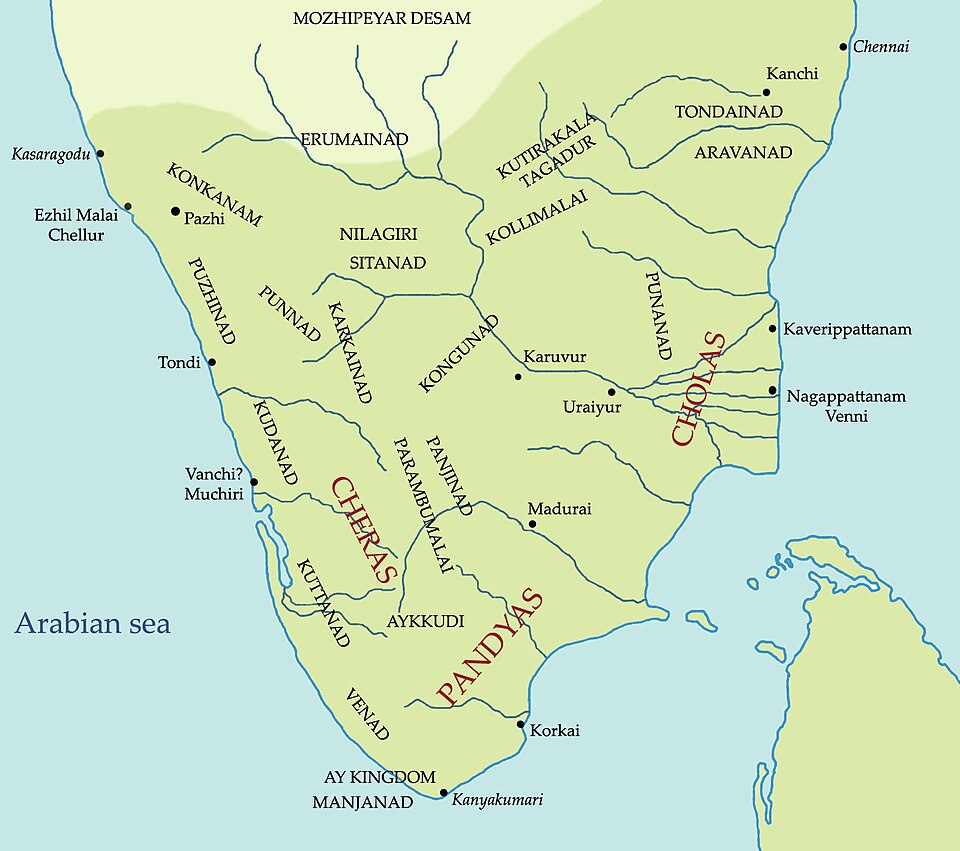
Political power in Tamilakam during this period was shared among three hereditary ruling lines, later tradition's "three crowned kings" — the Chera, Chola, and Pandya — alongside numerous smaller chieftains known as the Velir. The Cholas, whose emblem was the tiger, ruled the Kaveri delta from a capital at Kaveripattinam and are associated with the famous early king Karikala. The Pandyas, marked by the fish emblem, governed the far south from Madurai. The Cheras, identified by the bow, controlled the Malabar coast region, with a capital traditionally placed at Vanji, and were especially active as a seafaring, trading power. All three kingdoms are independently attested outside Tamil sources: Ashoka's rock edicts name the Cheras, Cholas, and Pandyas as neighboring peoples living beyond the southern edge of Mauryan territory, and the Hathigumpha inscription of the Kalinga king Kharavela also refers to a confederacy of Tamil states — external confirmation that these were real, recognized polities rather than purely literary constructions.
A literature of love and war, and a debated legend
Sangam poetry survives in major anthologies — the Ettuttokai ("Eight Anthologies") and Pattuppattu ("Ten Songs") — alongside the Tolkappiyam, an early grammar of Tamil that also codifies poetic convention. Sangam poems divide broadly into akam, intimate poetry of love and personal emotion, and puram, poetry of war, kingship, and public life, together totaling several thousand verses by hundreds of named poets, several of them women. Later Tamil tradition holds that this literature was produced and judged by three successive royal academies, or sangams, convened at Madurai under Pandya patronage — the origin of the era's name. Historians treat this academy legend with real caution: some, such as the scholar David Shulman, have argued there is no solid evidence such formal academies ever existed, while others, including Zvelebil, suggest the legend likely exaggerates a real, more informal gathering of poets at the Pandya court, since the linguistic consistency of the surviving poems suggests some shared literary institution shaped them. Either way, the poems themselves — not the legend of their assembly — are what historians rely on as a genuine historical source.
Trade with Rome and a wider world
Sangam-era Tamilakam was tied into long-distance maritime trade on a scale that surprises many readers today. Poems describe Yavanas — a term covering Greek and Roman traders — arriving at ports such as Muziris on the Kerala coast in "beautiful ships," exchanging gold for pepper and other spices, and Roman writers such as Pliny the Elder complained about the drain of Roman gold to India as a result. This trade is not just a literary claim: archaeologists have recovered hoards of Roman gold and silver coins across Tamil Nadu, and excavations at sites such as Arikamedu, near Puducherry, have uncovered Roman amphorae and other imported goods confirming a genuine and substantial trading relationship stretching across the Arabian Sea. The Sangam Age's combination of vivid vernacular literature, well-documented monarchies, and international trade makes it an essential counterweight to a version of ancient Indian history told only through the Gangetic plain: while the Mauryas and later the Guptas built empires in the north, an equally sophisticated and independent set of Tamil kingdoms flourished in the south, leaving behind, in Sangam poetry, one of the richest literary windows onto everyday life anywhere in the ancient world.