Around 320 CE, a minor king named Chandragupta I in the Gangetic plains near Magadha married Kumaradevi, a princess of the Lichchhavi clan, and used the alliance to found a dynasty that would grow, within two generations, into the most celebrated empire of ancient India. He took the imposing title Maharajadhiraja, "great king of kings," though historians are not fully certain which region — eastern Uttar Pradesh, Magadha in modern Bihar, or Bengal — the Gupta family originally came from before Chandragupta I's rise. What followed, over roughly the next two centuries, was a period later writers and historians alike would come to call India's classical or "golden" age.
Samudragupta and Chandragupta II: an empire built and secured
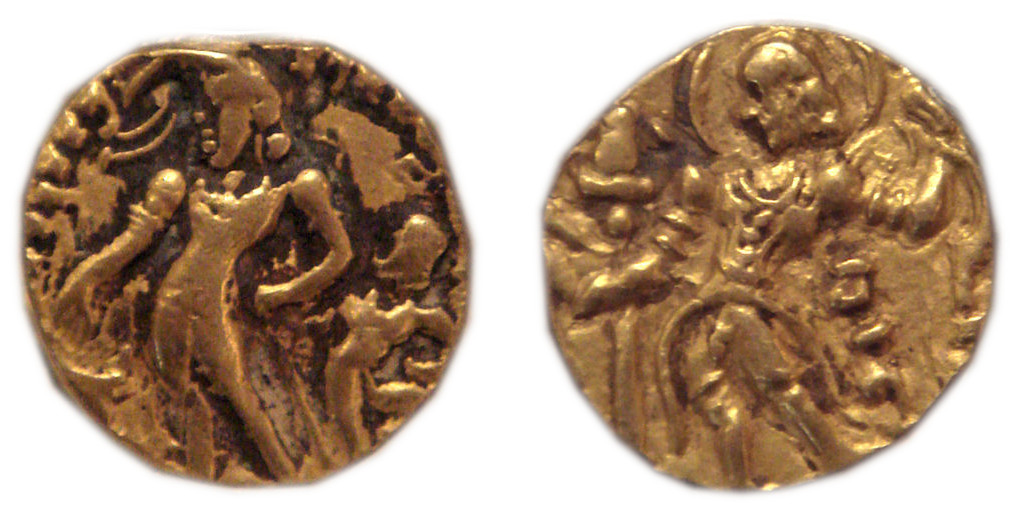
Chandragupta I's son, Samudragupta, who ruled from around 335 to 375 CE, transformed a regional kingdom into a subcontinental power. His military campaigns, recorded on a stone pillar inscription at Prayaga composed by the court poet Harishena, describe the defeat and reincorporation of kings across the Gangetic plain and a sweeping southern campaign that brought distant kingdoms in the Deccan under Gupta tribute without full annexation — a pattern of direct rule at the center and looser overlordship at the edges, familiar from the earlier Mauryan Empire. Samudragupta was also a patron of the arts, memorably shown on his gold coins playing the veena. His son, Chandragupta II, who ruled from about 375 to 415 CE and took the title Vikramaditya, pushed the empire's boundaries further west, defeating the Western Kshatrapas of Gujarat and Malwa and making the city of Ujjain a second capital alongside Pataliputra. Chandragupta II's court is remembered for hosting the Navaratna, or "nine jewels," a group of celebrated scholars and poets that later tradition associates with his reign, including Kalidasa, whose Sanskrit plays and poetry are still read as high points of classical Indian literature.
A period of scientific, artistic, and architectural achievement
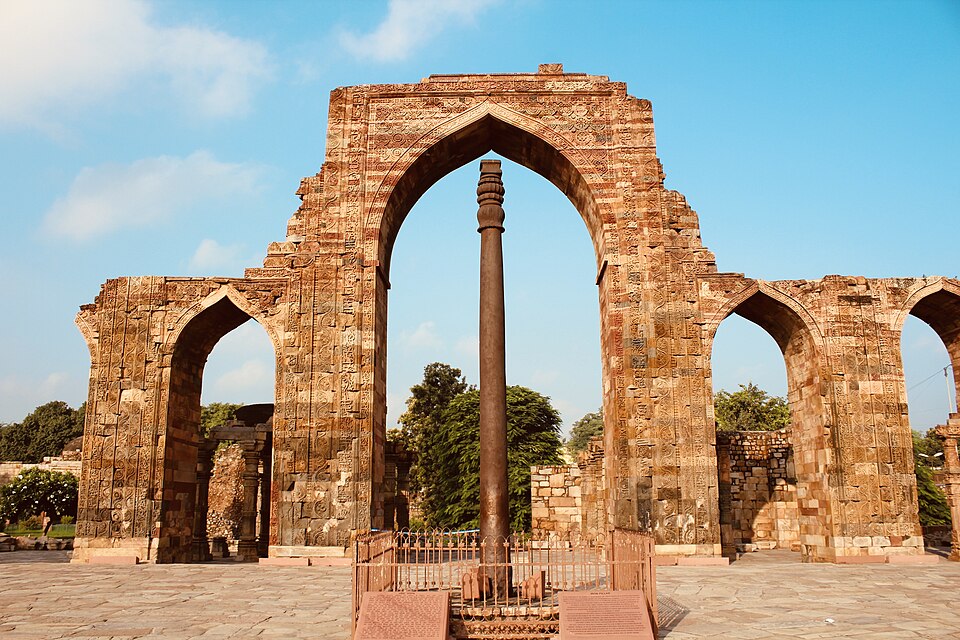
The Gupta period is remembered above all for what it produced rather than for how it was governed. The mathematician and astronomer Aryabhata, working in the early sixth century, wrote the Aryabhatiya, which used a positional decimal number system, calculated the length of the solar year with striking accuracy, and proposed that the Earth rotates on its axis — well ahead of comparable ideas elsewhere at the time. Gupta-era metallurgists produced the Iron Pillar now standing in Delhi, a roughly six-tonne column that has resisted serious rusting for over 1,500 years, evidence of an advanced understanding of iron composition. Kumaragupta I, who succeeded Chandragupta II and ruled through the mid-fifth century, founded the great Buddhist monastic university at Nalanda in Bihar, which would draw students from across Asia for centuries. Temple architecture also matured during this period: stone shrines such as the Dashavatara Temple at Deogarh show an early, refined version of the freestanding Hindu temple form that would spread across the subcontinent in later centuries, and Buddhist cave paintings at Ajanta, though begun earlier, reached a high point of technical sophistication under Gupta-period patronage.
Decline, and a debate over the word "golden"
Gupta power weakened over the fifth century under sustained pressure from Huna invaders from Central Asia; Skandagupta, who ruled from about 455 to 467 CE, held them off at heavy cost to the treasury, but later rulers faced renewed incursions under Huna leaders Toramana and Mihirakula, alongside the rise of ambitious former feudatories such as Yashodharman, who carved out an independent realm in Malwa in the early sixth century. By around 550 CE, Gupta authority had effectively dissolved into a patchwork of successor kingdoms. Historians broadly agree on this sequence, though they continue to debate how much weight to give the Huna invasions versus internal fragmentation and the loss of feudatory loyalty in explaining the empire's end; some recent archaeological work has even pointed to a major mid-sixth-century flood as a contributing factor. There is also a real and separate historiographical debate about the "Golden Age" label itself: while Gupta-era science, literature, and art were genuinely remarkable, some historians caution that this flourishing was concentrated among an elite, Sanskrit-literate, urban minority, and that the same period saw social hierarchies — including restrictions codified in texts such as the Manusmriti — harden rather than soften. The label endures because the era's specific achievements are real and well documented, but it is worth reading as a description of certain elite cultural and scientific output, not as a claim that Gupta India was uniformly prosperous or equal.