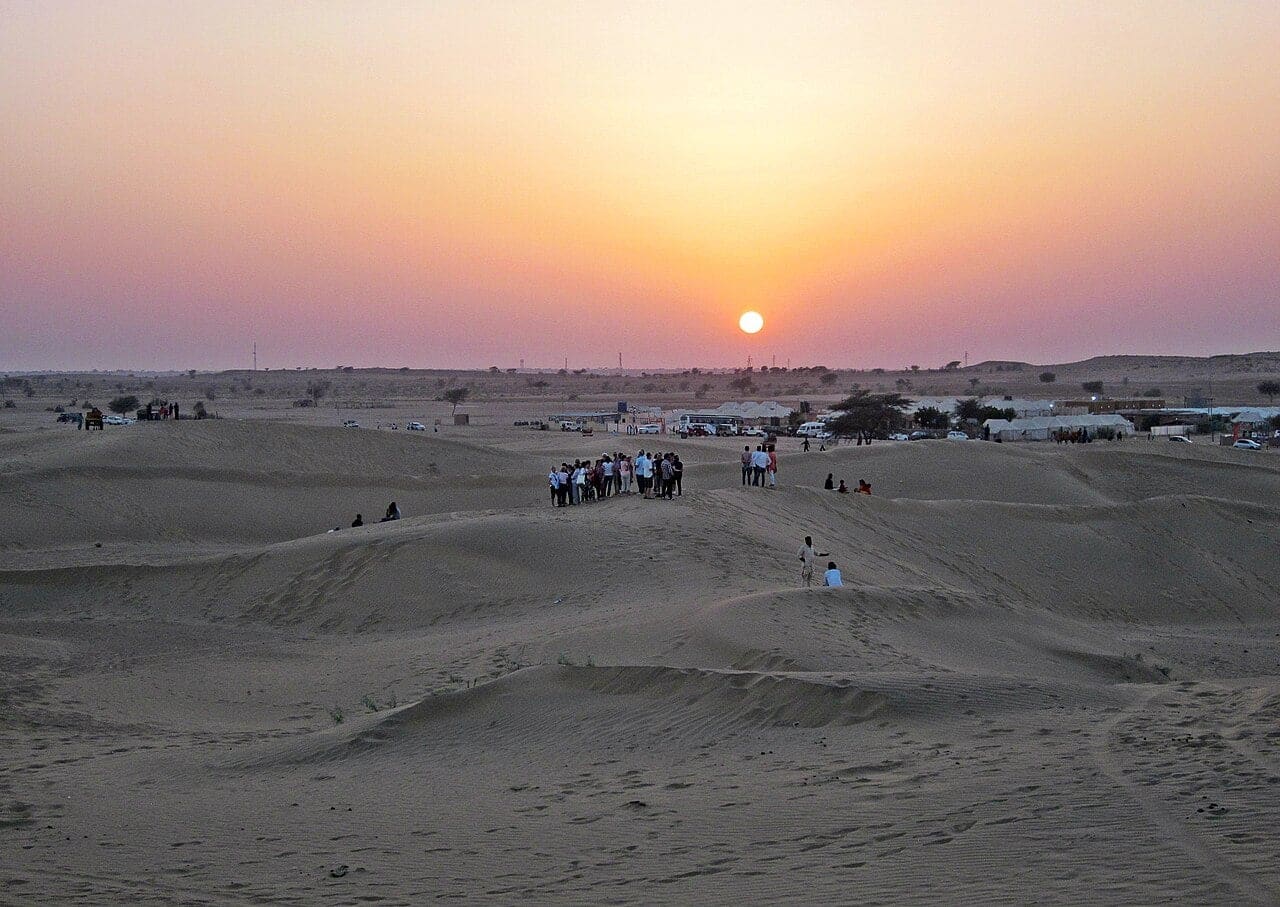
On the morning of 18 May 1974, a nuclear device exploded in a shaft deep under the desert at Pokhran, an army range in the Thar desert of Rajasthan. India became the sixth country known to have set off a nuclear explosion, and the first outside the five permanent members of the UN Security Council. Its government insisted the explosion was peaceful. For the next twenty-four years India kept its nuclear capability in the shadows, neither testing again nor giving it up. Then, on 11 and 13 May 1998, it exploded five more devices at Pokhran and declared itself a nuclear weapons state. The two rounds of tests, and the long silence between them, shaped India's place in the world for decades (George Perkovich, India's Nuclear Bomb[1]).
How did India's nuclear programme begin?
India's nuclear programme was the creation of Homi Jehangir Bhabha, a Cambridge-trained physicist from a wealthy Bombay Parsi family. With Nehru's backing he set up the Atomic Energy Commission in 1948 and a research centre at Trombay, near Bombay, which was later named after him. Nehru spoke against nuclear weapons, and the programme was publicly about nuclear power and research, but Bhabha built it so that India would have the knowledge and materials to make a bomb if it chose. The CIRUS research reactor at Trombay, built with Canadian help and American heavy water and opened in 1960, could produce plutonium, and a plant to separate it was running by 1964 (George Perkovich, India's Nuclear Bomb[1]).
Two events turned the question from theory to politics. India's defeat in the war with China in 1962 was followed, in October 1964, by China's first nuclear test. Bhabha argued publicly that India could build a bomb within eighteen months. Prime Minister Lal Bahadur Shastri resisted building weapons but allowed work on what was called a peaceful nuclear explosive. Bhabha was killed in an air crash on Mont Blanc in January 1966. Two years later India refused to sign the Nuclear Non-Proliferation Treaty, which allowed the five countries that already had nuclear weapons to keep them while forbidding everyone else. Indian governments of every party called it discriminatory, dividing the world into nuclear haves and have-nots (Raj Chengappa, Weapons of Peace[2]).
What was Smiling Buddha?
Indira Gandhi authorised the test in the early 1970s, and the work was led by the physicist Raja Ramanna, with P. K. Iyengar and R. Chidambaram among the team and Homi Sethna as chairman of the Atomic Energy Commission. The device used plutonium from CIRUS. It was exploded on 18 May 1974, the festival of Buddha Purnima, which gave the operation its unofficial name, "Smiling Buddha"; the message sent to the Prime Minister was said to be "the Buddha is smiling". India announced a yield of about 12 kilotons. Many outside experts believe it was lower (Raj Chengappa, Weapons of Peace[2]).
The government called it a "peaceful nuclear explosion", carried out to study the use of nuclear explosives for mining and engineering, and said India had no intention of building weapons. Few other countries were convinced. Canada, angered that a reactor it had supplied had been used, cut off nuclear cooperation. The test led directly to the creation of the Nuclear Suppliers Group, a club of countries that agreed to control the export of nuclear materials and technology, and to new American laws that restricted nuclear trade with India. In Pakistan, recently defeated in the war of 1971, Prime Minister Zulfikar Ali Bhutto pushed ahead with a crash programme to build a bomb of its own (George Perkovich, India's Nuclear Bomb[1]).
Why did India wait twenty-four years?
After 1974 India did not test again for a generation. Indira Gandhi and her successors kept the option open without exercising it, partly because of the costs: sanctions, loss of access to nuclear fuel and technology, and the risk of pushing Pakistan to test. India's scientists continued to work on weapon designs, and from 1983 the Integrated Guided Missile Development Programme, led by A. P. J. Abdul Kalam, built rockets that could carry them. By the late 1980s it was widely believed that both India and Pakistan could assemble nuclear weapons quickly (Raj Chengappa, Weapons of Peace[2]).
In the 1990s the pressure grew. The NPT was extended indefinitely in 1995, and a Comprehensive Test Ban Treaty was negotiated in 1996, which India refused to sign. Indian leaders feared that the door to testing was closing for good. In December 1995 the government of P. V. Narasimha Rao prepared a test at Pokhran, but American satellites spotted the preparations, and it was called off under pressure from Washington.
What happened in May 1998?
In March 1998 a coalition led by the Bharatiya Janata Party came to power under Atal Bihari Vajpayee, which had promised in its manifesto to consider declaring India's nuclear weapons. Within weeks, preparations were under way. This time the scientists and soldiers worked mostly at night and covered their tracks to avoid detection by satellites. The project was led by Kalam, then head of the Defence Research and Development Organisation, and R. Chidambaram, chairman of the Atomic Energy Commission (Raj Chengappa, Weapons of Peace[2]).
On 11 May 1998, again on Buddha Purnima, India exploded three devices at Pokhran: a fission device, a low-yield device and what it described as a thermonuclear, or hydrogen, device. Two more low-yield devices followed on 13 May. This time there was no talk of peaceful explosions. Vajpayee announced the tests himself and declared India a nuclear weapons state. In a letter to President Bill Clinton, he cited the threat from China and China's help to Pakistan. Some Indian scientists later questioned whether the thermonuclear device had worked as designed, a claim the government rejected (Ramachandra Guha, India after Gandhi[3]).
How did the world respond?
On 28 May 1998, Pakistan exploded its own devices in the Chagai hills of Balochistan, followed by another on 30 May. South Asia now had two declared nuclear powers. The United States, Japan and other countries imposed economic sanctions on both, and the UN Security Council condemned the tests. India announced a voluntary moratorium on further testing and, in the following years, a doctrine of "no first use" and "credible minimum deterrence" (George Perkovich, India's Nuclear Bomb[1]). Within a year the two new nuclear powers were fighting each other in the mountains of Kargil.
Sanctions did not last long. Long talks between India's foreign minister, Jaswant Singh, and the American deputy secretary of state, Strobe Talbott, slowly rebuilt relations. In July 2005 Prime Minister Manmohan Singh, who as finance minister had led the economic reforms of 1991, and President George W. Bush agreed to cooperate in civil nuclear energy, and in 2008 the Nuclear Suppliers Group, the club created in response to Pokhran in 1974, made an exception that allowed India to buy nuclear fuel and reactors without signing the NPT. In India, 11 May is now observed as National Technology Day. The tests remain one of the most debated decisions in the republic's history: for supporters, they gave India security and standing; for critics, they began an expensive arms race in a poor region and made nuclear war between neighbours possible (Ramachandra Guha, India after Gandhi[3]).
Pokhran timeline
| Date | Event |
|---|---|
| 1948 | Atomic Energy Commission set up under Homi Bhabha |
| 1960 | CIRUS research reactor begins operating at Trombay |
| October 1964 | China's first nuclear test |
| January 1966 | Bhabha dies in an air crash |
| 1968 | India refuses to sign the Nuclear Non-Proliferation Treaty |
| 18 May 1974 | "Smiling Buddha" test at Pokhran |
| 1974–1975 | Nuclear Suppliers Group formed |
| 1983 | Integrated Guided Missile Development Programme begins |
| December 1995 | Planned test called off after detection |
| 1996 | India refuses to sign the Comprehensive Test Ban Treaty |
| 11 and 13 May 1998 | Operation Shakti: five devices tested |
| 28 and 30 May 1998 | Pakistan's tests at Chagai |
| 2005–2008 | India-US civil nuclear agreement and NSG exemption |