In the summer of 1991, India was close to defaulting on its foreign debts. Its reserves of foreign exchange had fallen to a little over a billion dollars, enough to pay for two or three weeks of imports. To raise emergency loans, the government pledged part of the country's gold, and some of it was flown to London to be held as security by the Bank of England. A new minority government, led by P. V. Narasimha Rao with the economist Manmohan Singh as finance minister, used the crisis to do what earlier governments had only talked about. Within weeks it devalued the rupee, abolished most of the permits needed to run a business and opened India to foreign trade and investment. The reforms of 1991 changed the Indian economy more than any policy since independence, and they are still argued over (Ramachandra Guha, India after Gandhi[1]).
What was the licence raj?
After independence, India's leaders chose a planned economy in which the state would direct investment and build heavy industry. The Industries (Development and Regulation) Act of 1951 required a licence from the government to set up a factory, expand it or make a new product in most industries. Over the next decades the controls multiplied. Large companies needed separate approval under the Monopolies and Restrictive Trade Practices Act of 1969. The Foreign Exchange Regulation Act of 1973 limited foreign ownership of most companies to 40 per cent, and Coca-Cola and IBM left India rather than comply. Imports needed licences and faced some of the highest tariffs in the world, and many products were reserved for small-scale industry or the public sector (Jagdish Bhagwati, India in Transition[3]).
People called it the licence-permit raj. Business decisions were made in government offices in Delhi rather than in markets. Families waited years for a telephone connection or a Bajaj scooter. The economy grew at about 3.5 per cent a year from the 1950s to the 1970s, a pace the economist Raj Krishna called the "Hindu rate of growth", while countries in East Asia that had been as poor as India grew much faster. The planned economy had achievements, among them steel plants, dams, scientific institutions and the Green Revolution, but by the 1980s many economists in India and abroad argued that the controls were holding the country back (Gurcharan Das, India Unbound[4]).
Why did the crisis come in 1991?
In the 1980s, under Indira Gandhi and then Rajiv Gandhi, the government loosened some controls, and growth rose to about 5.5 per cent. But it was paid for with borrowing. Government deficits grew, and India borrowed more and more abroad, much of it in short-term loans. In 1990 Iraq invaded Kuwait, and the Gulf War that followed sent oil prices up and cut off the remittances that Indian workers in the Gulf sent home. At the same time, Indian politics was in turmoil. The government of V. P. Singh fell in November 1990, and his successor Chandra Shekhar led a weak minority government that could not pass a full budget. Credit rating agencies downgraded India, and Indians living abroad began withdrawing their deposits (Vijay Joshi and I. M. D. Little, India's Economic Reforms[2]).
By the spring of 1991 the country was close to running out of money to pay for its imports. Chandra Shekhar's government sold gold that had been confiscated from smugglers to raise funds. In May, during the general election campaign, Rajiv Gandhi was assassinated. When the new Congress government took office on 21 June, Rao chose Manmohan Singh, a former governor of the Reserve Bank with no political base, as finance minister. In July the Reserve Bank pledged about 47 tonnes of gold to the Bank of England and the Bank of Japan to raise loans, and India also borrowed from the International Monetary Fund (Ramachandra Guha, India after Gandhi[1]).
What did the reforms change?
The government moved fast. On 1 and 3 July the rupee was devalued, in two steps, by about 18 per cent against the dollar, making Indian exports cheaper. A new trade policy cut back import licensing. On 24 July 1991, the government announced a new industrial policy that abolished industrial licensing for all but a short list of industries, removed the MRTP limits on the size of companies, cut the list of industries reserved for the public sector, and allowed foreign companies to own up to 51 per cent of businesses in many industries with automatic approval (Vijay Joshi and I. M. D. Little, India's Economic Reforms[2]).
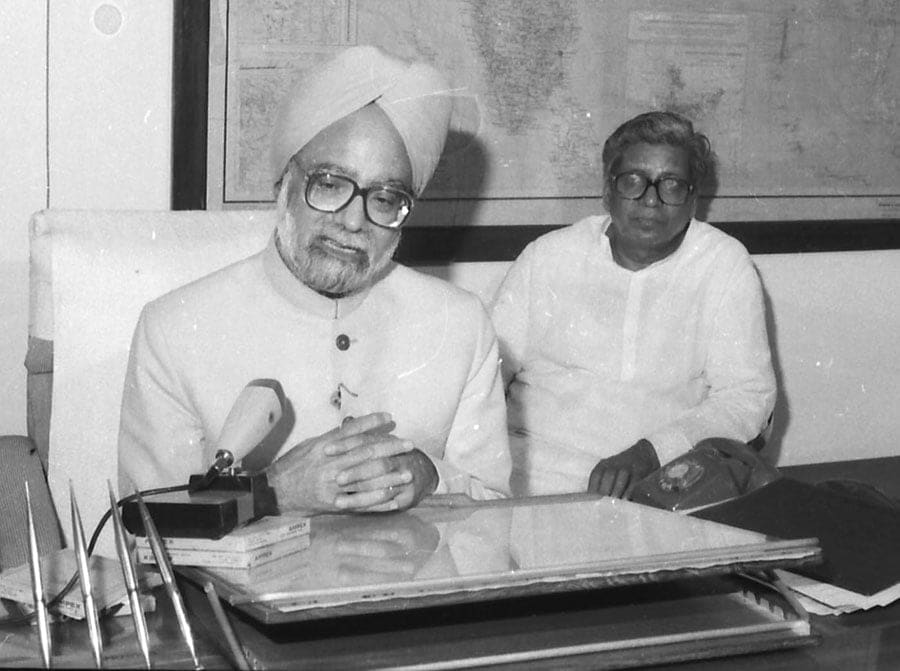
That evening Manmohan Singh presented his budget to Parliament. He promised to cut the government's deficit and reform taxes, and he ended by quoting Victor Hugo: "No power on earth can stop an idea whose time has come." He argued that India's emergence as a major economic power was such an idea (Gurcharan Das, India Unbound[4]).
The reforms continued over the following years. Import tariffs were cut step by step, the stock market regulator SEBI was given legal powers in 1992, banks were given more freedom, and the rupee was made convertible for trade and current transactions in 1994. Telecommunications, airlines and other sectors were opened to private companies. Rao gave Singh political cover in a party where many members were uneasy, and he presented the reforms as a continuation of Congress tradition rather than a break with it.
Who opposed the reforms?
The Left parties and trade unions argued that they would hand the economy to foreign companies, a fear sharpened by the Bhopal gas disaster at an American-owned plant in 1984, cost jobs in the public sector and hurt the poor, and they organised strikes against them. Some Indian industrialists, who had been protected from foreign competition, formed a group known as the Bombay Club in 1993 to ask for a slower pace. Within the Congress, many leaders worried about the political cost. A stock market scandal in 1992, involving the broker Harshad Mehta, gave critics further ammunition (Ramachandra Guha, India after Gandhi[1]).
What did 1991 achieve?
The crisis was over within two years, and the economy grew by an average of about 6 per cent a year through the 1990s, faster again in the 2000s. Every government that followed, of whatever party, kept the reforms and in most cases extended them. Information technology, telecommunications, cars, airlines and consumer goods grew rapidly, and a large new middle class emerged. The share of Indians living in extreme poverty fell substantially in the decades after 1991 (Vijay Joshi and I. M. D. Little, India's Economic Reforms[2]).
The debate about what the reforms did has never ended. Critics point to rising inequality, the slow growth of manufacturing jobs, the distress of farmers and the limited reach of the reforms into agriculture, labour law and education. Supporters argue that most of these problems come from reforms left undone rather than from those carried out, and that growth paid for much of the welfare spending that came later. Historians of the period also note that India reformed gradually, through democratic politics, rather than through the sudden "shock therapy" seen in other countries at the time. Rao's role was long played down by his own party; Manmohan Singh went on to become Prime Minister in 2004. Together with the Pokhran tests of 1998, the reforms changed the terms on which India dealt with the rest of the world.
1991 reforms timeline
| Date | Event |
|---|---|
| 1951 | Industries (Development and Regulation) Act introduces industrial licensing |
| 1969 | Monopolies and Restrictive Trade Practices Act |
| 1973 | Foreign Exchange Regulation Act limits foreign ownership |
| 1980s | Partial loosening of controls under Indira and Rajiv Gandhi |
| August 1990 | Iraq invades Kuwait; oil prices rise |
| November 1990 | V. P. Singh's government falls; Chandra Shekhar takes office |
| May 1991 | Gold sold to raise funds; Rajiv Gandhi assassinated |
| 21 June 1991 | P. V. Narasimha Rao becomes Prime Minister, with Manmohan Singh as finance minister |
| 1 and 3 July 1991 | Rupee devalued in two steps |
| July 1991 | Gold pledged to the Bank of England and the Bank of Japan |
| 24 July 1991 | New industrial policy and Union Budget |
| 1992 | SEBI given statutory powers; Harshad Mehta scandal |
| 1994 | Rupee made convertible on the current account |