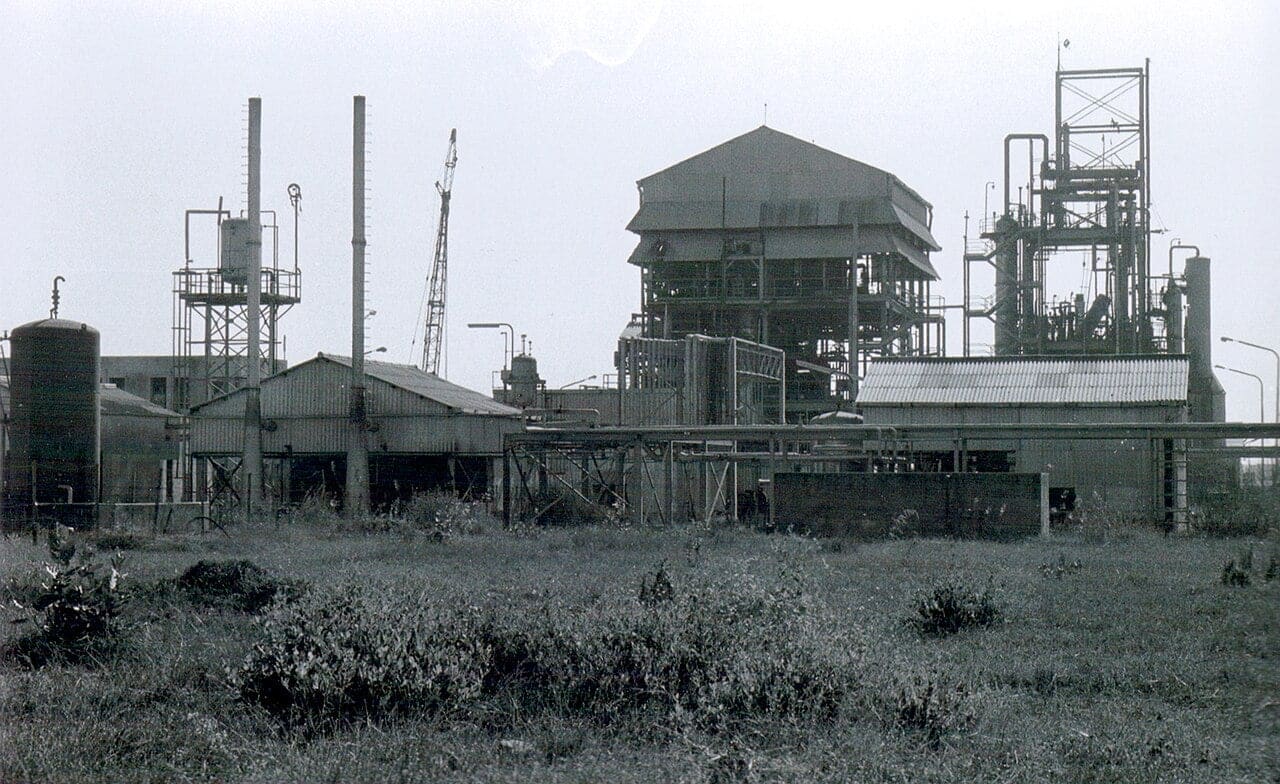
Shortly after midnight on 3 December 1984, a cloud of methyl isocyanate gas escaped from a storage tank at the Union Carbide pesticide plant on the northern edge of Bhopal, the capital of Madhya Pradesh. The gas was heavier than air. It drifted south over the crowded settlements beside the factory and into the old city, where most people were asleep. People woke choking, their eyes burning, and ran into the streets, where the gas was thickest. Thousands died that night and in the days that followed, and hundreds of thousands were injured. Bhopal is still regarded as the worst industrial disaster in history, and the struggle over who should answer for it lasted for decades (Ramachandra Guha, India after Gandhi[4]).
Why was there a pesticide plant in Bhopal?
The plant belonged to Union Carbide India Limited, a company in which the American Union Carbide Corporation held just over half the shares. It was opened in the late 1960s, at a time when India was trying to increase its food production through the Green Revolution, and pesticides were in great demand. From 1979 the factory made the insecticide carbaryl, sold as Sevin, using methyl isocyanate, or MIC, a highly toxic and reactive chemical that it stored on site in large underground tanks (Paul Shrivastava, Bhopal: Anatomy of a Crisis[1]).
By the early 1980s the plant was losing money. Demand for pesticides had fallen, and the company was cutting costs and considering selling it. Staff numbers and training were reduced, and maintenance was neglected. There had been warnings. In 1981 a worker died after exposure to phosgene, another chemical used at the plant, and a local journalist, Rajkumar Keswani, wrote a series of articles warning that the factory was a danger to the city (Dominique Lapierre and Javier Moro, Five Past Midnight in Bhopal[2]).
What gas leaked in Bhopal?
The gas was methyl isocyanate, or MIC, a colourless liquid that boils at about 39°C and turns quickly into a vapour. The plant used it as an intermediate chemical, combining it with other compounds to make carbaryl. MIC reacts violently with water, giving off heat, which is why the tanks were meant to be kept cold and dry. Its vapour is about twice as heavy as air, so it settles close to the ground, and it attacks the eyes and lungs: even low concentrations cause burning eyes and coughing, and heavier exposure fills the lungs with fluid (Paul Shrivastava, Bhopal: Anatomy of a Crisis[1]).
What went wrong on 2–3 December?
On the night of 2 December, water entered tank 610, which held about forty tonnes of MIC. The water set off a violent reaction, and the temperature and pressure in the tank rose rapidly. How the water got there was contested: the investigations accepted by the Indian courts concluded that it entered during the washing of pipes, while Union Carbide argued that a disgruntled employee had introduced it deliberately (Paul Shrivastava, Bhopal: Anatomy of a Crisis[1]).
What is not in dispute is that the safety systems failed. The refrigeration unit that was meant to keep the MIC cold had been shut down months earlier. The scrubber designed to neutralise escaping gas was on standby and could not cope; the flare tower that should have burned off gas was out of service; and the water spray meant to knock down a leak could not reach high enough. The public warning siren was sounded only briefly, and switched off again. The people living nearby had never been told what was stored at the plant or what to do if it leaked (Ramachandra Guha, India after Gandhi[4]).
How many people died?
The number has never been settled. The official immediate death toll was 2,259, and the Madhya Pradesh government later confirmed 3,787 deaths. Doctors, volunteers and later researchers put the deaths in the first two weeks at around 8,000, and the total from the effects of the gas over the following years at 15,000 to 20,000 or more. Government figures later recorded more than half a million people as injured. Survivors suffered from damaged lungs and eyes, and doctors and researchers, including long-term studies by the Indian Council of Medical Research, have recorded lasting effects on breathing, vision, mental health and reproductive health (Dominique Lapierre and Javier Moro, Five Past Midnight in Bhopal[2]).
Most of the dead and injured were poor. Many lived in the shanty settlements that had grown up next to the factory walls, and many were migrant labourers.
Who was held responsible, and was anyone convicted?
No one from the American parent company ever stood trial in India. Union Carbide paid a settlement in 1989, and in 2010 an Indian court convicted seven former executives of the Indian subsidiary of causing death by negligence.
Warren Anderson, the chairman of Union Carbide Corporation, flew to Bhopal on 7 December. He was arrested, released on bail the same day and allowed to leave India. He never returned, and an Indian court later declared him an absconder; he died in the United States in 2014. Victims' lawyers first sued Union Carbide in American courts, but in 1986 a US judge sent the cases back to India. In 1985 Parliament passed the Bhopal Gas Leak Disaster (Processing of Claims) Act, which made the Government of India the sole representative of all the victims (Kim Fortun, Advocacy after Bhopal[3]).
In February 1989 the Supreme Court approved a settlement under which Union Carbide paid US$470 million in full and final settlement of all claims, and criminal charges were dropped. Survivors' groups were outraged. The sum was far below what the government had claimed, and once it was divided among the hundreds of thousands of registered claimants, most received small amounts. In 1991 the Supreme Court upheld the settlement but restored the criminal cases. In 2010, more than twenty-five years after the leak, a Bhopal court convicted seven former Indian executives of the company, including its chairman Keshub Mahindra, of causing death by negligence, and sentenced them to two years in prison. They were granted bail. In 2023 the Supreme Court rejected the central government's petition to reopen the settlement and seek more compensation (Ramachandra Guha, India after Gandhi[4]).
What did Bhopal change?
The disaster changed Indian law. In 1986 Parliament passed the Environment (Protection) Act, and in the same year, in a case about a gas leak in Delhi, the Supreme Court laid down a principle of absolute liability: an industry engaged in hazardous activity is fully liable for harm it causes, with no exceptions. A Public Liability Insurance Act followed in 1991, the year India also began opening its economy to foreign investment, and the memory of Bhopal was often raised in debates over how to hold foreign companies to account. Around the world, Bhopal led to new rules requiring companies to tell communities what dangerous chemicals they stored and to plan for emergencies (Kim Fortun, Advocacy after Bhopal[3]).
For the people of Bhopal, the disaster did not end. Union Carbide sold its stake in the Indian company in 1994, and in 2001 Union Carbide Corporation became a subsidiary of Dow Chemical, which has said it bears no responsibility for Bhopal. Toxic waste remained at the abandoned site for decades, and studies found contaminated groundwater in neighbouring settlements. Survivors and activists, among them Rashida Bee and Champa Devi Shukla, who won the Goldman Environmental Prize in 2004, kept up the campaign for medical care, clean water, compensation and justice, and survivors still gather in Bhopal every year on the anniversary of the night of 2–3 December. The disaster is still cited wherever dangerous industries are placed beside poor communities, as an example of what cutting corners on safety costs and of how hard it is to make a company answer for harm across borders (Kim Fortun, Advocacy after Bhopal[3]).
Bhopal gas tragedy timeline
| Date | Event |
|---|---|
| Late 1960s | Union Carbide India's Bhopal plant opens |
| 1979 | The plant begins making carbaryl using methyl isocyanate |
| 1981 | A worker dies after exposure to phosgene |
| 1982–1984 | Journalist Rajkumar Keswani warns of danger at the plant |
| 2–3 December 1984 | About forty tonnes of MIC escape over Bhopal |
| 7 December 1984 | Warren Anderson is arrested, bailed and leaves India |
| 1985 | Bhopal Gas Leak Disaster (Processing of Claims) Act |
| 1986 | US court sends the cases to India; Environment (Protection) Act |
| February 1989 | Supreme Court approves the $470 million settlement |
| 1991 | Supreme Court upholds the settlement and revives criminal charges |
| 2001 | Dow Chemical acquires Union Carbide |
| 2004 | Rashida Bee and Champa Devi Shukla win the Goldman Prize |
| 2010 | Seven former executives convicted of negligence |
| 2023 | Supreme Court rejects the plea for more compensation |