In December 1970 Pakistan held its first general election based on universal adult franchise. The result should have made a Bengali politician, Sheikh Mujibur Rahman, Prime Minister of Pakistan. Instead, a year later, the country had been broken in two. Between March and December 1971 Pakistan's army waged a campaign of terror against the people of its eastern wing, around ten million refugees fled to India, and India, after months of diplomacy and covert support for the Bengali resistance, fought a thirteen-day war that ended with the surrender of the Pakistani army in Dhaka. The independent state of Bangladesh was the result. For India it is still remembered as its most decisive military victory (Srinath Raghavan, 1971[1]).
Why did East Pakistan rebel?
Pakistan, created at Partition in 1947, was two territories separated by some 1,600 kilometres of Indian territory. East Pakistan, formerly East Bengal, had the majority of the population, but power, the army and most investment were concentrated in West Pakistan. The first great quarrel came over language: in 1952 police in Dhaka fired on students demanding that Bengali be recognised as a national language, and 21 February is still kept as Language Martyrs' Day. In 1966, months after the war of 1965 had left many in the east feeling undefended, Mujib's Awami League put forward six demands for autonomy, which the government treated as secession (Richard Sisson and Leo E. Rose, War and Secession[2]).
In November 1970 a cyclone struck the coast of East Pakistan, killing several hundred thousand people, and the slow response from the military government added to Bengali anger. In the election a few weeks later, the Awami League won 160 of East Pakistan's 162 seats, an absolute majority in the national assembly. The military ruler, General Yahya Khan, and Zulfikar Ali Bhutto, whose Pakistan Peoples Party had won in the west, were not prepared to accept a government led by Mujib on his terms. In March 1971 the opening of the assembly was postponed. East Pakistan came to a standstill in a campaign of non-cooperation, and on 7 March Mujib told a huge crowd in Dhaka that "the struggle this time is the struggle for our freedom" (Richard Sisson and Leo E. Rose, War and Secession[2]).
What happened on 25 March 1971?
On the night of 25 March the army launched Operation Searchlight. Troops attacked Dhaka University, the police and paramilitary barracks, and Hindu neighbourhoods; Mujib was arrested and flown to West Pakistan. Bengali officers and soldiers mutinied, and independence was proclaimed. In the following months the army and its local auxiliaries killed large numbers of Bengalis, singling out Hindus, students, intellectuals and Awami League supporters. Mass rape was widespread. Estimates of the dead range from a few hundred thousand to the three million figure used by the government of Bangladesh (Gary J. Bass, The Blood Telegram[3]).
In April the American consul general in Dhaka, Archer Blood, and his staff sent a cable to Washington accusing their own government of moral bankruptcy for failing to denounce what they called genocide. President Richard Nixon and his adviser Henry Kissinger, who were using Pakistan as a secret channel to open relations with China, ignored it. A Bangladeshi government-in-exile was formed in April at Mujibnagar, on the Indian border, and operated from Calcutta.
Why did India intervene?
The refugees forced India's hand. They crossed into West Bengal, Tripura, Assam and Meghalaya at a rate of tens of thousands a day, and by the end of the year there were around ten million of them, living in camps, schools and drainage pipes. The cost of feeding and sheltering them strained India's budget, and the influx threatened the politics of the border states (Srinath Raghavan, 1971[1]).
Prime Minister Indira Gandhi chose not to go to war at once. The army chief, General Sam Manekshaw, advised waiting until after the monsoon, and India needed time to prepare diplomatically. Through the summer India trained, armed and sheltered the Bengali guerrillas of the Mukti Bahini. In August it signed a Treaty of Peace, Friendship and Cooperation with the Soviet Union, which promised consultation if either were attacked. In October and November Indira Gandhi toured Western capitals, including Washington, to make India's case. On 1 August George Harrison and Ravi Shankar's Concert for Bangladesh in New York brought the crisis to a world audience (Gary J. Bass, The Blood Telegram[3]).
How was the war fought?
On 3 December Pakistan's air force attacked Indian airfields in the north and west. That night Indira Gandhi announced that India was at war. In the east, Indian forces and the Mukti Bahini advanced into East Pakistan on several axes, bypassing fortified towns rather than besieging them and moving troops across rivers by helicopter, so that columns converged on Dhaka faster than Pakistan's commanders expected. The Indian Navy's aircraft carrier Vikrant blockaded the coast, and the Pakistani submarine Ghazi sank off Visakhapatnam (Srinath Raghavan, 1971[1]).
In the west, India aimed mainly to hold. On the night of 4–5 December missile boats of the Indian Navy struck Karachi harbour in Operation Trident, sinking ships and setting oil tanks ablaze. A small Indian company at Longewala in the Rajasthan desert held off a Pakistani armoured attack until the air force arrived. In the Shakargarh sector, at Basantar, Second Lieutenant Arun Khetarpal was killed after destroying several tanks and was awarded the Param Vir Chakra.
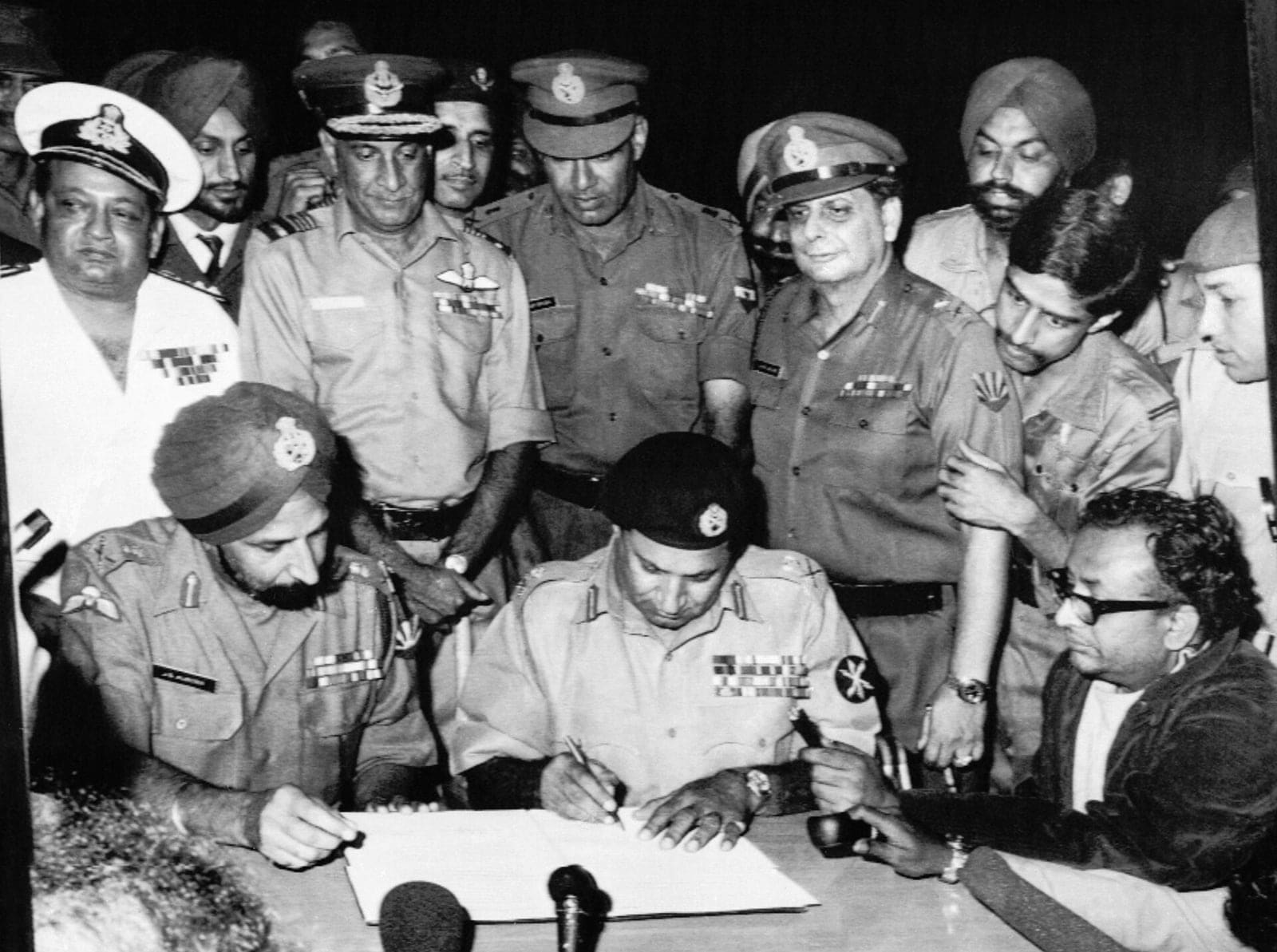
The war also drew in the superpowers. The Soviet Union vetoed ceasefire resolutions at the UN Security Council. Nixon ordered an American naval task force led by the aircraft carrier USS Enterprise into the Bay of Bengal, a show of support for Pakistan that Indians long remembered. It arrived too late to change anything. On 16 December 1971, at the Ramna Race Course in Dhaka, Lieutenant General A. A. K. Niazi, commander of Pakistan's Eastern Command, signed the Instrument of Surrender before Lieutenant General Jagjit Singh Aurora, the commander of India's Eastern Command. About 93,000 Pakistani soldiers and civilians became prisoners of war. India declared a ceasefire in the west, which took effect the next day (Ramachandra Guha, India after Gandhi[4]).
What did the Simla Agreement settle?
Mujib was released and returned to Dhaka in January 1972 as the leader of the new state, and Indian troops left Bangladesh by March. In Pakistan, Yahya Khan resigned and Bhutto took power. In late June 1972, Indira Gandhi and Bhutto met at Simla. In the Simla Agreement, signed on 2 July, the two countries agreed to settle their differences by peaceful means through bilateral negotiation, and to respect the line of control in Jammu and Kashmir resulting from the ceasefire of 17 December 1971, which became the Line of Control, the line Pakistani troops would cross at Kargil in 1999 (Ministry of External Affairs, Simla Agreement[5]). India returned most of the territory it had taken in the west. The prisoners of war were repatriated by 1974, the year Pakistan recognised Bangladesh.
What did 1971 change?
For India, 1971 erased the memory of 1962 and made Indira Gandhi, for a time, the dominant figure in Indian politics. The war showed that India could act decisively in its region, and the American naval deployment pushed it closer to the Soviet Union for two decades. Critics have since asked whether India's motives were humanitarian or strategic; most historians conclude that they were both, and that the refugee crisis was the trigger. For Pakistan, the loss of half its population was a national trauma, and Bhutto's government started a nuclear weapons programme soon afterwards. For Bangladesh, independence came at a terrible price, and the questions of justice for the killings of 1971 still shape its politics (Srinath Raghavan, 1971[1]). In India, 16 December is marked as Vijay Diwas, Victory Day, and in Bangladesh as Bijoy Dibosh.
1971 timeline
| Date | Event |
|---|---|
| 21 February 1952 | Language movement killings in Dhaka |
| 1966 | The Awami League's six-point programme for autonomy |
| November 1970 | Bhola cyclone devastates the coast of East Pakistan |
| December 1970 | Awami League wins a national majority in Pakistan's election |
| 7 March 1971 | Mujib's speech at the Dhaka Race Course |
| 25 March 1971 | Operation Searchlight; Mujib arrested |
| April 1971 | Archer Blood's dissent cable; government-in-exile formed at Mujibnagar |
| 1 August 1971 | Concert for Bangladesh in New York |
| 9 August 1971 | Indo-Soviet Treaty of Peace, Friendship and Cooperation |
| 3 December 1971 | Pakistani air strikes; war begins |
| 4–5 December 1971 | Operation Trident against Karachi; battle of Longewala |
| 16 December 1971 | Pakistani surrender in Dhaka |
| 17 December 1971 | Ceasefire in the west |
| January 1972 | Mujib returns to Dhaka |
| 2 July 1972 | Simla Agreement signed |
| 1974 | Prisoners of war repatriated; Pakistan recognises Bangladesh |