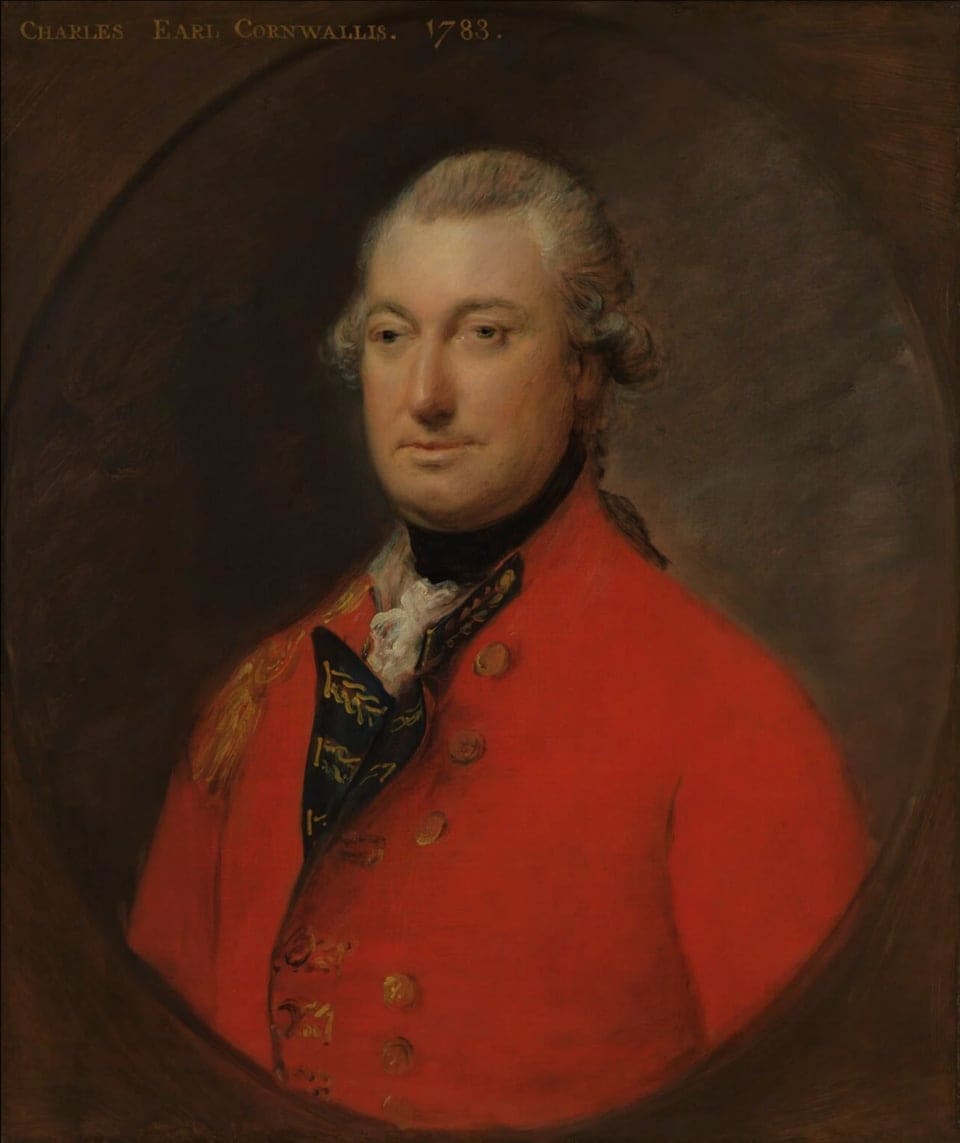
On 22 March 1793 the Governor-General of the East India Company's territories, Lord Cornwallis, proclaimed that the land revenue of Bengal and Bihar would be fixed for ever. The zamindars, the great landholders who collected the revenue from the villages, were recognised as the owners of their estates. They could buy, sell, mortgage and bequeath them like any English landlord, and the state promised never to raise what they owed. In return, they had to pay in full and on time, or lose their land at auction. The Permanent Settlement was meant to give the Company a secure income and Bengal an improving class of landlords. It did change who owned Bengal's land, more than anyone intended, and it shaped the countryside of eastern India until after independence (Sugata Bose, Peasant Labour and Colonial Capital[1]).
Why did the Company want a permanent settlement?
When the Mughal emperor granted the Company the diwani of Bengal, Bihar and Orissa in 1765, after Plassey and Buxar, the Company became responsible for collecting the land revenue, the largest source of income in the province. It had little idea how to do it. In 1769–70 a terrible famine killed perhaps a third of the people of Bengal, yet the Company's collections hardly fell, which says much about how hard they were pressed. In 1772, under Warren Hastings, it auctioned the right to collect revenue to the highest bidders for five years. Many bidders were speculators who promised more than the land could yield, then squeezed the peasants or defaulted. Annual settlements followed, and revenue remained uncertain (P. J. Marshall, Bengal: The British Bridgehead[2]).
Officials in Bengal and London increasingly argued for a fixed, permanent tax. Philip Francis, a member of the Bengal council, had proposed one in 1776. Many were influenced by the economic ideas of their time, especially the belief that agriculture was the source of national wealth and that secure property encouraged landowners to invest. If zamindars knew that the state would never take more, the reasoning went, they would bring waste land under the plough, improve their estates and keep the increase. A fixed tax would also give the Company a predictable income and save it the cost of reassessing the land every few years. The historian Ranajit Guha later called this "a rule of property for Bengal" (Burton Stein, A History of India[4]).
How did the settlement work?
Cornwallis arrived in 1786 with instructions from London to settle the revenue permanently. Settlements for ten years were made with the zamindars in 1789–90. John Shore, the Company's leading revenue expert, argued for keeping them at ten years until more was known about the land, but Cornwallis overruled him, and in 1793 the decennial settlement was declared permanent (S. C. Ray, The Permanent Settlement in Bengal[3]).
The revenue was fixed at the level of the 1789–90 assessment, which was high. In principle, the state took about ten-elevenths of the rent the zamindar collected, and the zamindar kept the rest. The zamindars became legal owners, but with one condition attached. Under what came to be called the sunset law, if a zamindar had not paid his instalment by sunset on the due date, his estate, or part of it, could be sold at public auction to make up the arrears (P. J. Marshall, Bengal: The British Bridgehead[2]).
What happened to the old zamindars?
In the first two decades, the results were drastic. The revenue demand was rigid, but harvests and prices were not. Many of the great old zamindar families, whose lands stretched across several districts, fell behind on their payments. Peasants who had their own problems paid late, the zamindars' agents cheated, and the Company would not wait. Large parts of Bengal's estates were sold at auction in the 1790s and early 1800s, including portions of the great estates of Burdwan, Nadia and Rajshahi. The buyers were often merchants, moneylenders and officials from Calcutta, or the zamindars' own former agents. Some old families held on by buying back their own land through relatives and agents under false names (Sugata Bose, Peasant Labour and Colonial Capital[1]).
Others found ways to pass the risk downward. The Raja of Burdwan leased out parts of his estate as patni tenures, permanent sub-leases on which the holder paid a fixed rent and could himself be sold up for default. The government legalised these tenures in 1819, and the system spread. Layers of intermediate tenure-holders grew between zamindar and peasant, each taking a share. Many zamindars moved to Calcutta and lived on their rents, and absentee landlordism became a mark of the Bengal countryside.
What did it mean for the peasants?
The settlement fixed what the zamindar owed the state, not what the peasant owed the zamindar. The regulations of 1793 told zamindars to give their tenants written agreements, but the rights of the ryots (peasant cultivators) were left vague. A regulation of 1799 allowed zamindars to seize a tenant's crops and property for unpaid rent without going to court. Rents rose, and peasants had little protection until the Bengal Rent Act of 1859 and the Bengal Tenancy Act of 1885 gave occupancy rights to some of them (Burton Stein, A History of India[4]).
The picture in the villages was also more varied than the zamindar-and-ryot model suggests. In many areas, especially northern Bengal, power lay with jotedars, rich peasants who controlled large areas of land, lent money and grain, and had the land worked by sharecroppers. Historians such as Sugata Bose have shown that patterns of landholding and labour differed greatly from one part of Bengal to another, and that these differences mattered as much as the settlement itself (Sugata Bose, Peasant Labour and Colonial Capital[1]).
Was the Permanent Settlement a success?
For the Company, it brought a steady income in the short run. In the long run, the fixed revenue lost value. As cultivation spread and prices rose over the nineteenth century, rents grew, but the state's share stayed the same. Later British officials regarded the settlement as a costly mistake, and when the Company settled other provinces it did not repeat it. In Madras and Bombay, Thomas Munro and others developed the ryotwari system, in which the state dealt directly with the cultivators and reassessed periodically. In the North-Western Provinces, the mahalwari system settled the revenue with village communities. The Permanent Settlement was extended only to Benares in 1795 and to parts of the Madras Presidency (Burton Stein, A History of India[4]).
The settlement did not produce the improving landlords Cornwallis had hoped for. Most zamindars invested in more land and rents rather than in drainage or new crops, and when crops failed, the burden fell on the cultivators. The weakness of tenant rights helps explain why later famines in Bengal, above all the Bengal famine of 1943, hit the landless so hard. Its social effects went further. It created a class of Bengali landholders whose rents supported Calcutta's professions and much of the nineteenth-century cultural revival, and a countryside in which many Muslim and low-caste peasants worked land held by Hindu landlords. That division would later shape Bengal's politics. After independence, East Bengal abolished the zamindari system in 1950 and West Bengal in 1953 (Sugata Bose, Peasant Labour and Colonial Capital[1]).
Permanent Settlement timeline
| Date | Event |
|---|---|
| 1765 | The East India Company receives the diwani of Bengal, Bihar and Orissa |
| 1769–1770 | Great famine in Bengal |
| 1772 | Warren Hastings auctions revenue rights for five years |
| 1776 | Philip Francis proposes a permanent land tax |
| 1784 | Pitt's India Act asks for permanent rules of revenue |
| 1786 | Lord Cornwallis arrives as Governor-General |
| 1789–1790 | Ten-year (decennial) settlement made with the zamindars |
| 22 March 1793 | The settlement is proclaimed permanent |
| 1795 | Extended to the Benares region |
| 1799 | Zamindars allowed to seize tenants' property for arrears |
| 1819 | Patni tenures given legal recognition |
| 1859 | Bengal Rent Act |
| 1885 | Bengal Tenancy Act |
| 1950–1953 | Zamindari abolished in East Bengal and West Bengal |