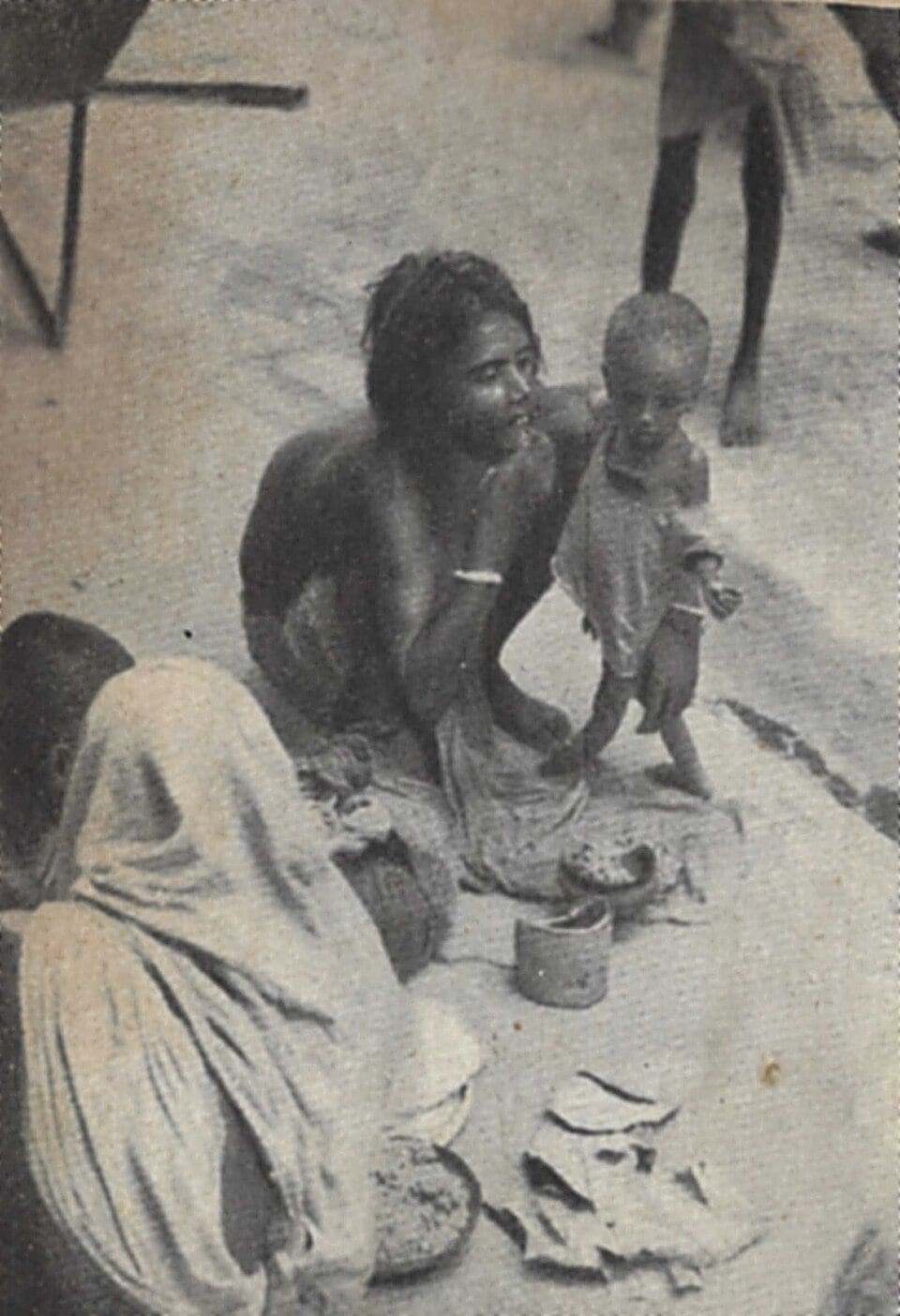
In 1943, while the British Empire was fighting the Second World War from bases in India, a famine killed around three million people in Bengal. The official inquiry put the number of deaths from the famine at about one and a half million; most later estimates run from about two to three million or more. The victims were mostly the rural poor: landless labourers, fishermen, artisans and the families of small cultivators, many of whom walked to Calcutta in search of food and died on its pavements. Bengal's total rice supply in 1943, Amartya Sen argued, was not dramatically worse than in other years, though some historians dispute this. The famine is now understood less as a shortage of food than as a collapse of poor people's ability to buy it, caused by war, policy and inflation (Amartya Sen, Poverty and Famines[2]).
What caused the Bengal famine?
Several blows fell on Bengal at once. In 1942 Japan conquered Burma, which had sold rice to Bengal, and the Japanese army stood on the province's eastern border. The government expected an invasion. Under a "denial policy", officials removed surplus rice from the coastal districts and seized or destroyed tens of thousands of boats so that an invading army could not use them. For the fishermen and boatmen of the delta, and for the farmers who moved their crops by river, losing their boats meant losing their livelihood (Famine Inquiry Commission, Report on Bengal[1]).
In October 1942 a cyclone and tidal surge struck Midnapore and the neighbouring coast, killing thousands and flooding rice fields with salt water. A fungal disease damaged much of the main winter rice crop. At the same time, war spending was flooding Bengal with money. Calcutta was a base for the war against Japan, the army and war industries were buying food, and prices of everything rose. Traders and well-off farmers, expecting prices to keep climbing, held on to their rice. Other provinces restricted the movement of grain out of their territory, so supplies from elsewhere in India did not arrive (Sugata Bose, Peasant Labour and Colonial Capital[4]).
The result was a price explosion. In Calcutta, rice that had cost about thirteen rupees a maund at the end of 1942 cost well over twice as much by mid-1943, and far more in some rural markets. Wages for agricultural labourers did not rise nearly as fast. Amartya Sen, who saw the famine as a nine-year-old boy in Santiniketan, later argued that the total supply of food in Bengal in 1943 was not much smaller than in earlier years, and was larger than in 1941, when there had been no famine. What collapsed, he argued, was the "entitlement" of particular groups, their ability to command food through wages, trade or their own produce (Amartya Sen, Poverty and Famines[2]).
Why didn't the government stop it?
Feeding the war effort came first. The government made sure that Calcutta's industrial workers, government employees and the armed forces were supplied with rice at controlled prices, and bought for them in the open market, pushing prices even higher for everyone else. The Bengal government denied for months that there was a famine at all and did not declare one under the Famine Code, the rules drawn up after the Great Famine of 1876–78, which would have required it to open relief works and free kitchens. Ministers in Calcutta, officials in Delhi and the government in London blamed one another, and a price-control scheme was abandoned in early 1943 (Famine Inquiry Commission, Report on Bengal[1]).
In London, Winston Churchill's war cabinet, short of shipping and determined to protect food stocks in Britain and for the war, refused or reduced repeated requests from the Viceroy and the Secretary of State for India, Leo Amery, for grain imports to India in 1943. Some rice continued to leave India in the early part of the year. Madhusree Mukerjee and others have argued that these decisions made the famine far worse, and that Churchill's personal hostility to Indians played a part. Other historians stress the genuine shortage of ships and the many failures within India. The weight to be given to each is still debated, but there is broad agreement that imports arrived too late and in too small amounts (Madhusree Mukerjee, Churchill's Secret War[3]).
What happened in Calcutta and the countryside?
By the summer of 1943, tens of thousands of starving people from the districts had walked to Calcutta, where they begged for rice water outside houses and died on the streets. Wartime censorship kept much of this out of the press. In August 1943 The Statesman, the British-owned Calcutta daily edited by Ian Stephens, published photographs of famine victims in the city and editorials attacking the government, and the famine became known around the world (Madhusree Mukerjee, Churchill's Secret War[3]).
Lord Wavell became Viceroy in October 1943. Within days he travelled to Calcutta and the countryside, and he ordered the army to transport food and run relief. Relief kitchens, rationing in Calcutta and the arrival of the large aman rice harvest at the end of the year eased the starvation. But hunger had weakened millions, and in the months that followed more people died of cholera, malaria, smallpox and dysentery than had died of starvation itself. Deaths remained high well into 1944 (Famine Inquiry Commission, Report on Bengal[1]).
Bengali artists and writers recorded what they saw. The artists Chittaprosad, whose drawings were published as Hungry Bengal, and Zainul Abedin sketched the starving in the villages and streets. Bijon Bhattacharya's play Nabanna, staged by the Indian People's Theatre Association in 1944, put the famine on stage, and Satyajit Ray's film Ashani Sanket (1973) returned to it a generation later.
Who was to blame?
The Famine Inquiry Commission, chaired by Sir John Woodhead, reported in 1945. It concluded that the famine could have been prevented. It blamed the Bengal government for failing to control the rice market and to recognise the famine in time, criticised the Government of India for not organising grain supplies between provinces sooner, and condemned hoarding and profiteering by traders. It said less about decisions taken in London (Famine Inquiry Commission, Report on Bengal[1]).
For Indian nationalists, then in prison after the Quit India Movement, the famine was proof that British rule could not protect Indians' most basic interests, and it added bitterness to the last years of the Raj. The famine also sharpened tensions in Bengal: the provincial governments of 1943 were led first by Fazlul Huq and then by the Muslim League's Khawaja Nazimuddin, and Hindu and Muslim politicians accused one another of profiteering and neglect (Sugata Bose, Peasant Labour and Colonial Capital[4]). Three years later, Calcutta's streets saw killing on a different scale in the communal violence before Partition.
Amartya Sen's work on the famine, published in 1981, changed how economists understand famines everywhere, and in later work he argued that famines do not occur in functioning democracies with a free press, because governments that must face voters and newspapers cannot ignore starvation. Independent India has suffered droughts and food shortages but no famine on the scale of 1943, and the memory of Bengal was one reason its leaders put such weight on food security, from controlled grain distribution to the Green Revolution.
Bengal famine timeline
| Date | Event |
|---|---|
| March 1942 | Rangoon falls to Japan; Burma's rice is cut off |
| Spring 1942 | Denial policy: rice and boats removed from coastal Bengal |
| August 1942 | Quit India Movement begins; nationalist leaders are imprisoned |
| 16 October 1942 | Cyclone strikes Midnapore and the coast |
| Early 1943 | Price controls abandoned; rice prices rise steeply |
| Mid-1943 | Starving migrants pour into Calcutta |
| August 1943 | The Statesman publishes photographs of famine victims |
| October 1943 | Lord Wavell becomes Viceroy, visits Calcutta and calls in the army |
| Late 1943 | Aman harvest eases food shortage; epidemics continue |
| 1944 | Deaths from disease remain high |
| 1945 | The Famine Inquiry Commission reports |