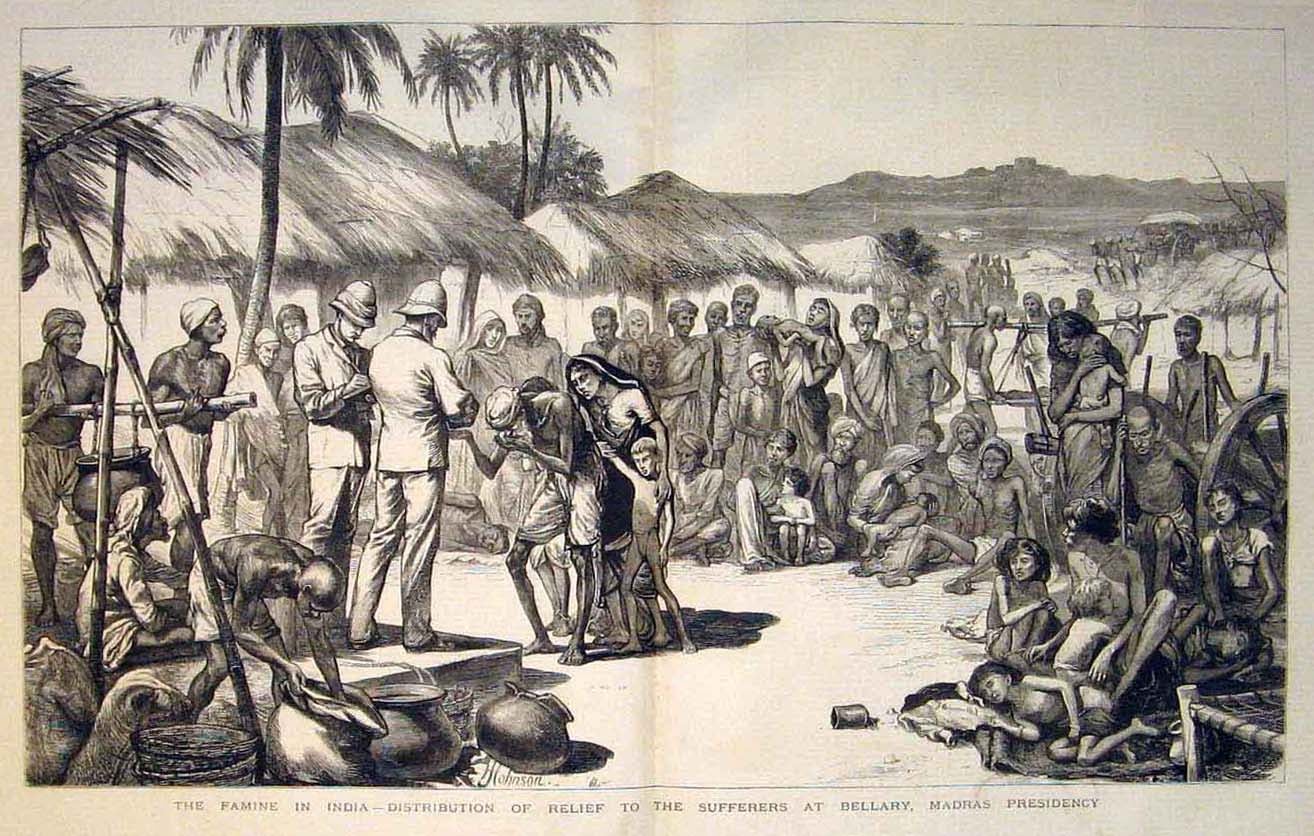
In the summer of 1876 the monsoon failed across the Deccan plateau and much of southern India. The rains were weak again in 1877, and the drought spread north. Over the next two years one of the worst famines in Indian history killed millions of people in the Madras and Bombay presidencies, the states of Mysore (then under British administration) and Hyderabad, and later parts of northern India. The government's own Famine Commission estimated some five and a quarter million deaths in British territory alone; later estimates, including the princely states, run from about five and a half to more than ten million. The drought was a natural event, but the scale of the death was not, and the arguments over who was responsible shaped both British famine policy and Indian nationalism (Mike Davis, Late Victorian Holocausts[1]).
How did a drought become a famine?
Most of the people who died did not die because there was no food in India. There was grain in the markets of the affected districts, and grain was still being exported from India during the crisis. What the poor lacked was the means to buy it. When the rains failed, farm labourers, weavers and small cultivators lost their work and income just as prices soared. Many had little or nothing saved, and many had already been pushed into debt by high land revenue and the shift to cash crops. They sold their cattle, their tools, their brass vessels, and then began to starve (Mike Davis, Late Victorian Holocausts[1]).
Mike Davis has linked the drought to El Niño, the warming of the Pacific that disrupts rainfall across the tropics, and placed the Indian famine alongside simultaneous disasters in China and Brazil. His argument is that colonial economic policy turned a climatic shock into mass death. Not all historians accept his framing, but the evidence that the poor starved amid available food is not in dispute.
How did the government respond?
The Viceroy, Lord Lytton, and his advisers believed that the government should not interfere in the grain trade, and that private merchants would move grain to wherever it was needed. They also feared that generous relief would bankrupt the treasury and teach people to depend on the state. In 1873–74, during a famine in Bihar, Sir Richard Temple had imported grain and spent heavily on relief, and few people died, but he was criticised for extravagance. In the new crisis, the Government of India was determined to spend less (Mike Davis, Late Victorian Holocausts[1]).
On 1 January 1877, as the famine was spreading in the south, Lytton presided over a vast assemblage at Delhi to proclaim Queen Victoria Empress of India. The celebration fed tens of thousands of guests for a week, and it was later held up by critics as a symbol of the government's priorities.
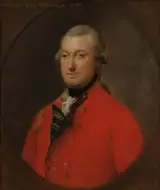
Temple was sent to Madras and Bombay as the Viceroy's famine delegate, this time with instructions to cut costs. Relief was given mainly through public works, such as road-building and digging, and able-bodied people had to work to receive it, often far from home. In early 1877 Temple reduced the daily wage on the relief works to one pound of grain and one anna for a man doing heavy labour, which became known as the "Temple wage". Dr William Cornish, the Sanitary Commissioner of Madras, protested that this was less than a prisoner received in jail and not enough to keep a working person alive. Mortality on the works rose sharply, and the ration was raised later in the year (William Digby, The Famine Campaign in Southern India[2]).
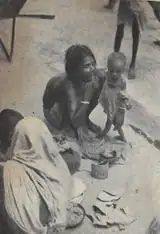
The Madras government, under the Duke of Buckingham, clashed with the Government of India over the limits on relief and tried to be more generous. In Britain, public appeals raised large sums for private charity, which William Digby, a journalist in Madras who acted as secretary to the relief fund there, later described in his two-volume The Famine Campaign in Southern India. Photographs taken by the army officer Willoughby Wallace Hooper and engravings in the Illustrated London News brought images of the starving to British readers (William Digby, The Famine Campaign in Southern India[2]).
What did the famine change?
The scale of the disaster forced a rethink. In 1878 the government appointed a Famine Commission under Sir Richard Strachey, whose report of 1880 accepted that it was the state's duty to save life in famine and set out principles for doing so. It recommended relief works close to people's homes, free relief for those who could not work, the suspension of land revenue in affected areas, and the building of railways and irrigation to move grain and protect against drought. It also recommended a Famine Insurance Fund (Report of the Indian Famine Commission[3]).
From these recommendations came the Famine Codes, the first of which was drafted in 1883 and adopted by the provinces over the following years. They defined the stages of scarcity and famine, told officials what signs to watch for, and set out rules for relief. The codes did not prevent later famines, including the terrible famines of 1896–97 and 1899–1900, and they still relied on hard work tests. But they gave India a framework for famine relief that lasted into the twentieth century, and their method of watching for warning signs influenced famine policy long afterwards.
How did Indians respond?
For educated Indians, the famine became evidence of a deeper problem with British rule. Dadabhai Naoroji, the Bombay merchant and scholar, had been arguing since the late 1860s that India's poverty was caused by a "drain of wealth": the money that left India each year as pensions, salaries, interest and profits paid in Britain, without anything coming back. The famines of the 1870s seemed to confirm it. In the Deccan, the Poona Sarvajanik Sabha, a public body associated with the reformer Mahadev Govind Ranade, sent volunteers to report on conditions and criticised government relief policy (Bipan Chandra et al., India's Struggle for Independence[4]).
The economic critique that grew out of these years, later developed by writers such as Romesh Chunder Dutt, became one of the foundations of the early national movement and of the Indian National Congress, founded in 1885. In 1879, in the famine-stricken Deccan, Vasudev Balwant Phadke went further, raising a small armed band against British rule. He was captured and transported to Aden, where he died.
How is the famine remembered?
In Tamil Nadu the famine is still remembered as the Thathu Varusha Panjam, after the name of the year it began in the Tamil calendar. In Britain it was largely forgotten until historians returned to it in the late twentieth century. It has since become central to debates about whether colonial rule made India's famines worse. Most historians agree that policy, and not only drought, decided how many people died. Later disasters, from the famines of the 1890s to the Bengal famine of 1943, showed how much depended on whether officials chose to act (Mike Davis, Late Victorian Holocausts[1]).
Great Famine timeline
| Date | Event |
|---|---|
| 1873–1874 | Famine in Bihar; Richard Temple's costly but effective relief |
| Mid-1876 | The monsoon fails across the Deccan and southern India |
| 1 January 1877 | Lord Lytton's Delhi assemblage proclaims Victoria Empress of India |
| Early 1877 | Temple reduces the relief wage on public works |
| 1877 | The monsoon fails again; famine spreads; relief funds raised in Britain |
| 1878 | The famine extends to parts of northern India; Famine Commission appointed |
| 1879 | Vasudev Balwant Phadke's rising in the Deccan |
| 1880 | The Famine Commission reports |
| 1883 | The first provisional Famine Code is drafted |