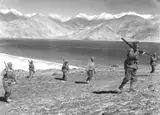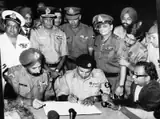
In August 1965, eighteen years after Partition had left Kashmir divided and contested, Pakistan tried to settle the question by force. Armed infiltrators crossed into the Indian-held part of the state, hoping to set off a popular rising. When that failed, Pakistani tanks drove towards Akhnoor and the road that supplied Indian forces in southern Kashmir. India answered by crossing the international border in Punjab and threatening Lahore. For three weeks the two armies fought the largest tank battles anywhere since the Second World War. Then, under pressure from the United Nations and the superpowers, they stopped, and in January 1966, at Tashkent, they agreed to return to where they had started (Srinath Raghavan, War and Peace in Modern India[1]).
Why did Pakistan go to war?
By 1965 Pakistan's military ruler, Field Marshal Ayub Khan, and his foreign minister, Zulfikar Ali Bhutto, believed that time was against them. India had been badly defeated by China in the war of 1962 and was rearming fast with Western and Soviet help. Nehru had died in 1964, and his successor, Lal Bahadur Shastri, a small, soft-spoken man, was thought to be weak. In Kashmir there was unrest after the theft of a holy relic from the Hazratbal shrine in Srinagar in late 1963. Pakistan's leaders concluded that a short, sharp campaign could force the Kashmir question open before India grew too strong (Farooq Bajwa, From Kutch to Tashkent[2]).
The first test came in the Rann of Kutch, the salt marshes on the Gujarat-Sindh border, where the boundary had never been clearly drawn. In April 1965 Pakistani and Indian forces clashed there, and Pakistan's American-supplied Patton tanks gave it the better of the fighting. Britain brokered a ceasefire, and the dispute went to an international tribunal, which in 1968 awarded about a tenth of the disputed area to Pakistan. The episode encouraged Pakistan's planners to think that India would not fight hard.
What were Operation Gibraltar and Grand Slam?
In early August, several thousand Pakistani irregulars and soldiers, organised in groups named after Muslim conquerors, crossed the ceasefire line into Kashmir in Operation Gibraltar. The plan assumed that Kashmiris would rise to join them. They did not. Many villagers reported the infiltrators to the police and army, and the operation was broken up. India went on the offensive in the mountains, and at the end of August Indian troops captured the Haji Pir pass, a main route the infiltrators had used (Srinath Raghavan, War and Peace in Modern India[1]).
On 1 September Pakistan launched Operation Grand Slam, an armoured thrust in the Chhamb sector in the south of Kashmir aimed at Akhnoor, a town on the Chenab guarding the road from Jammu to Indian forces in Rajouri and Poonch. If Akhnoor fell, those forces could be cut off and Jammu itself threatened. The Indian Air Force was thrown in, and the attack slowed (Farooq Bajwa, From Kutch to Tashkent[2]).
How did the war spread to Punjab?
Shastri and his army chief, General J. N. Chaudhuri, decided not to fight only on ground of Pakistan's choosing. On 6 September Indian troops crossed the international border in Punjab and advanced towards Lahore, and two days later they attacked in the Sialkot sector further north. Pakistan had to pull forces back to defend its heartland, which relieved the pressure on Akhnoor.
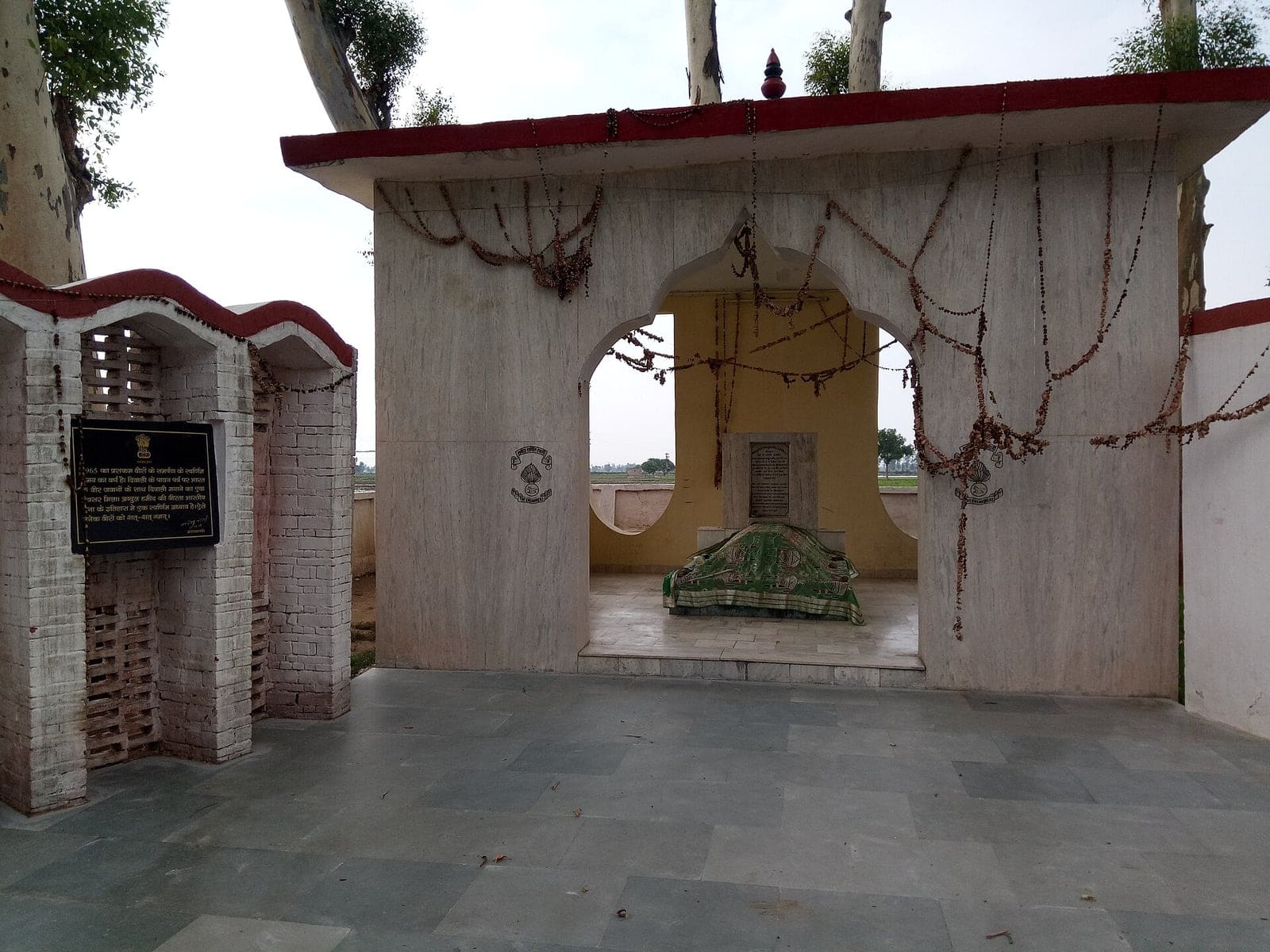
The decisive battle in Punjab was fought near the village of Asal Uttar, close to Khem Karan, from 8 to 10 September. Pakistan's 1st Armoured Division, equipped with modern American Patton tanks, attacked into Indian territory. The Indian commanders flooded the fields around their positions and laid an ambush in the sugarcane, and the Pakistani tanks bogged down and were destroyed or abandoned in large numbers. So many were left behind that the area was nicknamed "Patton Nagar", Patton town. Company Quartermaster Havildar Abdul Hamid, firing a recoilless gun mounted on a jeep, knocked out several tanks before he was killed. He was awarded the Param Vir Chakra after his death (Srinath Raghavan, War and Peace in Modern India[1]).
In the Sialkot sector, the battles of Phillora and Chawinda pitted hundreds of tanks against each other in some of the largest armoured engagements since 1945. Lieutenant Colonel A. B. Tarapore of the Poona Horse was killed there and also received the Param Vir Chakra. Indian forces advanced but could not take Chawinda. On the Lahore front they reached the Ichhogil canal, and in the war's last days took the village of Dograi on its banks. In the air, both air forces struck at each other's bases, and India's small Gnat fighters earned a reputation for downing Pakistan's Sabres.
How did the war end?
Neither side could win outright, and both were running short of ammunition. The United States and Britain stopped arms supplies to both countries, and China sent India a threatening ultimatum about its border with Sikkim. On 20 September the UN Security Council passed Resolution 211, demanding a ceasefire, and it took effect on 23 September. Each side claimed victory. Most historians see the war as a military stalemate, though India held more territory at the end and had defeated the attempt to take Kashmir by force. Several thousand soldiers had died on each side (Ramachandra Guha, India after Gandhi[3]).
The Soviet premier, Alexei Kosygin, invited Shastri and Ayub Khan to Tashkent, in Soviet Uzbekistan. After a week of hard negotiation, they signed the Tashkent Declaration on 10 January 1966. Both sides agreed to withdraw their forces to the positions they had held before 5 August 1965 and to settle their disputes by peaceful means (Ministry of External Affairs, Tashkent Declaration[4]). India gave back the Haji Pir pass, which was unpopular at home. In the early hours of the next morning, 11 January, Shastri died in Tashkent, officially of a heart attack.
What did the war change?
In India, the war restored some of the confidence lost in 1962 and made Shastri a national hero in his short time as Prime Minister. During the war, as American food aid became uncertain, he asked Indians to skip a meal a week, and he popularised the slogan "Jai Jawan, Jai Kisan", "Hail the soldier, hail the farmer". The food crisis of the mid-1960s helped launch the Green Revolution (Ramachandra Guha, India after Gandhi[3]).
In Pakistan, the war damaged Ayub Khan's rule. Bhutto broke with him over Tashkent, and in East Pakistan many people concluded that their defence had been neglected while the army fought in the west, a grievance that fed into the crisis of 1971. The Kashmir dispute itself was no closer to a settlement, and in 1999 Pakistan would again try to change the line by stealth, at Kargil. The next war between the two countries, six years later, would be fought mainly over East Pakistan and would end very differently, with the liberation of Bangladesh.
1965 war timeline
| Date | Event |
|---|---|
| December 1963 | Theft of the relic from the Hazratbal shrine causes unrest in Kashmir |
| April 1965 | Fighting in the Rann of Kutch |
| 30 June 1965 | Ceasefire in Kutch, brokered by Britain |
| August 1965 | Operation Gibraltar: infiltrators enter Kashmir |
| 28 August 1965 | Indian troops capture the Haji Pir pass |
| 1 September 1965 | Operation Grand Slam: Pakistani armour attacks Chhamb towards Akhnoor |
| 6 September 1965 | India crosses the Punjab border towards Lahore |
| 8–10 September 1965 | Battle of Asal Uttar |
| September 1965 | Tank battles of Phillora and Chawinda in the Sialkot sector |
| 20 September 1965 | UN Security Council Resolution 211 demands a ceasefire |
| 23 September 1965 | Ceasefire takes effect |
| 10 January 1966 | Tashkent Declaration signed |
| 11 January 1966 | Lal Bahadur Shastri dies in Tashkent |