In the first two decades after independence, India could not reliably feed itself. Repeated droughts, a fast-growing population, and agriculture still organized much as it had been for generations left the country dependent on foreign food aid, most of it wheat shipped from the United States under the PL-480 programme; officials and commentators of the era openly described India as living a "ship-to-mouth" existence, with grain reserves so thin that a delayed cargo could threaten shortages in Indian cities. Two consecutive years of severe drought, in 1965-66 and 1966-67, pushed the crisis to its worst point and turned the search for a faster way to raise domestic grain output into an urgent matter of national policy rather than long-term research.
Borlaug's seeds and Swaminathan's trials
The breakthrough India adopted had already been proven elsewhere. Working in Mexico from the 1940s, the American agronomist Norman Borlaug had bred semi-dwarf wheat varieties that, unlike traditional tall wheat, could take up much larger doses of fertilizer without collapsing under their own weight, producing far higher yields per acre when grown with adequate water and nutrients. M. S. Swaminathan, a geneticist at the Indian Agricultural Research Institute in New Delhi who had lived through the Bengal famine of 1943 and made food security his life's work, invited Borlaug to India in 1963 and helped organize multi-location trials of the Mexican varieties under Indian growing conditions. The results were strong enough that in 1966 the Indian government, under agriculture minister C. Subramaniam, approved the import of some 18,000 tonnes of Mexican wheat seed — at the time the largest seed import of its kind anywhere — to be sown at scale.

A concentrated transformation
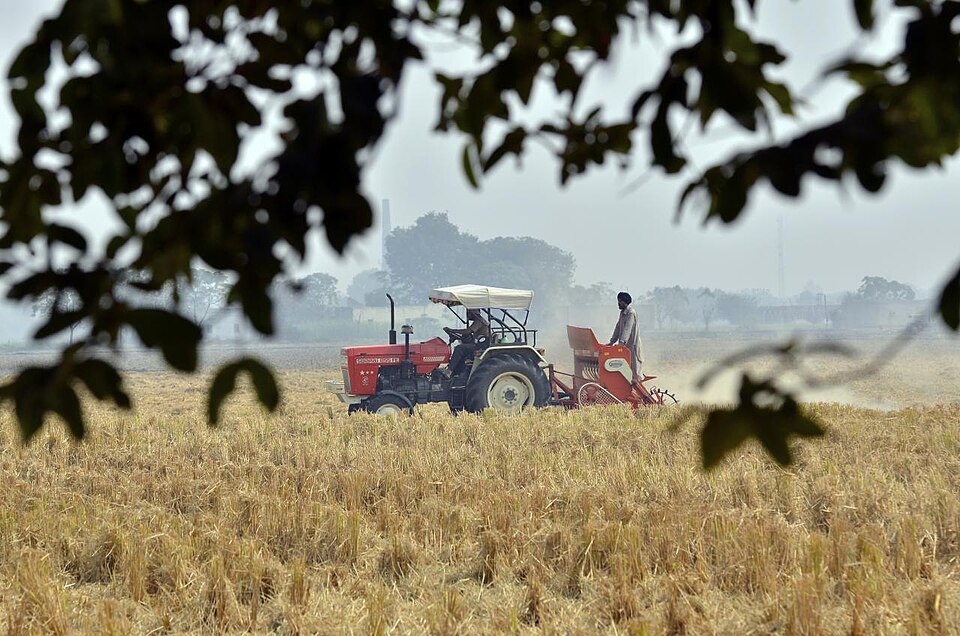
The new seeds performed best where farmers could guarantee irrigation and afford the fertilizer they needed, and those conditions existed most reliably in Punjab, Haryana, and western Uttar Pradesh, which is where the new agriculture took hold fastest and most completely. Working with scientists at Punjab Agricultural University, agronomists such as Dilbagh Singh Athwal helped adapt and popularize wheat varieties like Kalyan Sona for local conditions, and Punjab in particular was transformed within a few growing seasons from an ordinary farming region into the country's grain-surplus heartland. The national numbers moved quickly: wheat production rose from roughly 12 million tonnes in 1965 to about 20 million tonnes by 1970, and total foodgrain output climbed from about 72 million tonnes in 1965-66 to more than 108 million tonnes by 1970-71, with rice yields improving further over the following decade through varieties developed at the International Rice Research Institute and adapted for Indian conditions. By the mid-1970s, India had built up enough of a buffer to end its dependence on imported food grain — a shift significant enough that an American aid official, William Gaud, had already coined the term "Green Revolution" to describe it in 1968.
A gain with costs still being weighed
The Green Revolution's core achievement — turning a food-aid-dependent country into one that fed itself — is not seriously disputed. What agricultural economists and historians continue to debate is how to weigh that achievement against its longer-term costs. Because the new varieties succeeded mainly where irrigation was already reliable, the gains concentrated heavily in Punjab, Haryana, and a handful of other regions, while large parts of eastern and central India, where farming still depended on rainfall, saw far less benefit — a regional gap in agricultural income that has never fully closed. The intensive irrigation, and the wheat-rice cropping cycle it made possible, drew down groundwater in Punjab and Haryana faster than it could be replenished, and decades of heavy fertilizer and pesticide use degraded soil quality and, by some accounts, local water supplies in the most intensively farmed districts. Rising costs for seed, fertilizer, and irrigation also pushed many smaller farmers into debt even as national output climbed. None of this reverses the basic fact that the Green Revolution ended famine-level food insecurity in India within about a decade; it does mean that historians increasingly describe it less as an unqualified triumph than as a genuine trade-off whose bill, in soil and water if not in hunger, is still being paid in the regions that adopted it first.