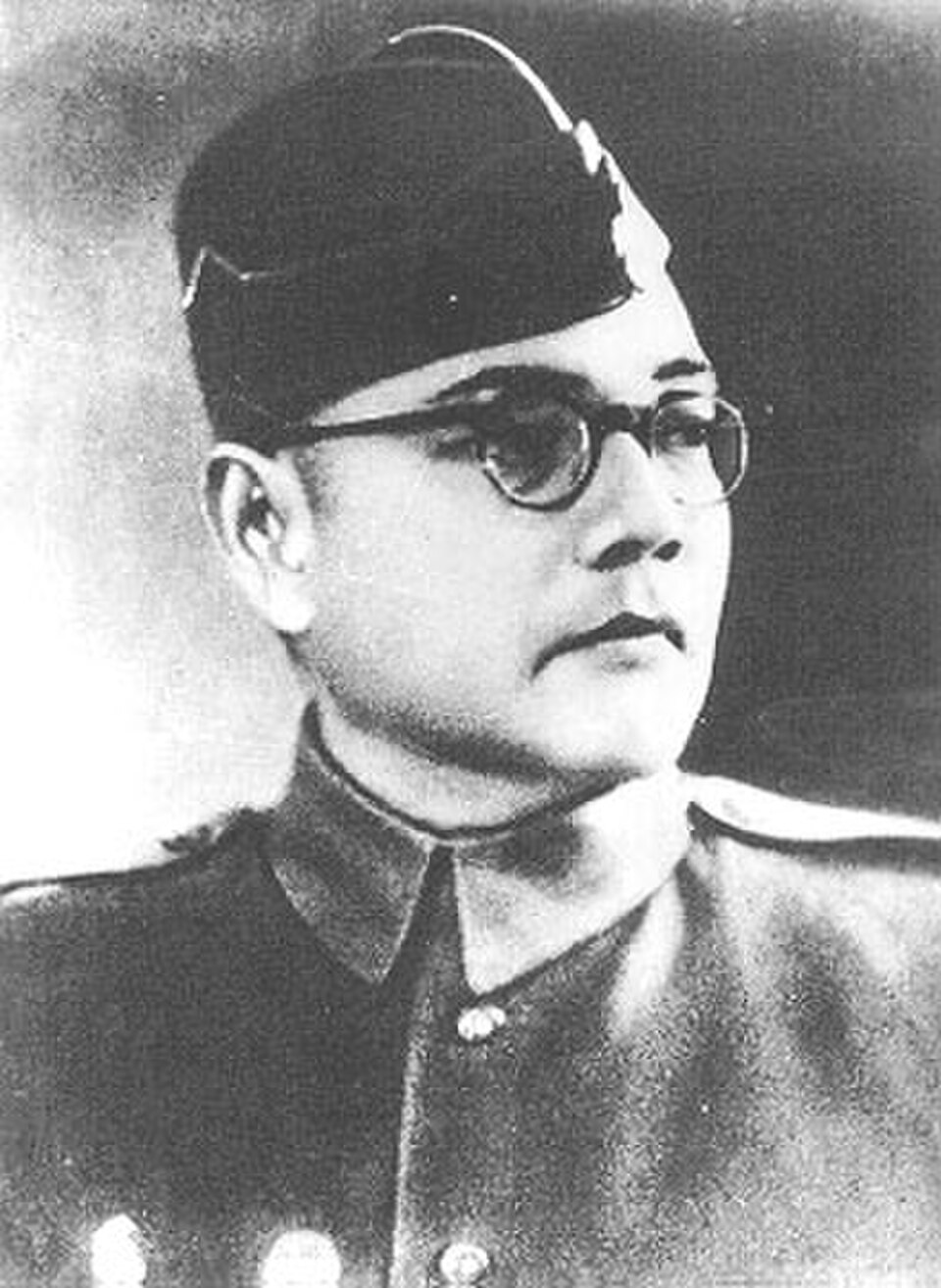
Subhas Chandra Bose, born in Cuttack in 1897, passed the Indian Civil Service examination in England in 1920 but resigned the following year, judging that he could not serve the colonial administration he wanted to overthrow. He rose quickly within the Indian National Congress, serving as its president in 1938 and again in 1939, but his 1939 re-election, won against Gandhi's preferred candidate, provoked a bitter internal conflict over strategy and ideology — Bose favored a more confrontational and militarily assertive approach to independence than Gandhi's — and he resigned the presidency within months, later founding his own party, the All India Forward Bloc, to pursue a more radical course outside mainstream Congress discipline.
From house arrest to the Axis powers
With the Second World War underway, British authorities placed Bose under house arrest in Calcutta; he escaped in January 1941 in disguise and made his way overland through Afghanistan to the Soviet Union and then to Germany, seeking military and political support from powers at war with Britain. In Germany, Bose organized the Indian Legion, a unit recruited from Indian prisoners of war held by the Germans, and met Adolf Hitler in person in East Prussia in May 1942, though the meeting produced little concrete German commitment to Indian independence. Judging that Japan, already at war with Britain in Asia and holding large numbers of Indian prisoners of war, offered a more promising base of support, Bose traveled by German and then Japanese submarine around the Cape of Good Hope to Japanese-held Southeast Asia in 1943.
The Indian National Army and Azad Hind
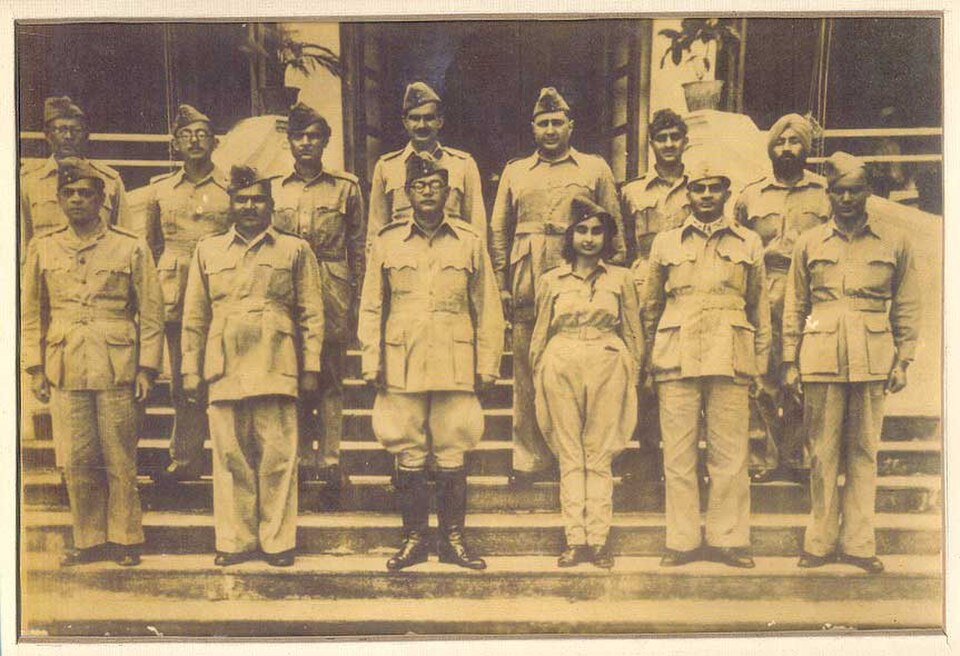
There Bose took command of the Indian National Army, a force that Japanese authorities had begun organizing the previous year, chiefly from Indian soldiers of the British Indian Army captured in the fall of Singapore, under the earlier leadership of Mohan Singh; that first attempt had collapsed amid disputes with the Japanese military, and Bose's arrival in July 1943 revived and substantially expanded it, eventually to a strength commonly put at around 40,000 troops. In October 1943, in Singapore, Bose proclaimed the Provisional Government of Free India, known as Azad Hind, with himself as head of state, and formally declared war on Britain and the United States. The INA included the Rani of Jhansi Regiment, an all-women combat unit commanded by Captain Lakshmi Sahgal, an unusual step for any army of the period. Addressing troops and supporters in Burma in July 1944, Bose delivered the rallying cry for which he remains best known: "Give me blood, and I shall give you freedom." Later that year, INA units fought alongside the Japanese Fifteenth Army in the Imphal-Kohima campaign, an attempt to break through into northeastern India, but the offensive collapsed under Allied resistance, monsoon conditions, and collapsing Japanese supply lines, and the INA was forced to retreat with the defeated Japanese forces.
A death that has never stopped being debated
Japan's surrender in mid-August 1945 left Bose and the Provisional Government without a patron and exposed to Allied capture. According to the account accepted by two of the three official Indian government inquiries into his fate — the Shah Nawaz Committee of 1956 and the G. D. Khosla Commission of 1970, both of which examined surviving witnesses, including fellow passengers — Bose died on 18 August 1945 from severe burns after a Japanese military aircraft carrying him crashed on takeoff at Taihoku airfield in Japanese-held Taiwan, and his remains were later cremated, with the ashes placed at the Renkoji Temple in Tokyo, where they remain today. This account represents the mainstream historical consensus. It has not, however, gone unchallenged: a dissenting member of the 1956 committee rejected it outright, and a third official inquiry, the Mukherjee Commission, concluded in 2005 that Bose had not died in that crash, a finding the Indian government of the day formally declined to accept as it conflicted with the two earlier commissions' findings. Bose's body was never recovered and independently verified, which has allowed decades of unverified theories, ranging from a secret escape to the Soviet Union to a life lived incognito in India as an ascetic, to persist in public discussion despite the absence of credible supporting evidence. Serious historians generally treat the plane-crash account as by far the best-supported explanation while acknowledging that some specific details were never conclusively pinned down, and it is this combination — a broadly accepted answer alongside genuine, officially unresolved loose ends — that keeps the question of Bose's death alive in Indian public memory to a degree unusual for a historical event now more than eight decades in the past.