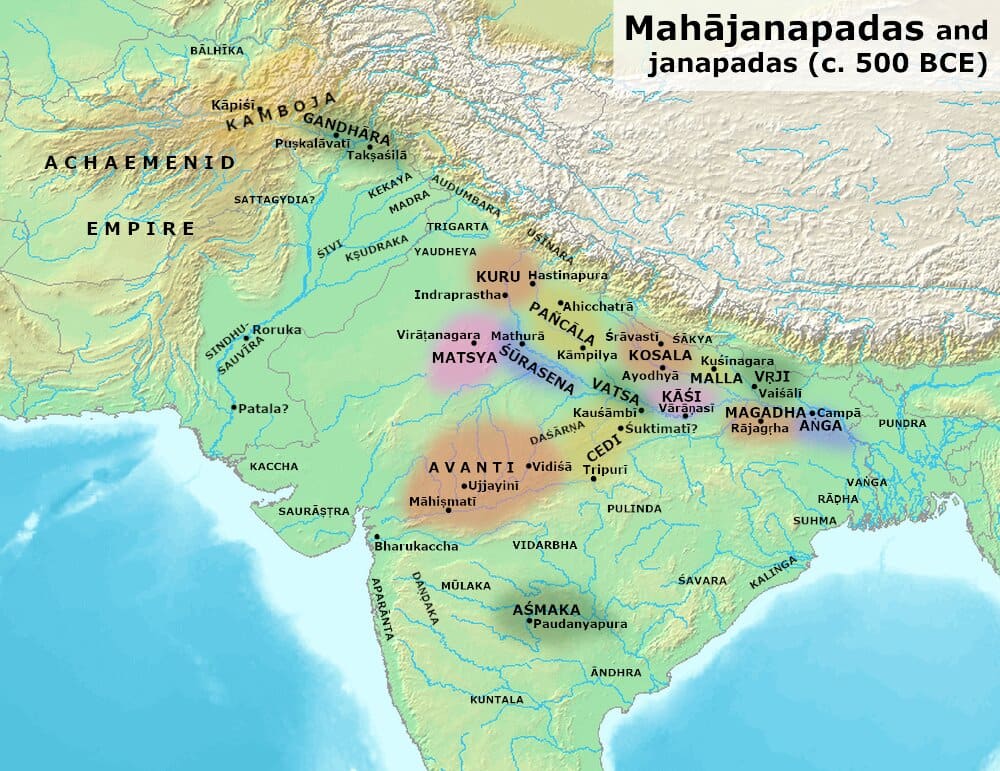
By the sixth century BCE, the cattle-herding chiefdoms described in the hymns of the Vedic Age had given way to settled states. Across the plain of the Ganges, and beyond it to the northwest and into central India, there were now territorial states with fixed borders, capital cities with ramparts, rulers who collected regular taxes, and armies paid to defend them. Buddhist texts call the largest of these states the mahajanapadas, the "great realms", from janapada, literally the place where a people (jana) has set its foot. The Anguttara Nikaya, one of the early collections of the Buddha's discourses, lists sixteen of them. Over the next two and a half centuries, almost all would be absorbed by one, Magadha, which became the base of the Mauryan Empire.
Sixteen great realms
The Anguttara Nikaya's list runs from the far northwest to the eastern Ganges plain and, in one case, south of the Vindhya hills.
| Mahajanapada | Capital | Region today |
|---|---|---|
| Anga | Champa | Eastern Bihar |
| Magadha | Rajagriha, later Pataliputra | Southern Bihar |
| Kashi | Varanasi | Around Varanasi, Uttar Pradesh |
| Kosala | Shravasti | Eastern Uttar Pradesh |
| Vajji | Vaishali | Northern Bihar |
| Malla | Kushinagara and Pava | Northeastern Uttar Pradesh |
| Chedi | Shuktimati | Bundelkhand |
| Vatsa | Kaushambi | Near Prayagraj |
| Kuru | Indraprastha | Around Delhi and Haryana |
| Panchala | Ahichchhatra and Kampilya | Western Uttar Pradesh |
| Matsya | Viratanagara | Around Jaipur, Rajasthan |
| Shurasena | Mathura | Around Mathura |
| Assaka | Potana | On the Godavari, Deccan |
| Avanti | Ujjayini and Mahishmati | Malwa, Madhya Pradesh |
| Gandhara | Taxila | Northwestern Pakistan |
| Kamboja | Uncertain | Northwest frontier, Afghanistan |
The list is not a precise map. Other texts give slightly different names (the Jain Bhagavati Sutra has its own sixteen), and the borders on modern maps are reconstructions. Several of the capitals are known only from texts; others, like Kaushambi, Ujjain and Rajgir, have been excavated, and their mud and brick ramparts are still visible. Gandhara, in the far northwest, was also brought into the Persian Achaemenid Empire in the late sixth century BCE, and it is named as a province in the inscriptions of Darius I.
Kings and clan republics
Most of the Mahajanapadas were monarchies, ruled by a king (raja) who claimed the right to tax farmers, traders and craftsmen and who kept an army and officials paid from that revenue. A handful were run differently. Historians call these gana-sanghas, a term often translated as "republics", though "oligarchies" is closer: power belonged to an assembly of the heads of the leading clan families, who met in a hall, debated and decided matters, sometimes by voting. Ordinary farmers, labourers and slaves had no voice. The best known was the Vajji confederacy, a league of clans, the Licchavis the most powerful among them, with its capital at Vaishali. The Mallas were another, and so were the Shakyas, the small clan state into which Siddhartha Gautama, the Buddha, was born.
Buddhist texts take a strong interest in these republics. In one story the Buddha tells a Magadhan minister that the Vajjis will not decline as long as they keep meeting often and in harmony, respect their elders and keep their traditions. Whether or not he said it, the story only makes sense in a world where an assembly-based state was a familiar alternative to kingship.
Cities, coins and new ideas
The age of the Mahajanapadas is often called India's "second urbanisation", the first being the Indus cities more than a thousand years earlier. Iron tools helped clear the forests of the middle Ganges valley and expanded rice cultivation, which in turn fed towns of traders, craftsmen and officials. Archaeologists trace this world partly through a distinctive glossy pottery, Northern Black Polished Ware, found at sites across the plain. The first Indian coins appear in this period too: small pieces of silver, usually bent or cut, stamped with symbols such as suns, wheels and animals, which historians call punch-marked coins. Exactly when the earliest were made is debated, but they were in wide use by the fifth and fourth centuries BCE.
New religious and philosophical movements grew up in these cities. The Buddha and Mahavira, the great teacher of Jainism, both taught in the kingdoms of the eastern Ganges plain, and both had royal patrons in Magadha and Kosala. Buddhist and Jain texts are among the main sources for the period's politics, so the picture historians have is drawn heavily through the eyes of monks, who had their own reasons for remembering certain kings kindly or harshly. The traditional dates for the Buddha's life, 563 to 483 BCE, have been revised by many scholars to around a century later, which shifts the chronology of the kings around him too.
How Magadha won
The sixteen states fought constantly, and over time four stood out: Kosala, Vatsa, Avanti and Magadha. Magadha came out on top. Its first great king, Bimbisara of the Haryanka dynasty, expanded it as much through marriage as war, taking wives from the royal families of Kosala and the Licchavis and receiving a village in Kashi as a dowry. He also annexed Anga to the east, which gave Magadha control of trade down the lower Ganges. His son Ajatashatru, who according to Buddhist tradition seized the throne and imprisoned his father, fought long wars against Kosala and the Vajji confederacy. Jain texts say he used two new machines against the Vajjis, a catapult that hurled large stones and a chariot fitted with a swinging mace. He also fortified a small settlement on the Ganga, Pataligrama, as a base for the war; under his successor Udayin it became the capital, Pataliputra, now Patna.
The Shishunaga dynasty that followed defeated Avanti, Magadha's last major rival. Then, in the fourth century BCE, the throne was taken by Mahapadma Nanda, a ruler of low-caste origin according to the sources, which treat him with open hostility. The Nandas built up a very large army and treasury, and Greek writers suggest that reports of that army helped persuade Alexander's exhausted troops to refuse to go further east when they reached the Beas river in 326 BCE.
Historians usually explain Magadha's success through geography as much as through able kings. It lay on fertile, well-watered land that produced large surpluses; it controlled the Ganges and the Son, the main trade and transport routes of the east; its hills held iron ore for weapons and tools; and its forests supplied the war elephants that made its armies formidable. Rajagriha, its first capital, was protected by a ring of five hills, and Pataliputra by the rivers that met there.
The Mauryas and after
Around 321 BCE, Chandragupta Maurya, with the help of the Brahmin strategist Chanakya, overthrew the last Nanda king and took Magadha for himself. The kingdom that had swallowed the other great realms became the core of the first empire to cover most of the subcontinent. The republics did not disappear all at once; clan states survived on the edges of the empires for centuries, and later coins of groups like the Yaudheyas show them still governing themselves in the early centuries CE. But the age of many competing states in the Ganges valley was over.
Later Indian states built on the cities, coinage, taxation and standing armies of the Mahajanapada period, and Buddhism and Jainism first took shape in it. It is also the first period of Indian political history that historians can tell through named kings, real cities and wars, instead of reconstructing it from hymns alone.