About a hundred kilometres apart in the hills of northern Maharashtra are two of the largest rock-cut monuments ever made. At Ajanta, Buddhist monks and their patrons cut thirty monasteries and prayer halls into the curve of a river gorge and covered many of their walls with paintings. At Ellora, over roughly four centuries, Buddhists, Hindus and Jains carved thirty-four temples and monasteries side by side along a single escarpment, ending with the Kailasa temple, a full-sized temple cut out of the hillside in one piece. Nothing at either site was built: every pillar, shrine and staircase was made by removing rock until only the building was left (UNESCO, "Ellora Caves"[3]).
Cliffs of old lava
The rock is basalt, part of the Deccan Traps, a thick stack of lava flows that spread across western India around 66 million years ago. It lies in roughly horizontal layers, which gave carvers a fairly even material to work, hard enough to hold fine detail. Cutting into a cliff also had practical advantages over building: a cave needs no foundations or roof timbers, stays cool in summer, and survives the monsoon. The practice in India goes back at least to the Barabar caves in Bihar, which Ashoka gave to a community of ascetics in the third century BCE. Buddhist monks in the western Deccan were cutting caves at sites such as Bhaja and Karle in the same centuries, often near trade routes whose merchants paid for them.
Ajanta's two bursts of work
The Ajanta caves sit in the northern wall of a horseshoe-shaped bend of the Waghur river. They were carved in two phases separated by several centuries (UNESCO, "Ajanta Caves"[2]). The earliest group, Caves 9, 10, 12, 13 and 15A, dates from about the second century BCE to the first century CE, when the region was ruled by the Satavahanas. Cave 10 carries a short Brahmi inscription from about the second century BCE, the oldest at the site. Two of these caves are chaitya halls, long apsed prayer halls with a stupa at the far end. The rest are viharas, where monks lived around a central hall.
Work then stopped for a long time, although monks went on using the caves. It started again in the fifth century CE under the Vakatakas, a Deccan dynasty whose senior branch had married into the family of the Gupta Empire. The art historian Walter Spink, who spent decades studying the site, argued that nearly all of this second phase took place in under twenty years, from about 462 to 480, during and just after the reign of the Vakataka king Harishena (Walter M. Spink, Ajanta: History and Development[1]). Harishena's courtiers sponsored individual caves. An inscription in Cave 16 records it as the gift of his minister Varahadeva, and a local ruler named Upendragupta paid for Cave 17. In Spink's account the work broke off after Harishena died in about 477 and the dynasty collapsed, which would explain why several caves were left unfinished, with plaster laid ready for paintings that were never done. Other scholars stretch the dates into the sixth century, but Spink's short chronology is now widely used.
Painting on dry plaster
The paintings are often called frescoes, but they are not true frescoes, in which pigment is applied to wet lime plaster. At Ajanta the painters first covered the rough rock with a layer of mud mixed with plant fibre and rice husk, finished it with a thin coat of lime, and painted onto the dry surface (Archaeological Survey of India, "Ajanta Caves"[4]). Most of the colours came from local earths and soot: red and yellow ochres, a green earth and lampblack. The blue was lapis lazuli, which had to come from Afghanistan or Iran.
Most of the surviving paintings are in Caves 1, 2, 16 and 17. Many of them tell Jataka tales, stories of the Buddha's earlier lives, and they are crowded with courtiers, dancers, merchants, elephants and city streets, so they are also some of the best evidence for how people in fifth-century India dressed and lived. The most famous single figures are the two large bodhisattvas, Padmapani and Vajrapani, painted on either side of the shrine door in Cave 1.
Three faiths on one cliff at Ellora
Ellora lies on the edge of the same plateau, near the old town of Verul. Its 34 main caves fall into three groups along about two kilometres of the Charanandri hills: twelve Buddhist caves at the southern end (Caves 1 to 12), seventeen Hindu caves in the middle (13 to 29) and five Jain caves at the north (30 to 34). Most of the carving was done between about 600 and 1000 CE, and the groups overlap in time, so for long stretches Buddhist, Hindu and Jain carvers were at work a short walk apart (Encyclopaedia Britannica, "Ellora Caves"[5]). Some scholars think the earliest Hindu caves, such as Cave 29, were cut as early as the sixth century, before most of the Buddhist ones, though the order is still debated.
The Buddhist caves include large, several-storeyed monasteries and one prayer hall, Cave 10, built around 650 CE. Its ceiling is carved into ribs that copy the wooden beams of older timber halls, which is why it is called the Vishvakarma or "carpenter's" cave. The Jain caves, cut in the ninth and early tenth centuries, are smaller but very richly carved. The best known is the two-storeyed Indra Sabha (Cave 32), with a small monolithic shrine standing in its courtyard.
Kailasa: carving from the top down
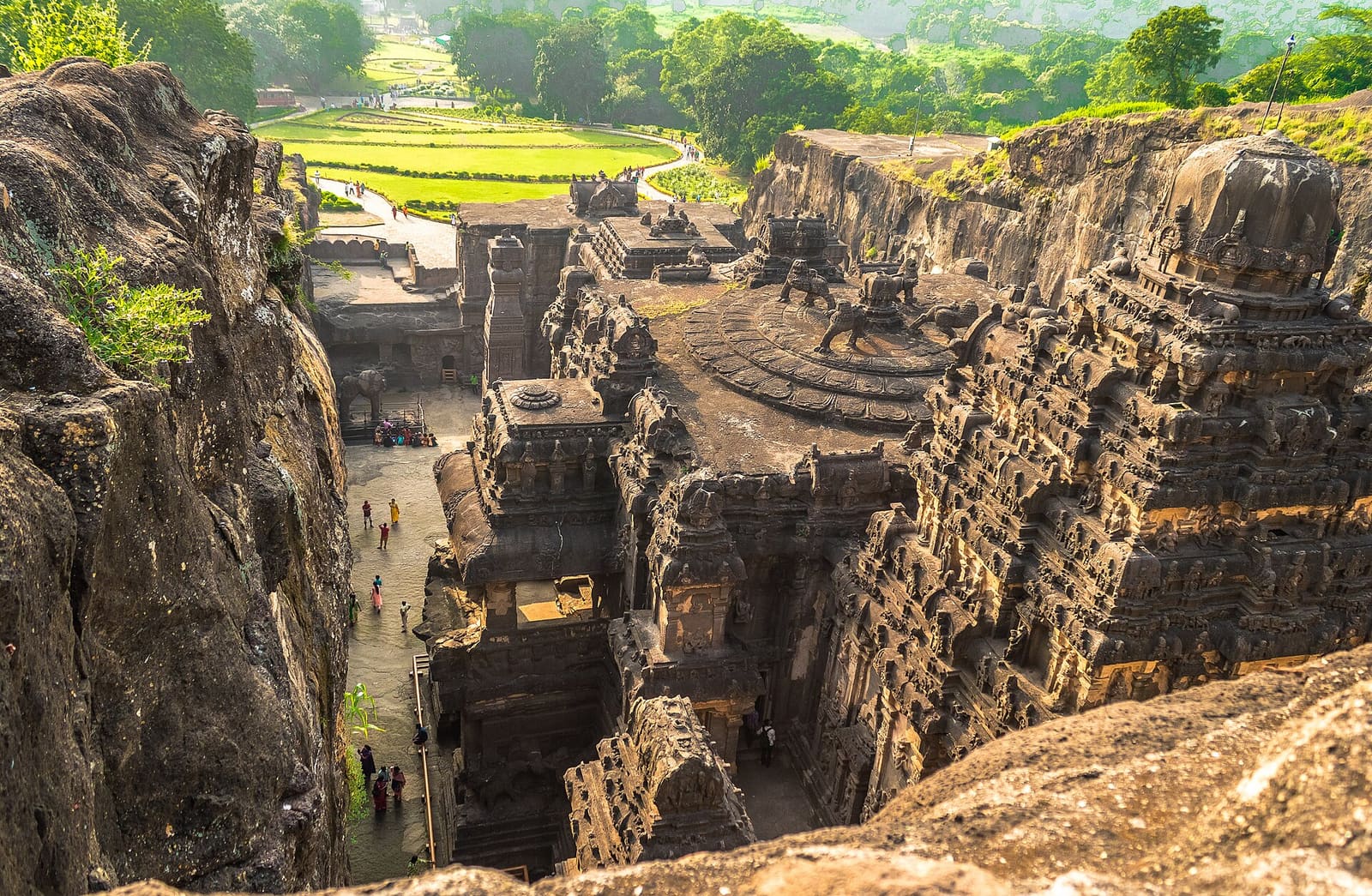
The largest work at Ellora is Cave 16, the Kailasa temple, dedicated to Shiva and named after Mount Kailasa, his home in the Himalayas. It is credited to the Rashtrakuta king Krishna I, who ruled from about 756 to 774. The attribution rests on a copper-plate grant of about 812 CE, issued by Karka II of the Rashtrakutas' Gujarat branch and found at Baroda. It praises a temple built "on a hill" at Elapura (Ellora) by Krishnaraja, and says its architect was so astonished at the result that he asked, in one translation, "How was it that I built it?"
The carvers began from above. They cut three deep trenches into the sloping hillside to free a huge block of rock, then worked down through it, shaping the tower, halls, gateway and shrines as they went and leaving the courtyard floor as the last level. The courtyard is about 82 metres long and 46 metres wide, and the cliff walls around it rise to about 30 metres. Estimates of the rock removed run to around 200,000 tonnes. Because nothing could be added afterwards, every detail had to be planned before it was reached. The temple stands on a high plinth lined with carved elephants, and has a separate shrine for Shiva's bull Nandi, two free-standing pillars and stone bridges joining its parts. Around it, a three-storey colonnaded gallery lined with large sculpted panels was cut into the surrounding cliff. Among its many panels is a well-known relief of the demon king Ravana shaking Mount Kailasa while Shiva holds it steady with his foot. Like most Indian rock-cut sites, it was once plastered and painted, and patches of the plaster survive.
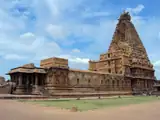
Kailasa was close to the end of large-scale rock-cut architecture in India. Temples were increasingly built from cut stone instead, as at the great Chola temple at Thanjavur two centuries later, which the Cholas raised as a structural tower of granite blocks.
Abandonment and rediscovery
Ellora was never lost. It sat beside a road, pilgrims kept visiting it, and travellers wrote about it. Active use seems to have faded in the thirteenth century, around the time the Delhi Sultanate overran the nearby Yadava capital of Devagiri, and many of the images were later damaged. Ajanta, on the other hand, was largely left to the jungle once its monks moved on, though its caves were not forgotten at once: the Chinese pilgrim Xuanzang, who studied at Nalanda in the 630s, described a great rock-cut monastery in this region that is usually identified with Ajanta. Local people knew the caves, but they were unknown to outsiders until 28 April 1819, when John Smith, an officer of the 28th Cavalry out hunting tigers, was led to Cave 10 by a local boy. Smith scratched his name and the date across a painted bodhisattva on one of its pillars, and it is still there.
The paintings began to suffer as soon as visitors arrived, from smoke, damp, bats, and varnishes applied by early copyists. Robert Gill, an army officer and painter, spent almost twenty years from 1844 making copies of the murals, and nearly all of them were destroyed when a fire broke out at the Crystal Palace in London in 1866, where they were on display. Both Ajanta and Ellora were inscribed as UNESCO World Heritage Sites in 1983, and the Archaeological Survey of India now looks after them.