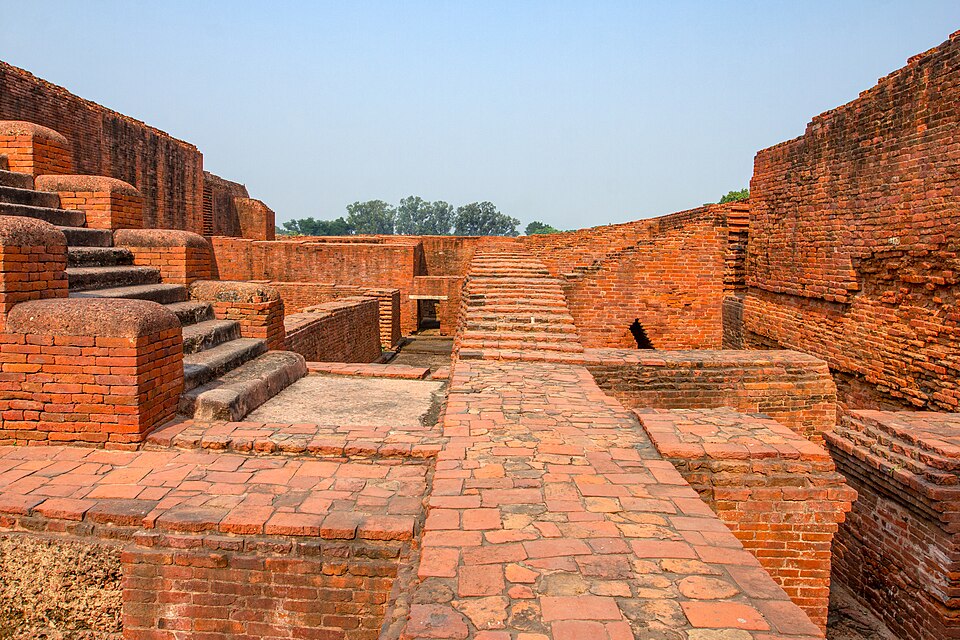
Near the ancient city of Rajagriha in present-day Bihar, archaeologists have uncovered the sprawling brick remains of what is widely regarded as the world's earliest surviving example of a residential university: Nalanda. Founded in the early fifth century CE and active for roughly the next seven to eight hundred years, Nalanda drew students and teachers from across Asia to study not just Buddhist philosophy, its founding subject, but also grammar, logic, medicine, astronomy, and the Vedas. It was not unique — ancient India had other notable centers of higher learning, including the much older, less formally structured teaching center at Taxila (Takshashila) in the northwest, and the later Vikramashila, founded under the Pala dynasty — but Nalanda's scale, documentation, and longevity make it the best-known example of ancient India's tradition of organized higher education.
Founding and centuries of patronage
An inscribed seal found at the site names Nalanda's founder as a ruler called Shakraditya; historians, comparing this title against Gupta-era coinage and inscriptions, generally identify Shakraditya with the Gupta emperor Kumaragupta I, who reigned in the first half of the fifth century CE — placing Nalanda's founding within the same Gupta period that also produced Aryabhata's astronomy and Kalidasa's poetry. Kumaragupta's successors continued to expand the institution, and later rulers well beyond the Gupta dynasty kept supporting it: the seventh-century emperor Harsha granted revenue from a hundred villages to support Nalanda's upkeep, and inscriptions show that not all of its patrons were even Buddhist — some donor seals carry images of Hindu deities such as Lakshmi and Shiva, suggesting the institution had a broader base of royal and elite support than its Buddhist curriculum alone might suggest. From around the eighth century, the Buddhist Pala dynasty of Bengal and Bihar became Nalanda's principal patrons, and the university's teaching increasingly reflected the Palas' own preference for the Vajrayana, or tantric, tradition of Buddhism, alongside its older Mahayana curriculum.
What studying there looked like
By the account of the Chinese Buddhist monk Xuanzang, who studied at Nalanda for roughly two years in the 630s CE under the renowned teacher Shilabhadra, the university housed over a thousand teachers and maintained a demanding curriculum and admissions process open to visiting scholars from across Asia. Later tradition's claims of ten thousand resident students are treated with some skepticism by modern historians, who note that the excavated residential and teaching space at the site would struggle to support a population that large, though there is no dispute that Nalanda operated at a scale unmatched by any other institution of its time. Xuanzang eventually returned to China with several hundred Sanskrit manuscripts, and he spent the rest of his life translating them; a second Chinese pilgrim, Yijing, spent about a decade at Nalanda later in the seventh century and likewise carried Sanskrit texts and Buddhist relics back to China. Through pilgrims like these, Nalanda functioned as one of the major channels through which Indian Buddhist philosophy, along with Indian achievements in logic, grammar, and the sciences, reached East Asia.
Destruction, and a less sudden ending than the popular story suggests
Nalanda's active life ended around 1200 CE, when a raiding force under the Turkic military commander Bakhtiyar Khilji attacked the monastery; archaeological excavation has found a thick layer of ash across many of the site's buildings, consistent with a major fire, and later accounts describe monks killed and manuscripts destroyed. The popular account of this event as a single, catastrophic end is broadly accurate but historians note it oversimplifies what the evidence actually shows: a Tibetan visitor named Dharmasvamin, who reached the site in 1235, found it damaged and largely deserted but still functioning on a much smaller scale under the protection of a local teacher, meaning Nalanda's decline was more gradual than the popular "sudden destruction" narrative suggests, even though the 1200 CE attack was clearly the decisive blow. The Archaeological Survey of India began systematically excavating the site in 1915, work that continued in phases through the twentieth century, and in 2016 UNESCO inscribed the Archaeological Site of Nalanda Mahavihara as a World Heritage Site, recognizing it as physical evidence of nearly eight uninterrupted centuries of organized higher education — a claim few other institutions anywhere in the ancient world can make.