When Harsha died in 647, he left no heir, but he did leave a capital. Kannauj, on the Ganges in today's Uttar Pradesh, had been the seat of the most powerful king in the north, and for the next three centuries whoever held it could claim to be his successor. From the late eighth century three dynasties fought over it: the Palas of Bengal and Bihar, the Gurjara-Pratiharas of Rajasthan and Malwa, and the Rashtrakutas of the Deccan. Historians call their long, three-sided contest the tripartite struggle. It was fought in campaigns spread over generations, and in the end none of the three could hold the prize for long (Upinder Singh, A History of Ancient and Early Medieval India[3]).
Why did Kannauj matter so much?
Part of the reason was prestige. Kannauj had been Harsha's capital and before that the Maukharis', and it had become what Pataliputra had been for the Mauryas and Guptas: the city a king held if he wanted to be taken seriously as an overlord of the north. Part of it was wealth. The city commanded the Ganges-Yamuna doab, some of the most fertile land in India, and the river and land routes between Bengal and the northwest that ran through it (Rama Shankar Tripathi, History of Kanauj[2]).
For a century after Harsha, Kannauj was held by a series of local kings. Yashovarman, in the early eighth century, was a patron of poets and was eventually defeated by Lalitaditya of Kashmir. After him came the weak Ayudha kings, whose throne was there for the taking.
Who were the three rivals?
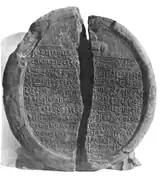
The Palas rose in Bengal around 750. The Khalimpur copper plate of Dharmapala says that the country had fallen into matsya-nyaya, the "law of the fishes", where the big devour the small, until the people chose Gopala as king to restore order. Whether he was literally elected or chosen by a group of chiefs, the dynasty he founded ruled Bengal and Bihar for some four hundred years. The Palas were Buddhists and major patrons of Buddhist learning (R. C. Majumdar (ed.), The Age of Imperial Kanauj[1]).
The Gurjara-Pratiharas rose in western India, in Rajasthan and around Ujjain in Malwa. Their early kings fought back the Arab armies that pushed east from Sindh in the eighth century, and their inscriptions present them as guardians of the frontier. Their name probably links them to the Gurjara people or region; pratihara means doorkeeper.
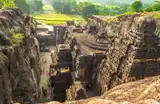
The Rashtrakutas took over the western Deccan around 753, when Dantidurga overthrew the Chalukyas of Badami. Under his successor Krishna I, the Kailasa temple at Ellora was cut downward out of a single hill of rock, one of the wonders of Ajanta and Ellora. Unlike the other two, the Rashtrakutas did not try to rule the Ganges valley. They raided it, collected tribute and glory, and went home (Upinder Singh, A History of Ancient and Early Medieval India[3]).
How did the struggle unfold?
The first round, in the 780s, set the pattern. The Pratihara king Vatsaraja defeated Dharmapala in the doab. Then the Rashtrakuta king Dhruva came north across the Narmada and defeated them both, before returning to the Deccan with his spoils. In the gap he left, Dharmapala removed the king of Kannauj and put his own candidate, Chakrayudha, on the throne. The Khalimpur plate describes the ceremony: kings from Punjab, Rajasthan, Malwa and the Himalayan foothills bowed their heads in approval, among them the kings of the Kurus, Yadus, Avanti, Gandhara and Kira. Dharmapala also founded the monastery of Vikramashila in Bihar, which became one of the great Buddhist universities (R. C. Majumdar (ed.), The Age of Imperial Kanauj[1]).
In the early ninth century a Rashtrakuta army came north once again. Govinda III defeated Vatsaraja's son Nagabhata II, and Dharmapala and Chakrayudha submitted to him, before he too returned south. Nagabhata then drove Chakrayudha out of Kannauj and defeated Dharmapala near Monghyr in Bihar, though historians differ on the exact order of these campaigns. From his reign Kannauj was the Pratihara capital (Rama Shankar Tripathi, History of Kanauj[2]).
Who came out ahead?
For most of the ninth century the Pratiharas held the advantage. Mihira Bhoja, who ruled from about 836 to 885, governed an empire from Punjab to the borders of Bengal and from the Himalayan foothills to the Narmada. His coins call him Adivaraha, an incarnation of Vishnu. An Arab merchant called Sulaiman, writing in 851, described the king of the "Juzr", generally identified as Bhoja, as having the finest cavalry in India and being no friend to the Arabs, and said that no part of India was safer from robbers. His son Mahendrapala I kept the empire together and patronised the poet and critic Rajashekhara (R. C. Majumdar (ed.), The Age of Imperial Kanauj[1]).
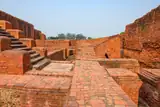
The Palas reached their height at the same time under Devapala, Dharmapala's son. One of his copper plates, found at Nalanda, records that he granted five villages to support a monastery there built by Balaputradeva, a king of Suvarnadvipa in the Malay-Indonesian world. The Rashtrakutas, meanwhile, were at their most splendid under Amoghavarsha I, who ruled for more than sixty years from his new capital at Manyakheta. Sulaiman counted the Rashtrakuta king, whom he called the Balhara, among the four great kings of the world (Romila Thapar, Early India[4]).
The decisive blow came from the south. In about 916, the Rashtrakuta king Indra III marched north and sacked Kannauj itself. The Pratiharas recovered the city, but not their former power. Their feudatories, among them the Chandelas of Bundelkhand and the Paramaras of Malwa, began to act as independent kings.
What did the long war leave behind?
None of the three dynasties outlasted the tenth century as a great power. The Rashtrakutas reached one last peak under Krishna III, who defeated the Cholas at Takkolam in 949, but in 973 the dynasty was overthrown by its own feudatory, Taila II, founder of the Chalukyas of Kalyani. The Pratiharas shrank to a kingdom around Kannauj. When Mahmud of Ghazni attacked in 1018, the Pratihara king Rajyapala abandoned the city, and it was sacked. The Palas lasted longest, with a revival under Mahipala I, until the Senas replaced them in the twelfth century (Upinder Singh, A History of Ancient and Early Medieval India[3]).
"Tripartite struggle" is a label from modern textbooks, and it can make the period sound like a single war with a winner. It was really a contest of raids and shifting alliances in which each power was usually also fighting others closer to home: the Palas in Assam and Odisha, the Rashtrakutas against the Eastern Chalukyas and Pallavas. Historians still debate how much it drained the three dynasties, but by 1000 the north was a patchwork of regional kingdoms, many of them ruled by families that would later be known as Rajput, and none of them strong enough to dominate the others (Romila Thapar, Early India[4]).
Struggle for Kannauj timeline
| Date | Event |
|---|---|
| 647 | Death of Harsha |
| c. 750 | Gopala is chosen king in Bengal, founding the Pala dynasty |
| c. 753 | Dantidurga founds Rashtrakuta power in the Deccan |
| 780s | Vatsaraja defeats Dharmapala; Dhruva defeats both |
| c. 790s | Dharmapala installs Chakrayudha at Kannauj |
| c. 800–815 | Govinda III campaigns in the north; Nagabhata II takes Kannauj |
| c. 810–850 | Devapala's reign; peak of Pala power |
| 814–878 | Amoghavarsha I rules the Rashtrakutas from Manyakheta |
| c. 836–885 | Mihira Bhoja's reign; peak of Pratihara power |
| 851 | The Arab merchant Sulaiman describes the kings of India |
| c. 916 | Indra III sacks Kannauj |
| 949 | Krishna III defeats the Cholas at Takkolam |
| 973 | The Rashtrakutas are overthrown by Taila II |
| 1018 | Mahmud of Ghazni sacks Kannauj |