By the late sixth century the Gupta Empire was gone, and northern India was divided among regional dynasties: the Maukharis at Kannauj, the Later Guptas in Magadha, the kings of Gauda in Bengal, and a family called the Pushyabhutis at Sthanvishvara, modern Thanesar, north of Delhi. In 606 CE a sixteen-year-old prince of that family, Harshavardhana, inherited its throne in the middle of a crisis. Over the next forty years he made Kannauj the leading city of the north and ruled a kingdom that stretched across much of the Ganges plain. He is unusually well documented for a king of his time, because two writers who knew him, a Sanskrit court poet and a Chinese Buddhist pilgrim, wrote about him at length (Upinder Singh, A History of Ancient and Early Medieval India[4]).
How did Harsha become king?
Harsha's father, Prabhakaravardhana, had made the Pushyabhutis a regional power and married his daughter Rajyashri to Grahavarman, the Maukhari king of Kannauj. When Prabhakaravardhana died, around 605, the family's position fell apart within months. The king of Malwa attacked Kannauj, killed Grahavarman and imprisoned Rajyashri. Harsha's elder brother, Rajyavardhana, marched out and defeated the Malwa army, but he was then killed by Shashanka, king of Gauda, who had been allied with Malwa. Bana says Shashanka lured him into a trap; Shashanka's side of the story has not survived (Bana, The Harsa-carita[1]).
Harsha took the throne in 606. The era counted from his accession was used in inscriptions for some time after. According to Bana, he went first to find his sister, who had escaped into the Vindhya forests, and reached her just as she was about to throw herself onto a funeral pyre. Kannauj, which had lost its king, came under Harsha's rule, and he moved his capital there. Joining the two kingdoms gave him the Ganges heartland on which his power rested (Rama Shankar Tripathi, History of Kanauj[3]).
How large was Harsha's kingdom?
Harsha spent much of his reign at war. Xuanzang says he fought continuously for six years and brought the "Five Indias" under his rule, which is a pilgrim's flourish rather than a survey. His direct rule covered the area from Punjab to Bihar. Further east, Shashanka stayed independent in Bengal until his death, and only afterwards did Harsha's influence reach Magadha and Odisha. Many rulers within his sphere were samantas, subordinate kings who kept their own lands in return for tribute, attendance at court and troops in war (Upinder Singh, A History of Ancient and Early Medieval India[4]).
His expansion stopped at the Narmada. The Chalukya king Pulakeshin II, who ruled the western Deccan from Vatapi (Badami), defeated him there. The battle is usually dated to around 618–619, though some historians place it in the 630s. The Aihole inscription of 634, composed for Pulakeshin by the poet Ravikirti, makes a pun on Harsha's name, which means "joy": his harsha melted away when he saw his elephants fall in battle. The Narmada remained the border between the two kingdoms (Romila Thapar, Early India[5]).
What did Bana and Xuanzang write?
Banabhatta, a Brahmin poet who joined Harsha's court, wrote the Harshacharita, "The Deeds of Harsha", one of the first biographies in Sanskrit. It is written in elaborate, highly ornamented prose and breaks off before the middle of the reign, so most of what Bana tells us concerns Harsha's family and how he came to power. It is a work of praise, and Bana is plainly on his patron's side, but it is full of detail about court life, army camps, villages and forest dwellers (Bana, The Harsa-carita[1]).
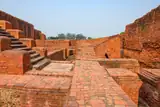
Xuanzang left China in 629 to collect Buddhist texts in India and returned in 645. He studied for years at Nalanda, which Harsha supported, and met the king, whom he calls Shiladitya, more than once. His Record of the Western Regions describes Harsha's kingdom as orderly and lightly taxed, with taxes said to be about a sixth of the crop and officials paid with grants of land rather than money. It also describes the roads as dangerous: Xuanzang was robbed more than once, and on one occasion river pirates nearly sacrificed him to the goddess Durga (Samuel Beal, Si-Yu-Ki[2]).
Xuanzang describes two great gatherings. At Kannauj in 643, Harsha held an assembly where Xuanzang expounded Mahayana Buddhism before kings, Buddhist monks, Brahmins and Jains. At Prayag, where the Ganges and Yamuna meet, Xuanzang watched one of the king's distributions of wealth, held every five years, at which Harsha gave away the contents of his treasury to Buddhist monks, Brahmins, Jains and the poor, down to his own clothes and jewels. Both accounts come from an admiring Buddhist guest and probably make Harsha more of a Buddhist than he was. His own inscriptions call him a devotee of Shiva, and his ancestors worshipped the Sun (Samuel Beal, Si-Yu-Ki[2]).
Was Harsha also a writer?
Three Sanskrit plays are credited to Harsha: Ratnavali and Priyadarshika, light court comedies about a king's love affairs, and Nagananda, a Buddhist play about a prince who gives his life to save the serpents from the bird Garuda. Some scholars have doubted that a busy king wrote them himself, but the attribution is old, and Harsha's patronage of poets such as Bana is not in doubt (Upinder Singh, A History of Ancient and Early Medieval India[4]).
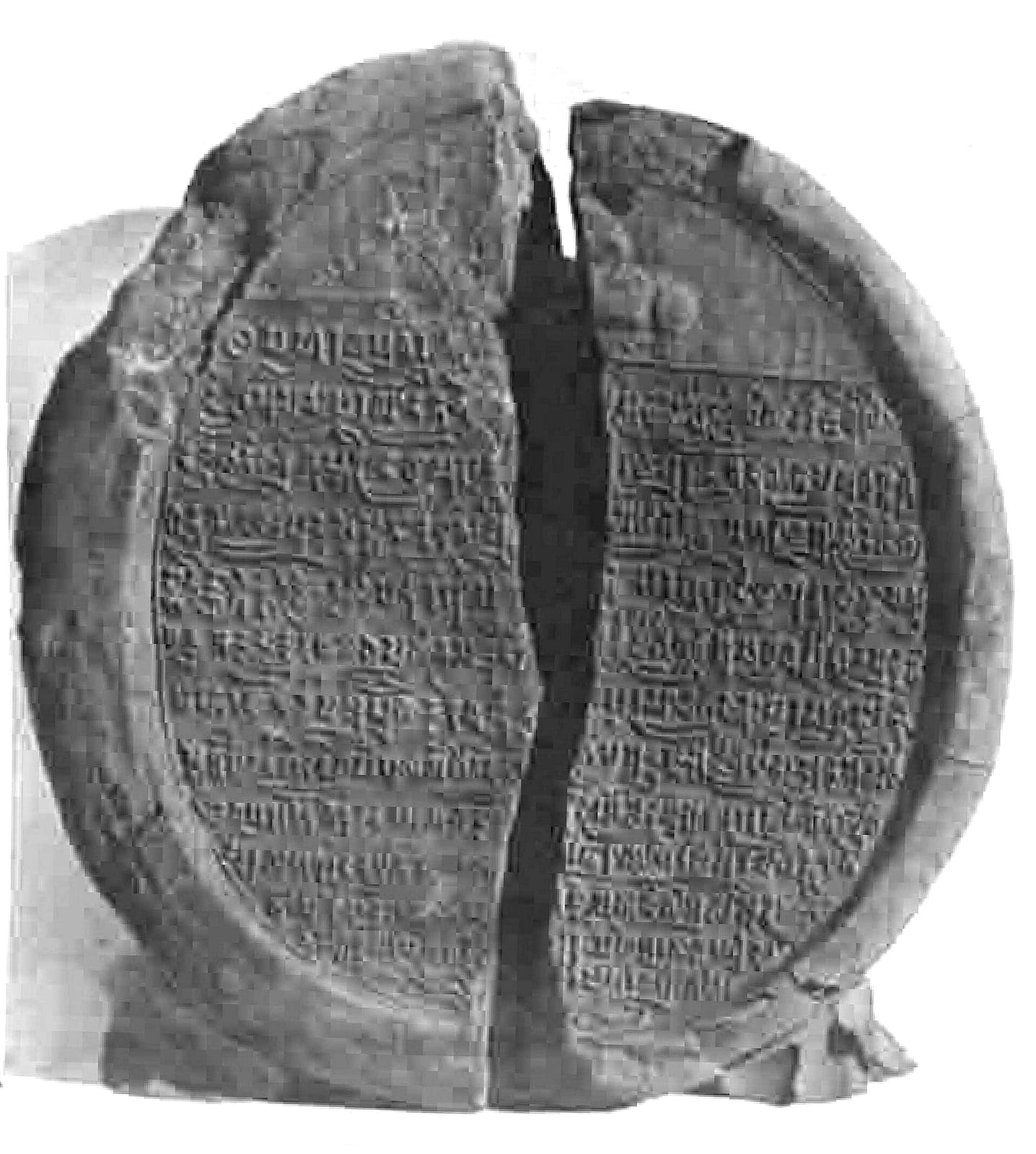
His own hand survives on one document. Copper plates recording land grants were found at Banskhera (dated 628) and Madhuban (631). The Banskhera plate ends with a flourishing signature in an ornamental script, reading "By my own hand, of the great king of kings, Sri Harsha" (Rama Shankar Tripathi, History of Kanauj[3]).
What happened after Harsha?
Harsha also looked beyond India. In 641 he sent an envoy to the Tang court of China, and Chinese missions came back in return. When the Tang envoy Wang Xuance arrived in 647 or 648, Harsha had died, and a minister had seized the throne and attacked the embassy. Wang escaped, raised troops from Tibet and Nepal, and returned to capture the usurper, whom he took back to China as a prisoner (Romila Thapar, Early India[5]).
Harsha left no heir, and his kingdom fell apart soon after his death. Older historians often called him the last great Hindu emperor of northern India. Most historians now see his kingdom differently: a network of tributary kings held together by one strong ruler and his army, rather than a centralised empire on the Mauryan or Gupta model. What he did leave was Kannauj itself. For the next three centuries, the kings of the north and the Deccan fought to control the city, in the long contest known as the struggle for Kannauj (Upinder Singh, A History of Ancient and Early Medieval India[4]).
Harshavardhana timeline
| Date | Event |
|---|---|
| c. 590 | Harsha is born, the younger son of Prabhakaravardhana of Thanesar |
| c. 605 | Prabhakaravardhana dies; Grahavarman of Kannauj is killed by the king of Malwa |
| c. 606 | Rajyavardhana is killed by Shashanka; Harsha becomes king |
| c. 618–619 | Probable date of Harsha's defeat by Pulakeshin II on the Narmada |
| 628 | Banskhera copper plate, bearing Harsha's signature |
| 629 | Xuanzang leaves China for India |
| 634 | Aihole inscription of Pulakeshin II records the victory over Harsha |
| 641 | Harsha sends an embassy to the Tang court |
| 643 | Assembly at Kannauj and distribution at Prayag, witnessed by Xuanzang |
| 645 | Xuanzang returns to China |
| 647 | Harsha dies without an heir |