Between the fall of the Mauryan Empire in about 185 BCE and the rise of the Guptas some five centuries later, one of the largest states in the subcontinent was founded by a dynasty from outside it. The Kushans were descended from nomads who had grazed their herds on the far edge of China. In the first and second centuries CE they ruled from the Oxus River in Central Asia, across the Hindu Kush, to Mathura and the Ganges plain. Their kings struck coins with the Buddha, Shiva and Greek and Iranian gods on them, sponsored the first great schools of Buddhist sculpture, and sat at the junction where the overland Silk Road met the trade routes of India (Upinder Singh, A History of Ancient and Early Medieval India[1]).
Where did the Kushans come from?
Chinese histories are the main witness to their origins. They describe a people called the Yuezhi, who lived in the grasslands of what is now Gansu in northwest China until the Xiongnu, a rival nomadic confederation, drove them out in the second century BCE. The Yuezhi moved west in stages and by about 130 BCE had settled in Bactria, the fertile country between the Hindu Kush and the Oxus in today's northern Afghanistan and southern Uzbekistan and Tajikistan. The Chinese envoy Zhang Qian visited them there around 128 BCE (Romila Thapar, Early India[2]).
According to the Hou Hanshu, the history of the later Han dynasty, the Yuezhi in Bactria were divided into five chiefdoms. More than a century after their arrival, the chief of one of them, the Guishuang (Kushan), overcame the other four and made himself king. This was Kujula Kadphises, who probably reigned around the middle of the first century CE. He pushed south across the Hindu Kush into the Kabul valley and Gandhara, and his son pressed further into northwest India (Encyclopaedia Britannica, "Kushan dynasty"[4]).
How did the Kushans build an empire?
Much of the dynasty's history has to be reconstructed from coins, because few other records survive. For most of the twentieth century historians were not even sure of the order of the early kings. That changed in 1993, when a stone inscription was found at Rabatak in northern Afghanistan. In it Kanishka, the most famous Kushan ruler, names his great-grandfather Kujula Kadphises, his grandfather Vima Takto and his father Vima Kadphises (Upinder Singh, A History of Ancient and Early Medieval India[1]).
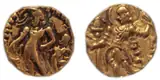
Vima Kadphises introduced a large gold coinage, minted to roughly the weight of the Roman gold coin. Much of the metal may have come from Roman coins paid to Indian merchants for pepper, textiles and gems, the trade described in the Silk Road and Indo-Roman trade. His coins show Shiva standing with a bull, giving an Indian god pride of place on an imperial gold coinage.
By Kanishka's reign the empire reached from Bactria to Mathura, and inscriptions dated in his years have been found at Sarnath and Kausambi. The Rabatak inscription goes further, listing cities including Saketa, Kausambi, Pataliputra and Champa among the places that came under his authority. Historians are not agreed on how firmly the Kushans held the eastern Ganges valley, as opposed to receiving tribute or raiding there (Romila Thapar, Early India[2]). The empire had several centres: Purushapura, modern Peshawar, in Gandhara; Mathura in the south; and Kapisa, modern Begram near Kabul, which seems to have served as a summer residence.
Who was Kanishka?
The date of Kanishka's accession was argued over for a century. An older theory linked it to the Saka era, which begins in 78 CE and is still the basis of India's national calendar. In 2001 the scholar Harry Falk used an astronomical text to argue that Kanishka's first regnal year was about 127 CE, and most historians now accept a date in the 120s (Upinder Singh, A History of Ancient and Early Medieval India[1]).
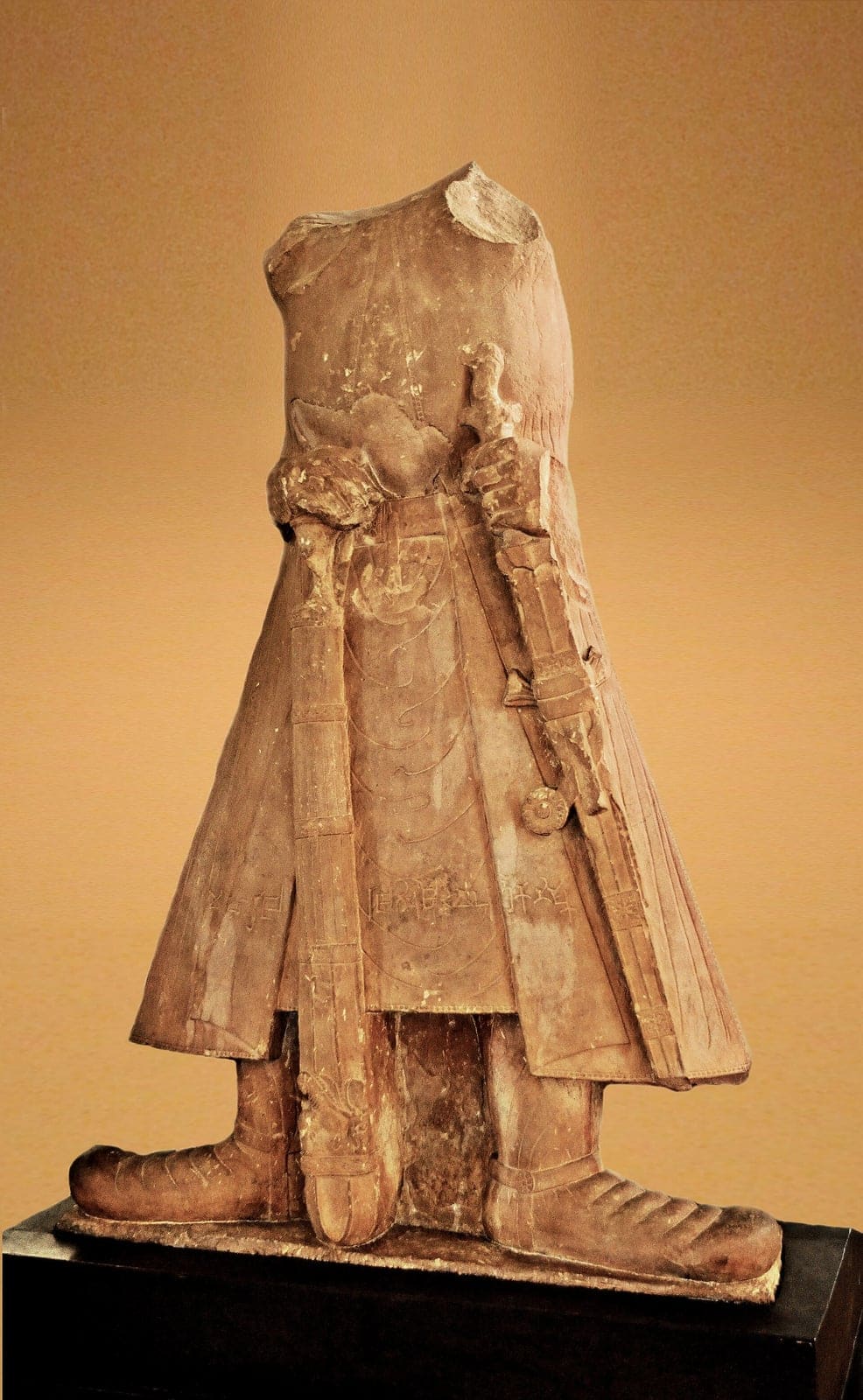
The Rabatak inscription records that Kanishka issued an edict in Greek and then had it put into "Aryan", meaning Bactrian, the Iranian language of his homeland. From his reign Bactrian, written in Greek letters, replaced Greek on the coins. His titles show how many traditions the empire drew on: maharaja (great king) from India, shaonanoshao (king of kings) from Persia, and devaputra (son of god), which may echo the Chinese emperor's title "son of heaven". The headless statue of Kanishka found at Mat near Mathura shows him in the long coat and heavy felt boots of a Central Asian horseman (John M. Rosenfield, The Dynastic Arts of the Kushans[3]).
His coins show the same mix. Their reverses carry Greek gods such as Helios, Iranian ones such as Mithra (written MIIRO), the moon god Mao and the goddess Nana, Indian deities such as Shiva (OESHO), and, on a small number, the Buddha himself, labelled BODDO. Kanishka built a dynastic sanctuary at Surkh Kotal in Bactria, but it was his patronage of Buddhism that later Buddhist writers remembered. Tradition credits him with a vast stupa outside Peshawar, which Chinese pilgrims described as one of the tallest buildings they had seen, and with convening the Fourth Buddhist Council in Kashmir. Later tradition also placed the poet Ashvaghosha, author of a verse life of the Buddha, and the physician Charaka at his court. These accounts were written down centuries afterwards and are hard to confirm (Romila Thapar, Early India[2]).
What did the Kushans leave behind?
Two great schools of sculpture flourished under Kushan rule. In Gandhara, around Peshawar and Taxila, sculptors working in grey schist drew on Greek and Roman models, carving the Buddha with wavy hair and draped robes like a classical statue. At Mathura, sculptors in mottled red sandstone worked in an Indian tradition of Yaksha figures and produced a broad, smiling, more massive Buddha. Both schools produced some of the earliest images of the Buddha in human form, who had earlier been shown only through symbols such as a footprint, a tree or an empty throne. Which school did it first is still debated (John M. Rosenfield, The Dynastic Arts of the Kushans[3]).
The Kushans also carried Buddhism north. Monks travelled with the caravans along routes the empire protected, and Kushan and Parthian monks were among the first translators of Buddhist texts into Chinese. One of them, Lokaksema, a monk from the Kushan lands, worked at the Han capital Luoyang from about 167 CE and translated some of the earliest Mahayana texts known in Chinese. Excavations at Begram found a hoard that captures the empire's position: Roman glass and bronzes, Indian carved ivories and Chinese lacquer, stored together in the same rooms (Upinder Singh, A History of Ancient and Early Medieval India[1]).
How did the Kushan Empire end?
After Kanishka came Huvishka, whose long reign was prosperous, and then Vasudeva I, whose Indian name and coins showing Shiva suggest how far the dynasty had settled into its Indian provinces. Under Vasudeva the empire began to shrink. In the third century the new Sasanian dynasty of Persia conquered Bactria and set up governors there, known as the Kushanshahs. Smaller Kushan kingdoms survived in Gandhara and Punjab. In the fourth century the Allahabad pillar inscription of Samudragupta lists a ruler with the Kushan titles "Daivaputra Shahi Shahanushahi" among the kings who sought the favour of the Gupta emperor (Encyclopaedia Britannica, "Kushan dynasty"[4]). By then the north Indian heartland had passed to the Guptas, who took up and developed much that the Kushans had begun, from gold coinage to the sculptural traditions of Mathura.
Kushan Empire timeline
| Date | Event |
|---|---|
| 2nd century BCE | The Yuezhi are driven west from the Chinese frontier by the Xiongnu |
| c. 130 BCE | The Yuezhi settle in Bactria |
| c. 128 BCE | Chinese envoy Zhang Qian visits the Yuezhi |
| Mid-1st century CE | Kujula Kadphises unites the five chiefdoms and crosses the Hindu Kush |
| Late 1st century CE | Vima Takto and Vima Kadphises extend Kushan rule into northern India; gold coinage begins |
| c. 127 CE | Probable start of Kanishka's reign |
| c. 167 CE | The Kushan monk Lokaksema begins translating Buddhist texts at Luoyang |
| Later 2nd century | Reign of Huvishka |
| c. 190–230 | Reign of Vasudeva I |
| 3rd century | Sasanian Persia conquers Bactria |
| 4th century | Remaining Kushan rulers in the northwest acknowledge Samudragupta |
| 1993 | The Rabatak inscription is discovered in Afghanistan |