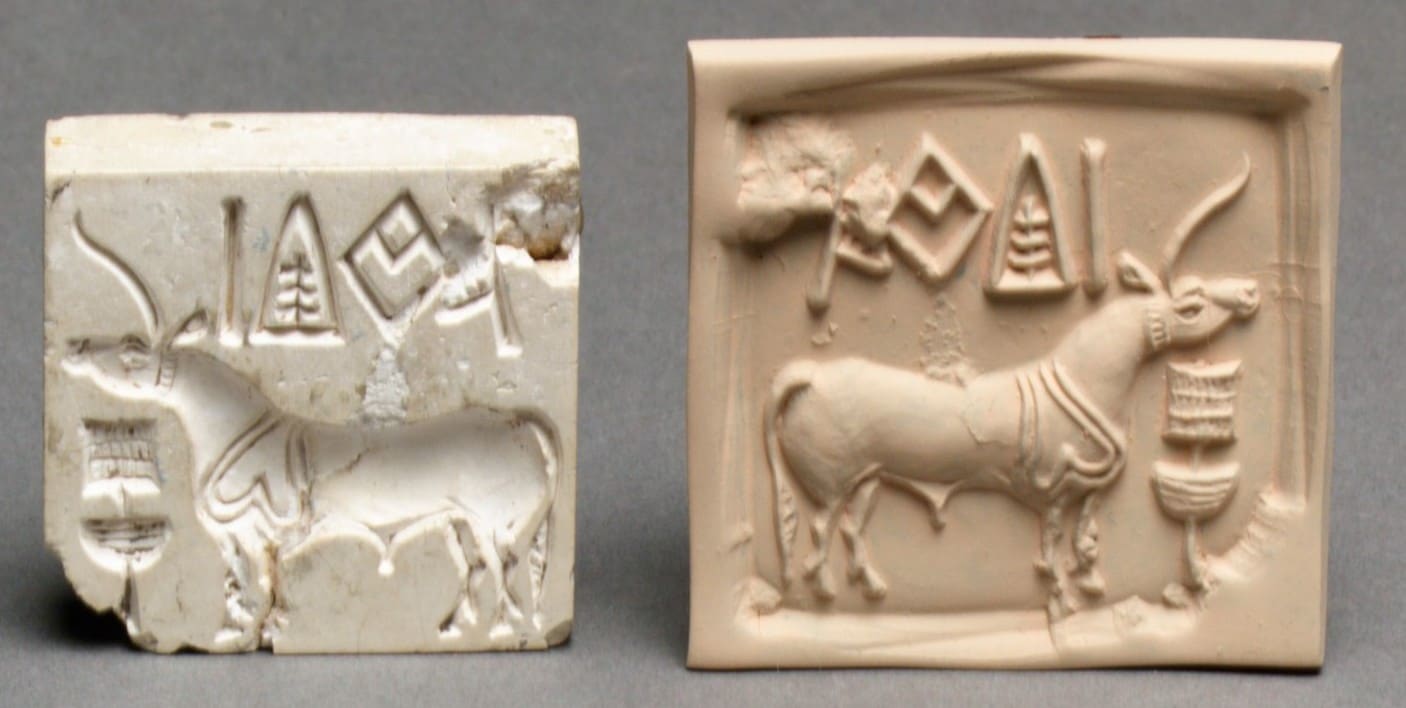
The first Indus seal reached print in 1875, when Alexander Cunningham, director of the Archaeological Survey of India, published a small stone square from Harappa carved with a bull and a row of unfamiliar signs. He guessed the signs were foreign. Fifty years later, after John Marshall announced the discovery of a lost civilization in 1924, it was clear the signs belonged to the people of the Indus cities themselves. Today about 4,000 inscribed objects are known from Harappa, Mohenjo-daro, Dholavira, Lothal and dozens of smaller sites. None of them can be read, and specialists still disagree about whether the signs record a language at all (Encyclopaedia Britannica, "Indus civilization"[5]).
What survives
Most Indus inscriptions are on small stamp seals of steatite, a soft stone that was carved and then fired hard, usually with an animal below a line of signs. The signs on a seal are cut in reverse so that the impression reads the right way round, and clay impressions of seals have been found pressed onto the knots and lids of packages. The same signs turn up scratched on pottery, moulded on small tablets, and on copper plates and bangles. The texts are short: about five signs on average, with the longest single inscription only 17 signs long (Steve Farmer, Richard Sproat & Michael Witzel, "The Collapse of the Indus-Script Thesis"[3]).
In 1977 the epigraphist Iravatham Mahadevan published a catalogue of all the inscriptions then known, with a list of 417 distinct signs and a concordance showing where each one occurs (Iravatham Mahadevan, The Indus Script: Texts, Concordance and Tables[2]). Counts since then vary from about 380 to 700, depending on how variants are grouped. Even the rough number is informative. An alphabet needs a few dozen signs and a fully word-based script like Chinese needs thousands, so a set of a few hundred points to a mixed system, with some signs standing for words and others for sounds, as in Sumerian cuneiform or Egyptian hieroglyphs. Scholars can also tell the direction of writing. Signs are often crowded together at the left end of a line, where the carver ran out of space, and one stroke overlaps another in a way that shows which was cut first, so most texts were written from right to left.
Why no one has cracked it
Every successful decipherment of an ancient script has had at least one of three things: a bilingual text, a known descendant script, or a known language. Egyptian hieroglyphs were read with the help of the Rosetta Stone, which gave the same decree in Greek. Linear B was read without a bilingual because it turned out to record an early form of Greek. The Brahmi of Ashoka's edicts was worked out by James Prinsep in 1837, building on work that traced its letters back from later Indian scripts; his breakthrough came from short donor inscriptions at Sanchi that kept ending in the same word, dānaṃ, "gift". Its language was a form of Prakrit that scholars could already read.
The Indus script has none of the three. Indus seals have been found at sites in Mesopotamia, and an Akkadian seal names a man called Shu-ilishu as an interpreter for Meluhha, the name Mesopotamian texts most likely used for the Indus region. So the two peoples did meet and talk, but no text written in both scripts has turned up. The script died out with the cities around 1900 BCE, and no later Indian script can be shown to descend from it. Nor is the language known: it may have been an ancestor of a living language, or one that has disappeared. The inscriptions are also too short to test a proposed reading properly, since almost any reading can be made to fit a text of five signs.
The rival theories
The most developed proposal links the script to the Dravidian family, the languages of southern India today, which include Tamil, Telugu, Kannada and Malayalam, along with Brahui, still spoken in Balochistan. In the 1960s a Soviet team led by Yuri Knorozov and a Finnish team including Asko Parpola independently reached this conclusion using computer analysis of the sign sequences. Parpola set out the case in full in Deciphering the Indus Script in 1994 (Asko Parpola, Deciphering the Indus Script[1]). His best-known example is the fish sign. In Dravidian languages the word mīn means both "fish" and "star", so a fish drawn beside other signs could be a picture-pun for a star or a deity, much as early Sumerian and Egyptian writing worked. Mahadevan also favoured a Dravidian reading. Critics point out that such puns cannot be checked against a known text, and that the reconstructed Dravidian of 2500 BCE is itself uncertain.
Others have argued for an Indo-Aryan language, the family that includes Sanskrit. The archaeologist S. R. Rao, who excavated Lothal, proposed in 1982 that the later signs worked like an early alphabet and recorded an Indo-Aryan tongue. Few specialists accepted it, mainly because most linguists date the arrival of Indo-Aryan speakers in the subcontinent to after the cities had declined, and later claims along the same lines have fared worse. In 2000 a supposed "horse seal" offered as evidence was shown to be a computer-altered image of a broken seal of a bull.
Writing, or not writing?
In 2004 the historian Steve Farmer, the computational linguist Richard Sproat and the Sanskritist Michael Witzel challenged the starting assumption that the Indus people were literate at all (Steve Farmer, Richard Sproat & Michael Witzel, "The Collapse of the Indus-Script Thesis"[3]). They pointed out that after more than a century of digging no long text has been found, that a large share of signs occur only once or twice in the whole corpus, and that there is no sign of manuscripts on perishable materials. They suggested the signs were a system of symbols for clans, offices, gods or goods, meaningful but not tied to spoken words, like the symbols on modern road signs or heraldry. The three offered a $10,000 prize, backed by an anonymous donor, for a single Indus inscription at least 50 signs long, provided it came from a known excavated site and was accepted as genuine by Indus specialists.
The argument drew sharp replies. In 2009 a team led by the computer scientist Rajesh Rao published a statistical study in Science showing that the order of Indus signs is neither random nor rigid, and that its degree of predictability falls in the range of known written languages (Rajesh P. N. Rao and others, "Entropic Evidence for Linguistic Structure in the Indus Script"[4]). Sproat replied that non-linguistic symbol systems can produce the same pattern. Parpola and others noted that short inscriptions are what seals carry in every literate culture, and that the Dholavira signboard, ten signs each about 37 cm tall, found by the citadel's north gate and probably once mounted above it, looks like public writing meant to be read.
Politics and prize money
The question would be a specialists' puzzle if it did not touch modern identities. A Dravidian reading would make the Indus people early ancestors of today's Dravidian-speaking south. An Indo-Aryan reading would tie the cities to the world of the Vedas and challenge the idea that Indo-Aryan speakers arrived later. Both positions have political supporters, and in January 2025, at an event marking the centenary of Marshall's announcement, the Chief Minister of Tamil Nadu, M. K. Stalin, offered a prize of one million US dollars for a convincing decipherment. Most specialists regard a Dravidian link as the best-supported hypothesis, though nothing has been proved. Until a bilingual inscription or a much longer text turns up, a new reading is worth taking seriously only if it can be tested.